Creating collective harmony through music
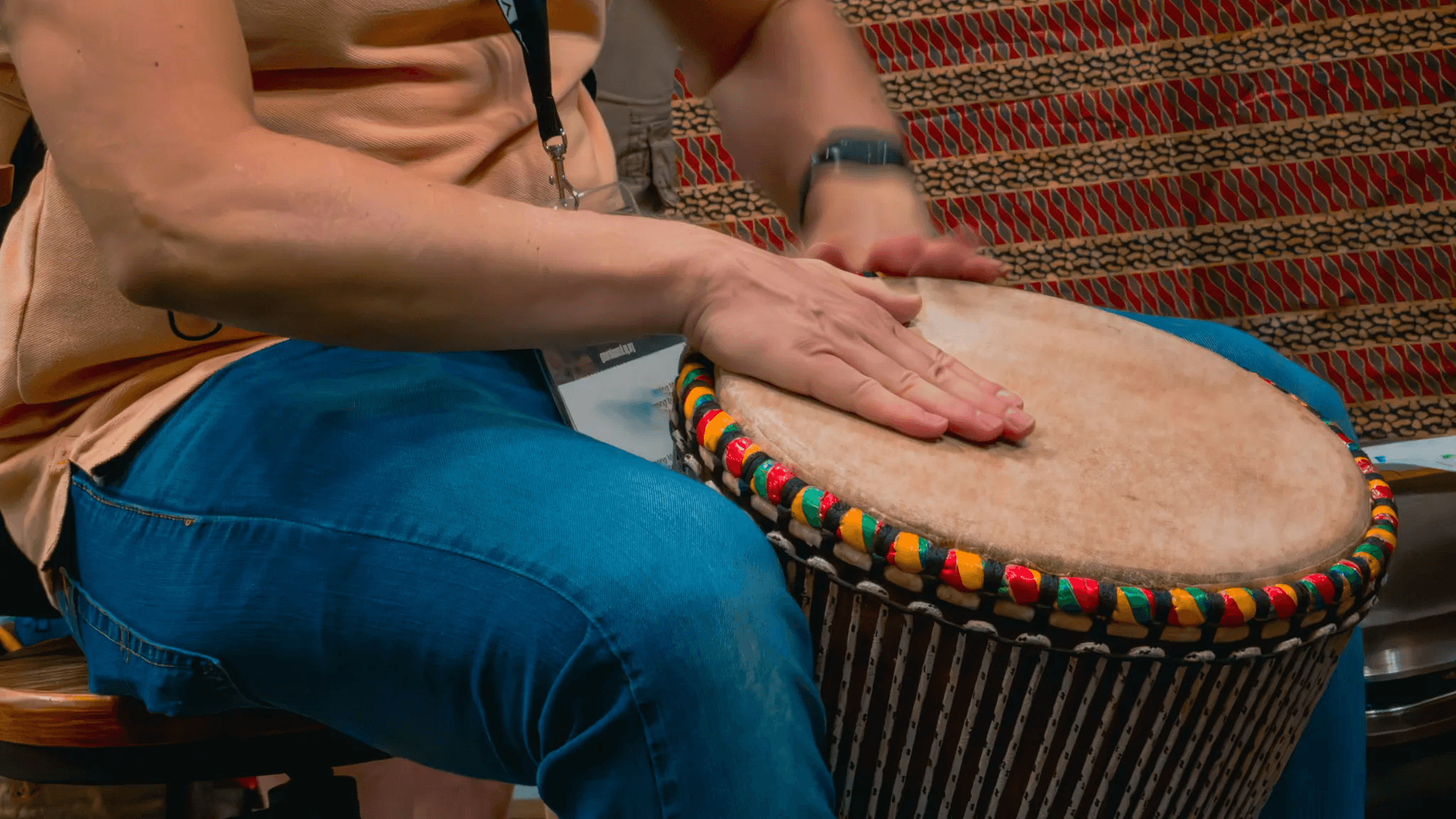
Truly listening to one another, finding one’s place, adjusting one’s pace to that of others, tuning in to form a whole: there are many reasons why team members choose to take part in a musical experience with Seven. During an immersive, collective training session, participants are guided step by step through the exploration of African percussion: djembe, dundun, krin, shekere, balafon. They discover that each instrument has its own voice and role, while contributing to the balance of the ensemble. They then continue the experience with an introduction to polyrhythm: several distinct rhythms that, once layered, create a shared harmony. It is a journey that engages mutual listening, adaptability, and intuitive coordination—essential skills for working and making decisions together more effectively. At Seven, we tailor the experience to the team’s context and needs. While music is a powerful catalyst for collective insight, other immersive workshops also make it possible to explore group dynamics and collective decision-making from different perspectives. We work with experienced facilitators who know how to create a space of trust and creativity. Their role: to guide without directing, inspire without imposing, and help each participant find their own rhythm within the group. Thanks to their keen understanding of collective dynamics, they know how to support the building of a group, help it grow together, establish practices that reflect who they are, and elevate their collective potential.
To prepare for the training
Additional resources (texts, practical case instructions, examples, or communication materials) may be shared depending on the context of the session. Their aim is to provide common reference points and to enrich collective reflection. Before or during the training, discussions with the trainers will help adjust the content to the participants’ level and needs.
Training objectives
Strengthen team cohesion through a shared musical experience
Develop active listening and collective synchronization
Find one's place and adjust one's rhythm to that of the group
Identify the conditions for smooth and harmonious collaboration
Know how to alternate between individual expression and collective contribution
Explore the complementarity of roles within a group
Cultivate trust and cooperation through joint creation
Transpose the lessons learned to one's professional environment
PROGRAM
Creating collective harmony through music
Session 1 - Strengthening team cohesion through music
A. Discovering instruments and musical codes
Discovering the history and oral traditions of African percussion
Introduction to the instruments: djembe, dundun, krin, shekere, balafon
Highlighting the role and unique voice of each instrument
Introduction to polyrhythm: layering several rhythms to create harmony
Collective practice around a common piece
Discussion on feelings and lessons learned from the experience
B. Playing together: from noise to harmony
Learning and reproducing simple rhythmic patterns
Unison practice through collective breaks
Progressive construction of a piece as a group
Synchronizing rhythmic entries, performances, and exits
Putting listening, adaptation, and intuitive coordination skills into action
Collective debrief on the group dynamics observed
C. Learning to listen to one another, adjust, and unite
Extending the rhythmic experience with Seven training tools
Exploring different listening styles through practical exercises
Discovering the 5 stages of a group's life according to the Tuckman model
Collective analysis of the dynamics observed during the session
Applying the learning to real professional situations
Sharing experiences and concrete examples from participants' daily lives
Session 2 - Rethinking team dynamics in a hybrid context
A. Experiencing silo logic and information flow
Sending two role sheets: a common sheet (project context) and an individual sheet (assigned role)
Immersion in a simulation
Negotiation and cooperation around a common project
Seeking balance between collective goals and individual interests
Debrief on the communication and collaboration strategies implemented
B. Learning to cooperate in a hybrid world
Immersion in a survival scenario
Individual then collective ranking of a list of objects essential for survival
Setting up a hybrid format with teams spread across different spaces
Introduction of unexpected events in real time
Observing reactions to contingencies and adjusting communication methods
Collective debrief on the impact of unexpected events and the levers for effective collaboration
C. Imagining together the future reflexes of cooperation
Debrief of all workshops: strengths, learnings, and areas for improvement
Working in subgroups to imagine simple actions to implement on a daily basis
Formulating reflexes and rituals that promote better cooperation
Sharing the proposals
Collective vote to select the most motivating and realistic commitments
Closing with a shared roadmap to embed new practices
Our teaching methods
We aspire for as many people as possible to have the freedom to act and fulfill themselves thanks to our innovative and collaborative training programs. We therefore offer truly memorable learning experiences, putting pace, the desire to learn, and people at the heart of the method.
Our credo: to build on expertise and innovative formats, capable of engaging all the ways our participants learn. Our approach is based on the 7 existing types of intelligence, to reach and leave a lasting impression on everyone.
At Seven, you have access to content that is always at the cutting edge and prompts action, as well as tools that guarantee an immediate impact. Our 300 experts trained in our method have already enabled 60,000 people to experience unforgettable learning experiences and develop new skills. Take the time to save time! Train with us.
Certification
The certification was issued under the following category of action: Training action
 Open certification
About
Is this training course covered by the OPCOs?
Yes! You can get in touch with your Skills Operator to ask them about coverage. We can support you with this process.
Are there any prerequisites?
This training is aimed at salespeople, managers, directors, team leaders, as well as anyone wishing to use their communication to support their relationships and telephone prospecting.
Does this training course fall under the FNE-Formation program?
Yes. The FNE-Formation scheme allows all employees on partial or full furlough to have their training costs covered. If your company is eligible for partial unemployment and you are in this situation: this training will be reimbursed 100% by FNE-Formation.
How am I evaluated?
Your learning outcomes will be assessed through a practical case, a simulation, or a questionnaire.
You will be given a certificate of completion at the end of the training.
Is the training accessible?
Regarding the terms and deadlines for access to this training, you can contact us directly with a minimum notice of 15 days before the desired date.
Accessible to people with disabilities: a designated disability coordinator will follow up on any adaptation request, which must be reported in advance of the training.
Are you interested in this training?
Training programs can be custom-designed.
Duration (in days)
2 half-days
(adjustable internally)
Duration (in hours)
6h (2x3h)
Location
Capacity
participants
NPS*
Inter price
600€ HT
per participant
Intra price
TRAINING