How can you foster constructive debates with the Régnier Abacus?
Published on
Training centers and schools are two neighboring environments with similar goals. Indeed, both aim to provide learners with concepts that can be immediately applied while capturing their attention. Although their missions are close, the methods used during interactions are different—or at least that is what one might think.
Yet the same tool can serve as a foundation for both school teachers and corporate facilitators. Let’s take Edward de Bono’s Six Thinking Hats, a theory SEVEN is particularly fond of! It shows that there are six main ways of perceiving the world. This tool, which we use extensively in our interventions in companies and higher education institutions, could also be applied with younger children. Of course, with the latter, explaining differences in points of view requires simplifying the theory, but the instructions would remain the same.
Curious about how one tool can be used for children and adults, we interviewed a primary school teacher from Lyon who had the opportunity to test the same tool with both groups. Here we will discuss the Régnier Abacus: a decision-making aid that is particularly constructive when you want to initiate debate. The principle: a group of people reacts to several given statements using a color code. Each person’s responses make it possible to observe group trends and encourage the development of constructive debates. Discover how it works and why to use it.
————
Creating a nuanced debate with the Régnier Abacus
The Régnier Abacus, little known among adults, has nevertheless existed since 1973. Created by physician François Régnier, this visual tool was born from the need to get every individual in a group to express themselves on a topic. It has the advantage of being applicable to all groups (small or large).
In practical terms, its use encourages participants to position themselves (alone, in pairs, or in groups of three) on statements using cards of different colors. Hélène Fraudet, a teacher at Hilaire Dunand school in Irigny, south of Lyon, had the opportunity to introduce the Abacus to a group of children (one 3rd-grade class and another 4th/5th-grade class) and a group of adults (as part of her training at INSPE). She shared her feedback with us.
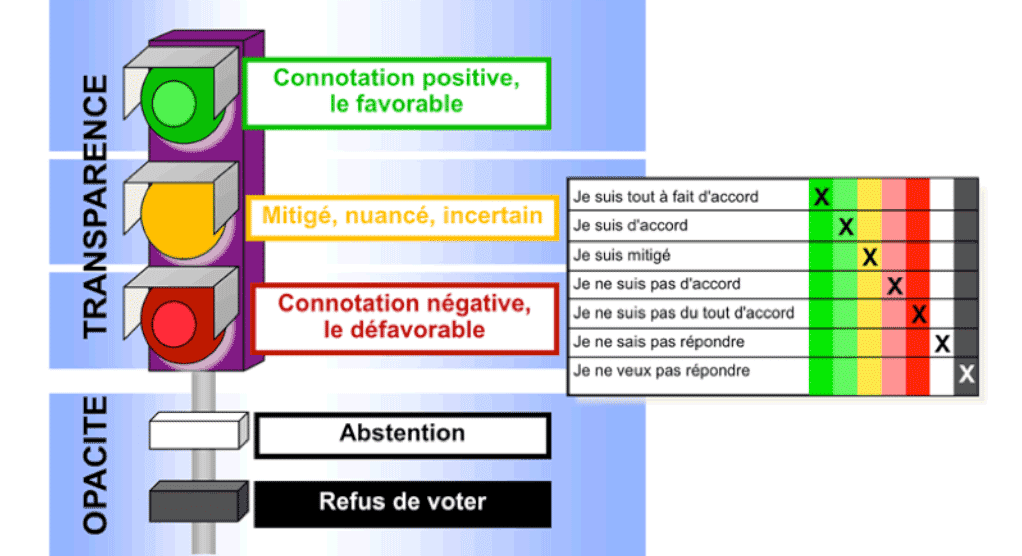
Since adults are more capable of bringing nuance to their answers, she chose to offer this group of “grown-up children” a broader color palette. Thus, during these corporate workshops, learners can choose between dark green, which expresses “yes, I agree with the statement,” light green, which means “yes, I agree with the statement but...,” yellow, which means “yes, I both agree and disagree,” pink, which means “no, I disagree but...,” and red, which expresses a radical no. For primary school pupils, Hélène deliberately limited the choice to three: green (=yes), yellow (=yes and no), and red (=no). At times, she added white as a joker when the user did not know what to answer or did not want to answer.
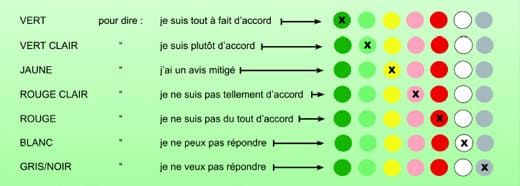
Photo credit: Echo Services
Choosing your statements: a crucial step for the facilitator
Testing the Régnier Abacus with two different populations implies adjustments depending on the audience’s level. So, when Hélène had the opportunity to test the Régnier Abacus with pupils aged 9 to 10, she chose to present 3 statements. For the corporate audience, she shared more statements.
Beyond the number of statements, which needs to be tailored to the target audience, topics must also be addressed according to that audience. To give you a concrete example, Hélène launched the following statement to her pupils: “Girls can’t solve math problems and boys are better at soccer.” Unsurprisingly, in a class of 24 pupils, all the boys raised their green card to answer “yes.” This statement then led to a debate on the space occupied by girls and boys during recess. The discussions then revealed that around 80% of the playground is occupied by soccer players, who are, for the vast majority, boys. Starting from everyone’s representations—and therefore thanks to the Régnier Abacus—Hélène was able to address the delicate topic of stereotypes, which, without a starting point, would have been difficult to tackle.
Now let’s look at application with adults. Because education is a topic dear to Hélène (and to SEVEN as well), she chose to address the theme “Education and health” with this group. Based on this topic, she defined six statements, including two she shared with us: “Providing health education at school means interfering in people’s private lives.” and “Health education is a specialist’s business.” These statements have the advantage of encouraging different points of view. For some, health education at school is obvious because it is a public issue, while for others, it is personal. The real difficulty of this exercise lies in the wording of the statement, which must be clear enough to encourage a definite choice among participants and divisive enough to lead them into debate. The greatest complexity for the facilitator therefore remains drafting the initial statements.
Showing kindness: a condition that fosters debate development
To run the Régnier Abacus well, there is one essential condition: kindness. During this workshop, participants share their points of view, open up, and reveal personal opinions. Now, if participants do not feel confident within a group, they may ultimately fail to share what they truly think and choose the color expected by the majority. Social pressure can lead them not to contradict the group and to follow others’ choices against their own opinion. Proceeding this way biases the final results, and ideas are not genuinely shared by everyone.
The facilitator’s role is therefore to remind everyone, from the start, of the importance of not judging others’ answers and not mocking; otherwise participants may self-censor. It is not only a matter of repeating this rule, but of ensuring it is applied by everyone (including oneself) throughout the exercise.
To create conditions that foster trust, the facilitator can invite individuals to reveal their answers at the same time. This is exactly what Hélène did with some of her primary school pupils. When she felt it was necessary, she asked them to show their selected color card simultaneously.
The advantages of the Régnier Abacus
A visual representation
Presented as a table with colored boxes (or cards), the Régnier Abacus makes it possible to very quickly visualize an assembly’s points of view. Thanks to this overall view, the facilitator and participants can observe everyone’s representations in just a few seconds and thus infer the group trend.
Through the visual representation of everyone’s opinions, information becomes easier to understand and is more readily grasped by readers. It then serves as a starting point for discussions and as support for decision-making.
You are a cereal brand and observe that 8 out of 10 customers chose pink or red for the statement “Breakfast is the most important meal of the day.” As for the remaining two people, they chose yellow. These observations will help you understand that communication focused on breakfast as the most important meal of the day is not aligned with people’s representations. Moreover, this finding may lead to debate on other related topics and raise questions such as “How do you view breakfast time?” and “On what occasions do you have it?”. Statements made in response to these questions can feed your new communication approach.
A pretext for discussion
One of the advantages of the Abacus is that it starts from participants’ representations. Their answers are what steer discussions toward one topic rather than another. Those who respond to the statements are ultimately the ones who initiate the debates.
The richness of this tool lies in the collective dimension. The exercise takes on its full meaning because it is carried out in a group. Indeed, thanks to the Régnier Abacus, some will realize that others think like they do, which can reassure them. Others will realize that some peers do not share the same point of view, which can broaden their initial perspective.
With this tool, each participant, on the one hand, speaks to explain their answer. On the other hand, everyone may feel inclined to express themselves in response to others’ answers. The probability that group trends will trigger reactions is high. Let us imagine that for the statement “The decoration of my workplace plays a major role in my productivity,” dark green (yes, I agree) and light green (yes, I agree but) represent 75% of the group’s responses. That would mean that the aesthetic aspect is not essential for members and that their productivity is linked to another factor (or factors). Which ones? More in-depth reflection on these factors can then begin. Unexpected topics can emerge from the chosen statements. Even if the facilitator may make assumptions beforehand about the main trend, during facilitation it is important to remain neutral and allow oneself to be surprised by everyone’s responses and the discussions that follow. “Debates sometimes head in unexpected directions, which is why uncertainty must be accepted,” Hélène told us. Being a Régnier Abacus facilitator ultimately means accepting surprise and being ready to welcome the unexpected.
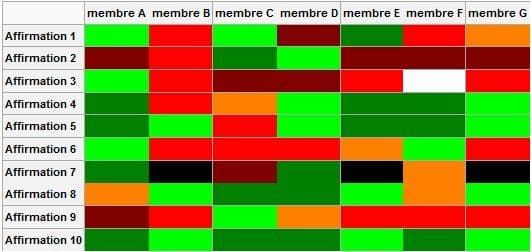
Photo credit: Stay Happening
An idea generator
Whether with adults in companies or pupils in class, the Régnier Abacus is a key for working on and developing ideas without even realizing it. “The opposite of seriousness is not play,” Hélène told us. A sentence we share 100% at SEVEN, since we make sure to use play to stimulate participants’ creativity. Our objective: that they leave with concrete, applicable actions for their daily lives—a serious outcome, as you can see.
The Régnier Abacus could partly be compared to the ideation stage of “design thinking,” since both methods aim to generate as many ideas as possible from participants’ initial representations. During the divergence phase (the first phase of ideation), participants think individually for a very short period of time based on a given topic. This individual part limits self-censorship and fosters reflection. Once ideas are written down, participants regroup to discuss their directions, sort them, and proceed to selection: this is when the convergence phase of ideation takes place.
Mobilizing all intelligences
If the Régnier Abacus inspired us, it is because its use mobilizes all forms of intelligence: not only logical-mathematical intelligence (the ability to demonstrate logic and reasoning) or verbal-linguistic intelligence (the ability to express oneself well in writing and speaking), but also visual, kinesthetic, interpersonal, intrapersonal, and rhythmic intelligence. In fact, the seven intelligences described by psychologist and cognitive science specialist Howard Gardner are activated through the Régnier Abacus.
Concretely, visual intelligence is mobilized through the color-based materialization of opinions and the assembly of views in table form. Through this visual process, it is easier to identify the group trend. Kinesthetic intelligence, for its part, is used when participants move to place their colored cards on a board or raise their hands to show everyone their selected color. In addition, intrapersonal intelligence develops when learners think alone about their color choices and react internally to other group members’ results. Debates generated after each statement then strengthen interpersonal intelligence, which fosters exchanges between individuals. Finally, with each new statement, the participant must adapt to a change of topic, and it is their rhythmic intelligence that is stimulated.
————
The Régnier Abacus is a valuable tool for getting all individuals in a group to speak, generating exchanges, bringing out ideas, and mobilizing different intelligences without even noticing. Used with both primary school children and adults, it can adapt to all populations, as we saw through Hélène Fraudet’s practical implementation. If statements and responses are more numerous with adults, the workshop instruction remains the same for everyone: respond as sincerely as possible by choosing the color closest to your thinking. Each individual’s transparency, kindness among all group members, selection of the right statements, facilitator neutrality, and the development of constructive debates are key elements in ensuring the success of this workshop.