>
>
>
How can we maintain students' attention and make them active participants in their own learning?
How can we maintain students' attention and make them active participants in their own learning?
Published on

It is not uncommon in training, and even in any sector, to observe a drop in attention as the day progresses. Participants may seem distant, passive, hard to mobilize even though they have taken the step of joining a training module. So is it a motivation problem? A priori, no. According to John Medina, a professor at Washington State University and a molecular developmental biologist, an adult’s attention span decreases by 80% after 10 minutes. And yes, it is scientifically proven that it is difficult to maintain a person’s attention over time—data that must be integrated into our professions.
————
A difficulty in maintaining individuals’ attention
If the sender of a message is obviously responsible for the content they convey, they are also responsible for the way, and even the WAYS, in which they convey it.
As Howard Gardner’s theory of multiple intelligences suggests, individuals operate through preferred intelligence channels, resulting in a specific learning capacity.
For him, there are 7 types of capacity that enable a person to evolve in their environment:
logical-mathematical,
interpersonal,
intrapersonal,
kinesthetic,
rhythmic,
and linguistic.
In light of this theory as well, how can you design your next training sessions, meetings, or workshops to ultimately maintain the attention of students or colleagues?
The example of the ESSEC startup shaker, or annual boot camp
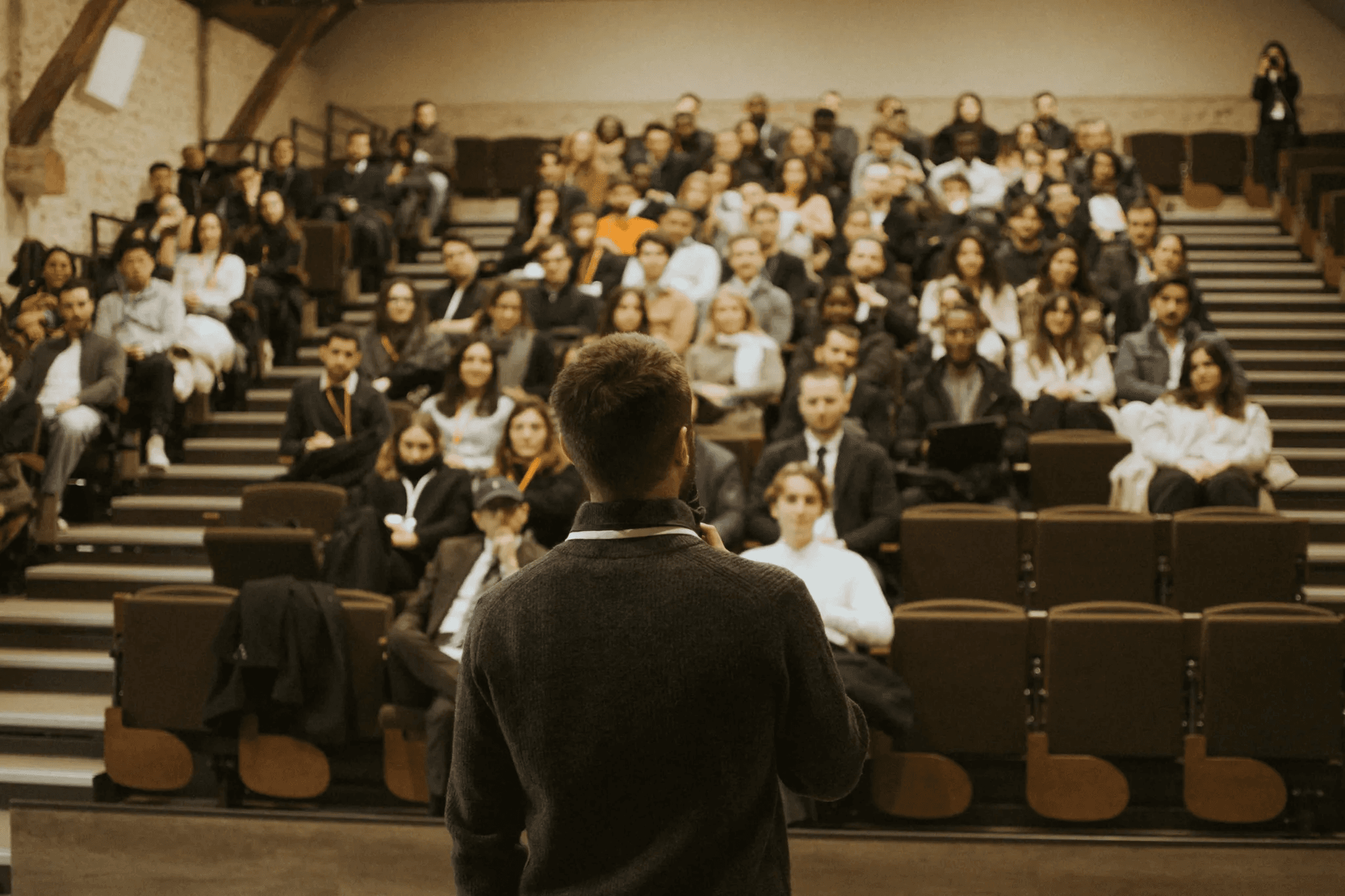
As part of our activity, our SEVEN team is regularly called upon to train, facilitate seminars, or coach groups. These sessions inevitably confront us with this question of transmission, among others during ESSEC’s startup shaker, an entrepreneurial program run by the institution for the past 7 years.
On this occasion, our objective as trainers is to lead each student to understand the challenges of entrepreneurship, a discipline that is by definition multifaceted and more than ever depends on the student’s ability to take ownership of the topic.
This startup shaker experience pushed us even more to reflect on the means to implement in order to maintain students’ attention, although the same exercise can also be done in a professional setting.
Combining all teaching methods to capture attention
Rather than yet another 30-hour lecture course in amphitheaters, far from the entrepreneur’s reality, the decision was made to create a 33-hour workshop combining all teaching methods to offer students an unforgettable learning experience.
To create this unique moment at ESSEC and maintain the attention of as many students as possible, we coordinated several approaches—ultimately creating tailor-made instructional design.
Thus, students were able to:
Take part in shared theory sessions delivered by experts who had studied entrepreneurship around the world;
Benefit from the experience of seasoned multi-entrepreneurs sharing their various projects;
Experiment live with the process of creating a company;
Be coached, individually and in groups, throughout the seminar;
Meet major corporations, present alongside us at the event, bringing the full intrapreneurial dimension.
Completely immersed for these 36 hours, freed from all logistical constraints, 100% dedicated to their project, students were able to grasp entrepreneurship in a rhythmic way and through different transmission formats.
Activating all forms of intelligence to succeed in training
Let’s return to our theory of multiple intelligences... the objective of this instructional design was indeed to ensure that ALL forms of our students’ intelligence were activated during the boot camp. We will share examples showing that each form of intelligence was leveraged.
To stimulate students’ rhythmic intelligence
Regarding the rhythmic approach, we engaged those who were sensitive to it through extremely tightly timed sessions. Top-down segments were condensed and paired with practice periods that did not exceed one hour. This sequence of rapid activities maintained attention levels.
To foster interpersonal intelligence
Students inclined toward interpersonal learning benefited from multiple opportunities for meetings and exchanges with their groups, their coaches, the mobilized experts, and even potential clients they interviewed to create their service.
For students sensitive to intrapersonal intelligence
Conversely, people more connected to their inner world needed to reflect on what they were experiencing to advance their understanding of a subject. They then relied on the various debriefs and constructive feedback from supervisors.
For students more comfortable with linguistic intelligence
Then came the “verbo-linguistic” students, who excel in preparing pitches and public speaking. By taking responsibility for presenting the project to their groups, then in front of all students, companies, and trainers, they took ownership of the exercise and felt comfortable.
On this topic, we offer a Public Speaking workshop to encourage everyone to feel more at ease in external communication and be proud of themselves.
For students with mathematical intelligence
Participants with strengths in logic and mathematics were invaluable during team confrontation phases. Able to extract key elements, they easily established cause-and-effect links.
For students who mainly rely on kinesthetic intelligence
For those who learn through the body, it was precisely the sustained intensity of the boot camp that enabled them to grasp the experience. Indeed, thanks to the physical effort required over periods longer than their usual alert phases, they somehow physically surpassed themselves.
For students who favor spatial intelligence
Finally, for those who prioritize the spatial dimension, a particular effort was made throughout the workshop to offer only impactful slides. By creating the right visual triggers in their memory, they anchored startup shaker learnings over time.
The success of this exercise thanks to the use of the 7 forms of intelligence
The success of this exercise, implemented for 7 years already within ESSEC, undoubtedly rests on our concern to address each participant according to their own learning capacity, their own intelligence. Because each student was more or less sensitive to one or more forms of intelligence, everyone was able to find the method that suited them best in order to keep their attention alert and give their maximum in the challenges they had
An achievement all the more remarkable this year with the Covid crisis. Indeed, if we manage to maintain this type of event, with this pedagogical aim, despite current health constraints, on what other aspects of education can instructional design be a response to changes in the world of training?