>
>
>
Visual-spatial intelligence: one of Howard Gardner's multiple intelligences
Visual-spatial intelligence: one of Howard Gardner's multiple intelligences
Published on

Do you learn more easily through images, videos, diagrams, drawings? Do you use mental images to understand a concept and find appropriate solutions? Can you picture things in space? Are you particularly observant and imaginative? Perhaps you recognize yourself and/or the profile of some of your loved ones! If so, the intelligence you develop the most is probably what is known as visuo-spatial intelligence. This term, highlighted by the theory of multiple intelligences, was mentioned by Howard Gardner; and is one of the 7 forms of intelligence he defined.
————
From intelligence in the singular to multiple intelligences
In 1983, Howard Gardner, an American psychologist, showed that human thought is actually more complete and complex than it appears. He explained that there is NOT ONE single intelligence common to everyone BUT SEVERAL types of intelligence. He therefore spoke of intelligence in the plural, since for him there were 7 (like our company Seven, in fact):
logical-mathematical intelligence,
linguistic intelligence,
kinesthetic intelligence,
musical intelligence,
interpersonal intelligence,
intrapersonal intelligence,
and visuo-spatial intelligence, the one we will discuss in this article.
Zooming in on visuo-spatial intelligence: the intelligence of the mind’s representation of the world
Let’s head into space—or rather visuo-spatial intelligence—with Howard Gardner!
Just like multiple intelligences, visuo-spatial intelligence has several names such as: visual intelligence, spatial intelligence, or visuo-spatial intelligence. Here, the choice of term matters little. What matters is understanding this intelligence. What do we call “visuo-spatial intelligence”? It is the ability to orient oneself in a given environment and to create mental images for a better understanding of the world.
“The navigator cannot see the islands while steering; instead, he maps their position in his mental ‘representation’ of the journey.” Howard Gardner. This quote thus highlights the power of mental representation for moving forward and finding one’s way. Here, the navigator relies on a map to continue the journey, and it is thanks to visuo-spatial intelligence that he manages to follow the direction that seems right.
To help you identify your visuo-spatial intelligence and your other forms of intelligence (because they are multiple, let’s not forget), we run a training course called Teaching with the 7 Intelligences, in which we guide each participant in discovering their intelligences.
If you would like to get in touch with Seven to share your opinion on Howard Gardner’s theory or get more information about our training method, we will be happy to talk with you.
How can you recognize individuals who develop this form of intelligence?
Adopting active listening is valuable because it brings considerable strengths:
According to neurologist Robert Sperry’s theory, our two cerebral hemispheres function like two separate brains. Each hemisphere would have different functions. The left hemisphere would be used largely for language, mathematics, and logic, while the right hemisphere would be linked to spatial perception, dreaming, imagination, intuition, and visual images. Thus, if we follow this theory, the right hemisphere would be particularly engaged when we demonstrate visuo-spatial intelligence. Let us, however, take this claim with caution and not label a person as left-brained or right-brained.
Special attention to the smallest details
How can we recognize individuals with this aptitude? We suggest that you pay attention to a few clues. Let us clarify, however, that this is not about putting so-and-so in a fixed box, but about using the clues you notice to formulate hypotheses about how others function (or how you function yourself).
An ease in orienting oneself in space
This intelligence may be developed by individuals who have a strong sense of direction, can estimate volume or distance, or can picture objects in 3D. Consequently, these are individuals who can easily place themselves in a given environment and can visualize an object from a different angle.
An overdeveloped visual memory
These are also individuals who, through their observational ability, have excellent visual memory. Indeed, they will find it easier than others to do games based on close observation of objects.
In everyday life, these individuals may possibly have what is known as hyperesthesia vision. This precise way of seeing allows them to capture a host of small details to better understand and reassure themselves. In her book Je pense trop, Christel Petitcollin explains that people with mental over-efficiency develop very sharp senses, including vision, and therefore pay much greater attention to all the small visual details around them.
A sensitivity to the arts
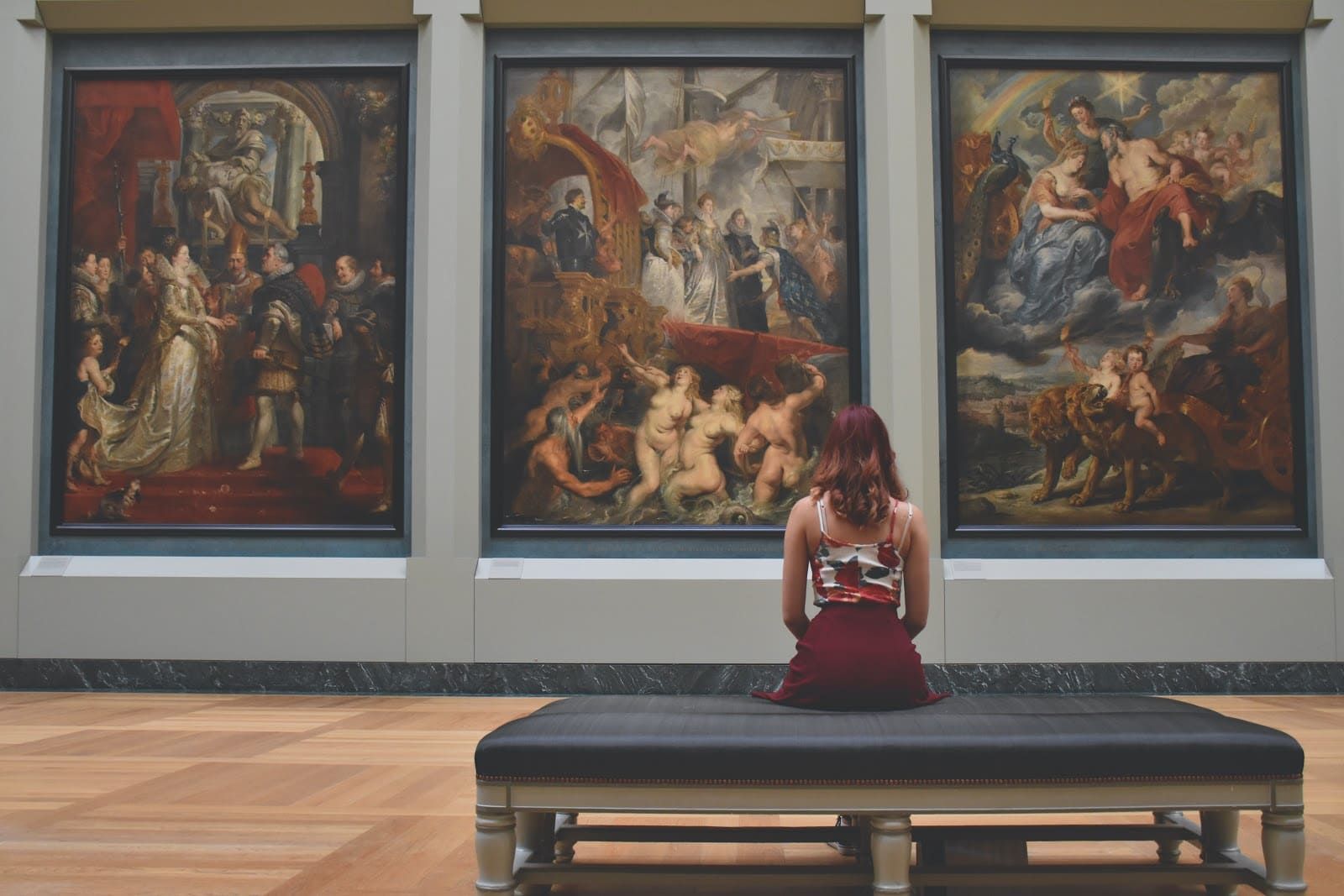
In addition, they often have a strong affinity for the visual arts. For example, they may be especially admiring of beautiful landscapes, paintings, photographs, or any other form of art. They will gladly attend art exhibitions, go on walks, or travel for visual pleasure and the feeling it gives them.
Visuo-spatial intelligence: for a minority or a majority of people?
The main professions where visuo-spatial intelligence is developed
In certain professions, you will observe that the use of visual intelligence is particularly strong. Among the professions where it is highly present, we can notably mention:
professions related to aesthetics: stylists, fashion illustrators, etc.
professions related to art: landscape designers, sculptors, graphic designers, illustrators, etc.
professions related to the audiovisual field: directors, camera operators, etc.
professions related to space: architects, interior designers, etc.
professions related to construction: technicians, etc.
The use of visuo-spatial intelligence by everyone, every day
However, it should be specified that this intelligence is not specific to a few very precise professional categories. It is found in all phases of life, both in childhood and in adulthood. At school, some children will especially mobilize this form of intelligence in subjects such as visual arts, sports, mathematics, and geography. Outside school, some children (as well as adults) can strengthen their observational ability through puzzles, brainteasers, chess games, or, for example, Rubik’s cubes.
Spatial intelligence is also particularly present in adult life. To illustrate this, we can take the example of orientation in a specific space: imagine that you are trying to position yourself in space in order to get to a specific place—you will try to use your spatial intelligence. It must be said that GPS and maps built into your smartphone somewhat limit the use of your spatial intelligence.
Driving a vehicle is a second example where your representation of space is key. When you are on the road, you must pay attention to a certain number of elements (otherwise it can be dangerous for you and for others): mirrors; cars driving around you, slowing down, accelerating, changing direction; pedestrians walking on sidewalks, about to cross, or crossing; road signs that give you indications about how to drive; changing weather that prompts you to adopt a certain way of driving; new places (tunnel, bridge, city, countryside, local road, highway, toll) that require you to adapt your driving; etc.
From becoming aware of this visuo-spatial intelligence to putting it into practice
Learn to identify your visuo-spatial intelligence
Knowing which methods help you retain information more easily, being aware of your natural abilities, understanding your way of reasoning, and therefore having good self-knowledge will be particularly useful in identifying your more or less pronounced visual intelligence.
Getting to know yourself may seem like an easy exercise, yet it is not always so. That is why it is essential to ask yourself the right questions: To what extent do you demonstrate visual/spatial intelligence? Are you good at representing objects in space? Do you think you use this intelligence regularly?
Develop your visual/spatial potential
To develop your visual/spatial potential, three components are useful:
Genes: We all have predispositions, different sensitivities to the world around us, without necessarily having anything to do with it. That is why we sometimes feel lucky or, conversely, cursed because we seem to lack visual talent. However, genes are not THE only component in developing visual/spatial potential. If you have this natural ease in positioning yourself in space but do not practice and do not put enthusiasm into it, you will not stimulate your visuo-spatial intelligence. The genetic factor must therefore be combined with other elements.
Training: By regularly stimulating your visual intelligence through visualization exercises (by creating diagrams, drawings, illustrations, etc.), by paying particular attention to visual arts (through exhibitions, artistic curiosity, etc.), by rethinking the layout of your home, and through many other activities, you will strengthen your visual intelligence. Like a muscle, visual intelligence can be trained!
Passion: The final essential component is loving to learn through mental images, loving to draw, loving to make diagrams. If visual intelligence is partly innate, passion is not and depends greatly on your personal appreciation of the world.
Combine your visual intelligence with other forms of intelligence
You can excel in spatial intelligence but also in mathematical and musical intelligence! You are not limited to ONE single form of intelligence but to SEVERAL, hence the theory of multiple intelligences. Moreover, one form of intelligence does not contradict another type of intelligence. Each person has primary and secondary intelligences. Furthermore, Howard Gardner’s theory is not an unquestionable postulate. So saying that there are 7 forms can be challenged.
Stimulate your visual intelligence with mind mapping
In his book Au bon plaisir d’apprendre, writer and teacher Bruno Hourst highlights the concept of the topogram, better known by its English translation, mind mapping. He defines a topogram as “a creative way to shape ideas and connect them together.” Concretely, this means representing your ideas on a sheet of paper in order to promote learning and make it easier to organize your thoughts.
Creating a mind map is not only for artists or a handful of people with an artistic streak! Anyone can, by making simple symbolic drawings, copying existing diagrams or drawings, using colors, using arrows appropriately, and arranging ideas properly, create a perfectly suitable mind map.
From now on, all that remains is for you to explore your visuo-spatial intelligence for a flight toward infinity and beyond!!!