Risk-taking: when should it be avoided or pursued?
Published on

Riding a bike, jumping from the diving board, horseback riding, going down a ski slope on a sled, learning a new language, changing classmates… during childhood, we more regularly choose to take risks, more willingly accept confronting unanticipated situations, and are less frightened by the unexpected. For younger people, risk is a way to assert themselves, gain freedom, eliminate monotony, and even grow up. As we gain maturity and age, we pay more attention to others’ judgments, think about the consequences of our actions, are less inclined to take risks, and are ready to refuse events that could have a negative impact.
What if, without realizing it, we were letting opportunities slip away because of our lack of risk-taking or our fear of the unknown? Between the risks we are advised to take and those we are advised against, we can quickly start questioning the nature of each. Which risks are “worth taking” and which are not? How can we reduce the probability of failure and increase our chances of success when facing a risk? Should we avoid risk-taking or seek it out? The question seems delicate and deserves closer examination.
———
How do we view risk?
A danger
A risk refers to the probability that an event will not unfold as planned and therefore that the expected outcome brings harm or danger. From the Latin “risco,” it means “that which cuts,” in other words, that which hurts. Thus, in its very definition and Latin origins, a negative meaning is present, which explains the reluctance we initially develop toward what we consider a risk.
A step toward freedom
In adulthood, we seem less free in our actions and reduce our risk-taking. For example, when we know that several people are counting on us and that our actions have consequences not only for us but also for people we love, we act consciously and prefer to avoid “risk.”
A fear of the unknown
When we lack information on a subject, have no past memories that echo what we are currently experiencing, and possess no proof of a positive outcome, we treat the situation as a threat and naturally prefer not to confront it. Novelty and possible radical changes tend to frighten us and steer us away from taking risks.
The different values of risks
Looking more closely, we see that each risk has a different value and that one action rather than another should be applied depending on its nature.
Risks known in advance vS unpredictable risks
First, we can distinguish:
risks identified in advance
and risks arising from the unexpected.
In the first category, these are situations we have anticipated, that do not catch us by surprise but still remain uncomfortable for us. We are aware of the danger and are not in denial.
In the second category, these are situations we did not think about: unforeseen events. It is preferable to anticipate them in order to classify them in the “identified risks” category and thus be able to act preventively rather than in haste.
The different levels of risk criticality
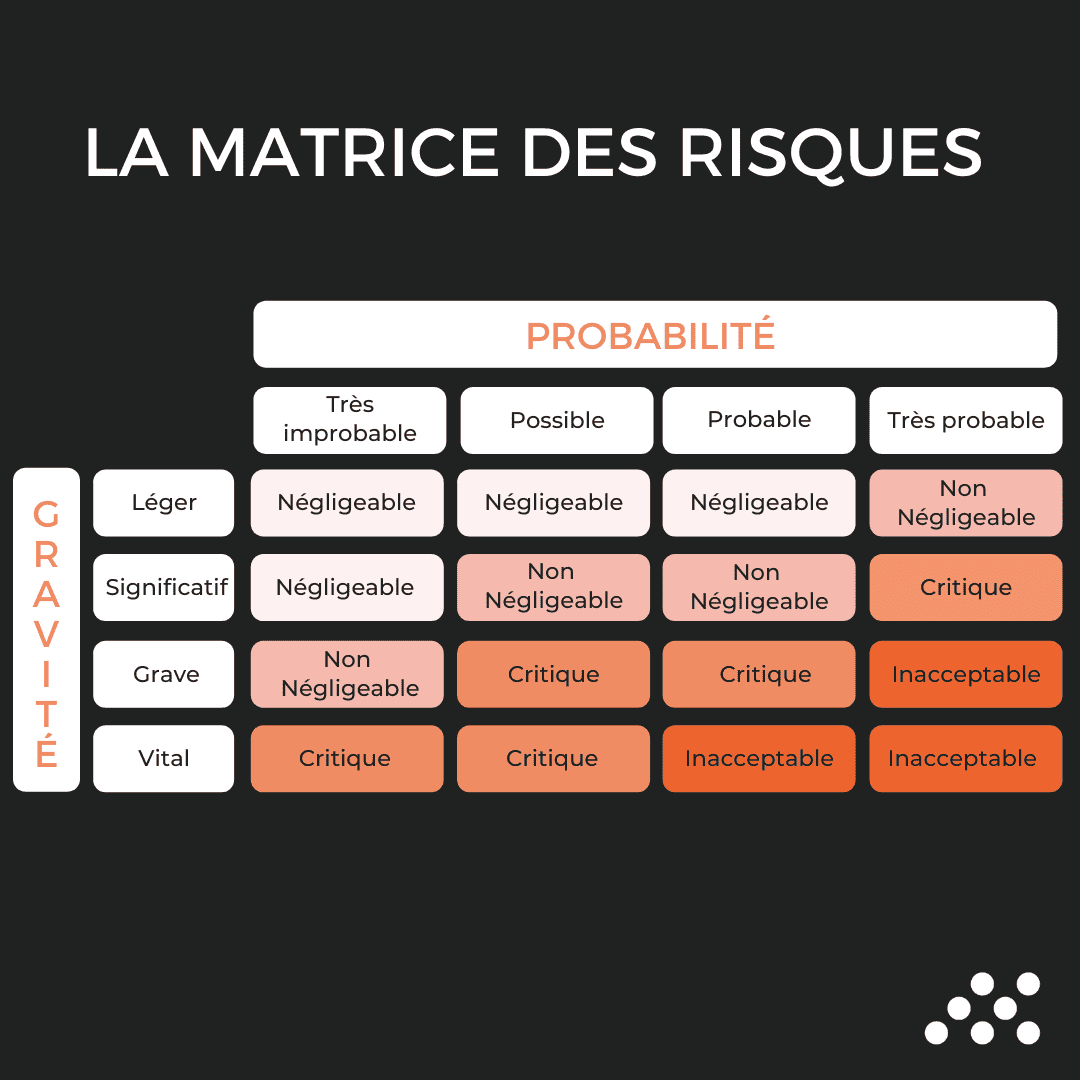
To refine the nature of each risk, you can rely on the risk matrix. It classifies situations according to two axes: the probability that the event occurs on the x-axis and the severity of the event on the y-axis. Depending on where these two axes intersect for a given situation, the risk will have one of the following 4 levels of criticality: “negligible,” “non-negligible,” “critical,” and “unacceptable.” After that, one action rather than another should be applied.
Imagine you invite 20 of your friends to your home to celebrate your birthday in mid-October. 18 of them have confirmed they will attend. The risk that half your guests cannot come because of rain is “negligible.” Indeed, since your event takes place at your home, sheltered from bad weather, and most of them live in Paris, they should in principle be able to get to your home easily by public transport, even in bad weather. The action to implement is to set up monitoring. Check in with your guests and ask them to confirm their attendance again a few days before the event.
Now suppose that rain has a greater impact on the smooth running of your event and that you want to organize a 10 km run in your village in April. The risk of rain is “non-negligible.” Indeed, it is possible that it will rain (cf probability axis) and that the severity of the situation is significant because the event is outdoors. Planning a follow-up measure will be necessary. Applied to this running-race example, you, as organizer, should list possible actions to take in case of rain, such as ordering appropriate clothing for staff, reviewing the route if some sections are dangerous in heavy rain, etc.
Now consider that you want to take your children for a hot-air balloon ride next November. However, you have read that in case of ground wind above 15 km/h, rain, and poor visibility, you will not be able to fly. Since the conditions are so specific and bad weather is often present in autumn, the risk of an accident if flying during this period will be “critical” or even “unacceptable.” Consequently, it is preferable to already think about an immediate corrective action. Since you cannot act on the weather, you could plan a Plan B to keep your children occupied and make them happy. You could therefore treat the hot-air balloon flight as an option and prioritize an activity that does not depend on the weather. Why not plan a visit to the Château de Fontainebleau in November?
Risks that depend on context vS individuals
Weather-related risks, which we discussed earlier, fall into the category of external environmental risks. To this, we can include all natural risks (avalanche, fire, cyclone, etc.). Some may be predictable, but forecasting them is limited and cannot be done far in advance.
We can also add all risks emanating from people outside your organization. If you are managing a 10 km running race and the production of race T-shirts relies exclusively on a single supplier, the risk that they inform you late that they can no longer fulfill the order is “critical” (because the probability is possible and the severity is serious). The best approach is to anticipate this “critical” risk in advance and carry out the necessary actions: actively searching for providers, discussing with them, selecting backup providers. That way, if your initial T-shirt supplier withdraws, you can react quickly.
Let’s keep the same example of managing a running race and this time imagine a risk coming from people within your organization: volunteers you recruited for the event inform you that they are sick or positive for Covid-19. Without any measures in place, you will be understaffed and face difficulties delivering a quality experience for the runners.
The benefits of risk-taking
Breaking the routine
You feel that your current work organization is not efficient and that it would be worth reworking. As you examine your work methods, you think you could optimize what already exists, increase your level of attention, and stimulate your motivation more. On the other hand, you know that changing your routine could penalize you. Even if uncertainty about a successful outcome is present, your desire to “break the routine” may prove stronger and ultimately encourage you to try. The desire to change one’s habits can thus be a driving force in risk-taking.
Pushing yourself
On a whim, you decide to sign up for a half-marathon even though you are not very athletic and have never run long distances. Two possible reactions: 1 - You perceive this race as a risk of injury, a constraint on your social life. 2 - You adopt an optimistic view and see this sporting event as a personal challenge you are setting for yourself, an opportunity to surprise yourself and prove you can do it: “I didn’t think I could finish this half-marathon, but thanks to my diligent training, self-discipline, and the encouragement of my loved ones, I succeeded.” The angle you adopt will make you perceive risks (or not).
Being rewarded
Do you remember your falls while learning to ride a bike when you first removed the training wheels? It is because you fell several times, stayed in the saddle longer and longer, and changed your approach that you eventually found your balance. Despite your injuries, you most often kept going because you knew your repeated failures would allow you to gain a certain freedom: knowing how to ride a bike. Without risk-taking, you would never have learned to pedal without training wheels. If in the short term there is a risk of falling and therefore getting hurt, learning to ride a two-wheeler can in the long term bring wonderful rewards, such as the joy of going wherever you want!
Taking the leap and achieving great success
Entrepreneurs who invest in their project and agree not to pay themselves for some time take risks at the start because it is the only way for them to launch their project. Upstream, they will devote themselves to their “business plan” and think about how to become profitable as quickly as possible. However, despite their anticipation (which is necessary, moreover), uncertainty about results will always remain. Their products or services, not yet having met their consumers nor even been confronted with competitors (direct or indirect), may either appeal (which is all we wish for them) or displease. Only the action of taking the leap, which involves a risk (financial for investors and founders), will be necessary. Uber’s founders would not have achieved the expected success if they had stopped because favorable results were not guaranteed. Their way of rethinking the taxi-booking model was innovative and never tested before, yet they dared anyway.
Helping others avoid repeating the same mistakes
“Learn from the mistakes of others. You can’t live long enough to make them all yourself,” explained Eleanor Roosevelt, wife of Franklin Roosevelt and American activist. Mistakes made by others, when identified and taken into account, can serve as a counter-model. Imagine that your uncle, with whom you are close, suffered severe aftereffects after skiing off-piste. It may be that his story marked you so deeply, and the fear of having lifelong injuries like him was so strong, that you have always been (and still are) very cautious when skiing. Perhaps your choices would have been different if you had never known this story?
How to take measured risks?
Start with risks that have no negative consequences
Tina Seelig, teacher and author of several books on creativity and innovation, explained in a TED conference in 2018 (we also recommend that you watch the TED video) that “small risks” allow us to catch “the winds of luck.” A teacher at Stanford University, she is accustomed to having her students fill out a “riskometer,” on which she encourages them to plan the “small risks” they are willing to take. She thus invites them to think about intellectual, physical, financial, emotional, social, ethical, and political risks. To illustrate her point, she cites three risks with no negative consequences, so that everyone can create their own luck:
Tackling a complex problem we have never faced would be an excellent way to stimulate ourselves intellectually.
Talking with a traveler sitting next to us on public transport could lead to a great professional or friendly encounter.
Sharing our feelings with someone dear to us could touch that person and make them want to share their impressions in return.
By gradually stepping out of one’s comfort zone, “risk-taking” will be demystified and individuals’ ability to confront “risky” situations will increase. You make small daily advances that gradually lead you toward the initial goal you were aiming for: this is the principle of the Kaizen method.
Gather as much information as possible
Even though risk-taking has advantages (pushing yourself, being rewarded, taking the leap, preventing others from repeating mistakes), depending on prior identification, severity, and probability (cf the risk matrix), “potential dangers” will never completely disappear. Since zero risk does not exist, the most important thing is to gather as much information as possible in order to reduce (not eliminate) the probability that events go wrong. Entrepreneurs launching a new product or service on the market will most often have gathered as much information as possible about their target consumers, produced projected budget plans, tested what they were selling with typical users, and analyzed their strengths and weaknesses, as well as those of their competitors.
Set boundaries
Taking a measured risk requires knowing yourself well, knowing when to set limits so you can push yourself without ever creating conflicts with others. Are you tempted by a solo trip in Eastern Europe? Through this experience, you know you will step out of your comfort zone, that your autonomy will be high, but that this adventure will involve risks (technical, financial, linguistic). To approach this trip—likely rich in discoveries and (good and bad) surprises—as best as possible, setting limits will be essential. Perhaps you could set a weekly budget not to exceed? Refuse proposals that carry high-probability and high-severity risk?
Be assertive
You are considering implementing an initiative that could be relevant for your work team, but because you do not dare express your point of view, lack self-confidence, and your vision was previously labeled too “risky,” you opted for caution and silence. Maybe you made the right choice? On the other hand, maybe you lacked assertiveness and missed the opportunity to try a new experience that could have brought you a lot? Assertiveness, based on sharing viewpoints, dialogue between parties, and collective decision-making, will allow you to make a decision with greater confidence.
———
Depending on the context, risk-taking can be either voluntary or involuntary. Taking a risk may first come from a choice on our part or at least begin as an emerging thought in a corner of our mind. “Can I try such a risk, or should I stay away from it?” In this case, we should ask ourselves what this risk would bring us in the medium or long term (changes in our daily life, self-improvement, etc.). If its impact proves rich in learning, perhaps it is worth trying? A few actions we could take: start with “small risks,” gather as much information as possible to minimize uncertainties that fuel our doubts, set limits not to cross, and dare to be assertive.
Risk-taking can also occur because situations impose it on us. Either we anticipated the “danger” or we discover it. Obviously, it is always more comfortable to have foreseen it in advance so we can prepare, reduce the stress of urgency, and act rigorously. However, even when anticipating, we can still encounter unforeseen events.
Whether we choose the risk we take, anticipate a “risky” situation that might arise, or face an unforeseen event, it remains essential to identify the nature of the risk by asking two questions: What is the probability that the risk will occur? How severe would it be if it occurred? By assessing the degree of criticality, we could carry out the most appropriate action: decide not to attempt this risk, conduct monitoring, plan an action in case the situation turns bad, or act immediately if the urgency is significant.
Whether to avoid it or seek it, risk-taking does not depend only on one’s attraction to adventure (although that contributes), but more broadly on the context of the situation.