Situational Management
Published on
In Roman times, negotiation was associated with leisure, with an activity carried out during one’s free time. The negotiation/leisure link may seem surprising today, since negotiation is more akin to a source of anxiety and uncertainty, especially when the parties involved hold differing points of view. It is all the more feared because its outcomes are uncertain. Negotiations take shape through exchanges during which the protagonists raise issues, sometimes bringing back topics that had previously been set aside, so their initial wishes do not always come to fruition; and what they have currently gained can be taken away. But no one can avoid negotiations forever (whether in personal or professional life). Continuing to fear them, hoping to experience them as little as possible, or simply enduring them when they arise, all fuel this fear of negotiation. Let’s take the bull by the horns and see negotiation as an opportunity to find creative, mutually beneficial solutions. The more prepared you are, the more information you have, the better your overall view of the situation, and the more solutions you consider according to different scenarios, the more you will increase your chances of coming away satisfied with your exchanges. In this article, we will present ten key factors to take into account to prepare effectively for a negotiation. These elements are grouped into three categories: knowledge of the negotiation stakeholders, the topics discussed (and likely to be discussed), and the course of the meeting. By following this practical advice, you will be better equipped to conduct a fruitful and constructive negotiation.
———
Management is an essential skill for anyone who leads a team, or plans to do so in the future. At Seven, we regularly work with clients who want to refine their managerial practices in order to help their employees grow, guide the collective toward achieving its goals, and adapt to a constantly changing work environment. In training, we encourage them to rely on their daily work reality and analyze it in light of Situational Leadership theory, a concept developed in 1989 following the work of Paul Hersey and Kenneth Blanchard.
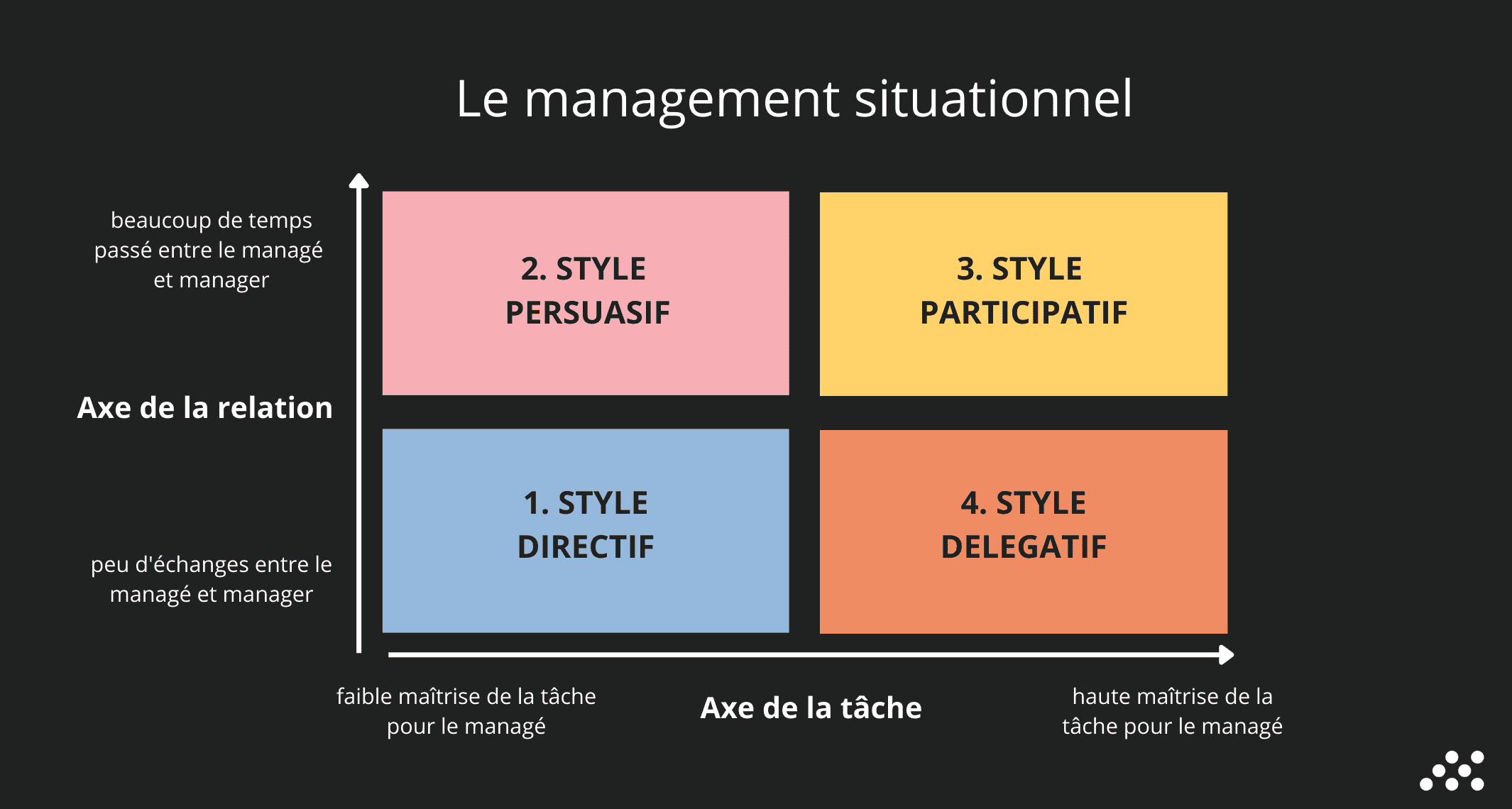
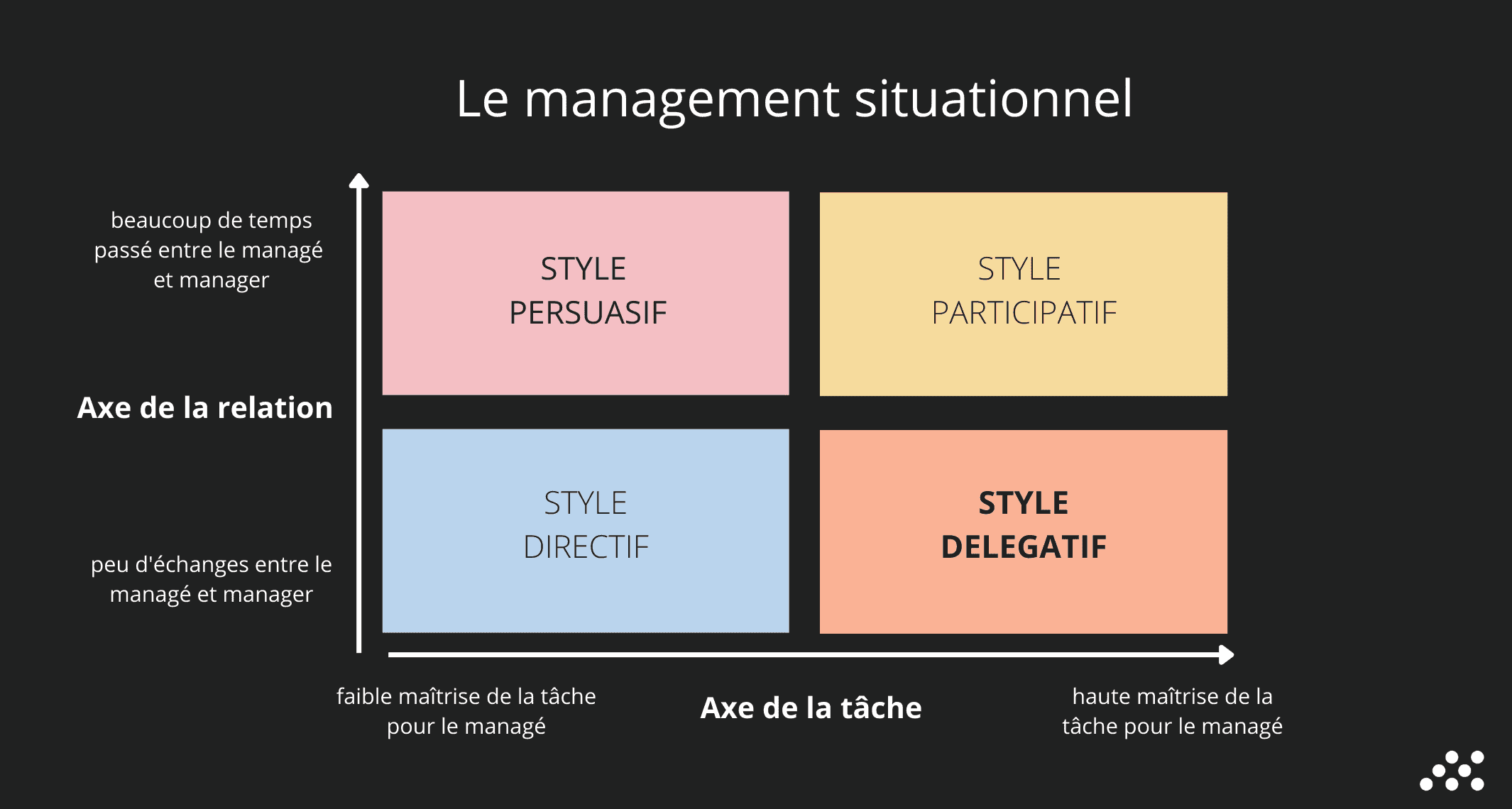
These two experts explain that depending on the situations encountered, one management style may be more appropriate than another. To determine the most effective one, they rely on two parameters: the relationship between the manager and the employee, as well as the employee’s behavior toward the task to be carried out. Based on these criteria, we get a four-quadrant matrix, each designating a very specific management style: directive, persuasive, participative, and delegative.
This tool is particularly powerful because it serves as a benchmark for both managers and managed employees. It invites everyone to question their way of managing (or the way they are managed), to analyze past and present situations, and to reflect on the best management choices going forward. Ultimately, it is a reference point for assessing one’s management.
If you want to optimize team management and strengthen your leadership, I suggest that, as you read this article, you reflect on your current management style (or the one applied to you) and on how you might evolve it depending on the situation.
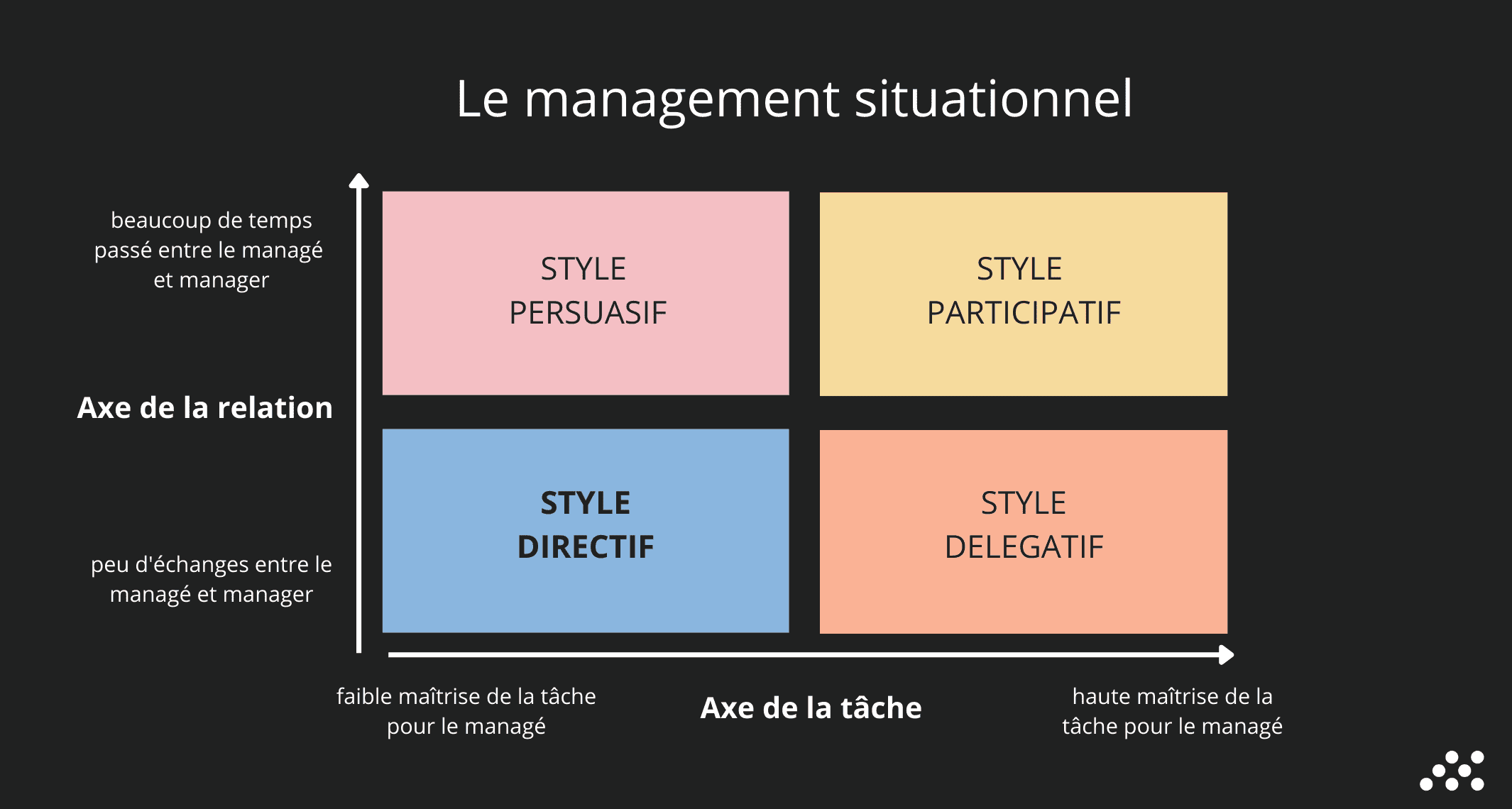
The directive style to guide and set a clear framework
For employees who are just starting a mission, role, organization, or skill, the directive style will be particularly suitable. Most often, these people are willing, motivated in their assignments, and enthusiastic, because they are in a learning mindset and eager to see the results of their actions. By giving them clear and precise instructions, the manager provides a reassuring framework to successfully carry out their assignments and minimizes the risk of them heading in the wrong direction. This style is also suitable for crisis situations, where quick decisions are needed to restore as quickly as possible what has been damaged and to limit already caused harm as much as possible.
Focused on short-term results, the directive style helps employees better understand the tasks and processes involved in their work, and also see the immediate impact of their actions. However, in the long term, they may feel bored, lose motivation, and have the sense that they are not developing their skills. It is up to the manager to change management style before this even becomes necessary. It is also up to the employee to approach the person supervising them and share their feelings, possibly using DESC, a method for giving constructive feedback (1-Describe the facts 2-Express your emotions - 3-Suggest solutions - 4-Conclude). With this communication tool, the discussion starts from concrete, indisputable facts, thereby creating a calm foundation; then it continues by sharing emotions, suggesting solutions while remaining open to the other person’s proposals, and ends by restating what has been said, recalling each person’s commitments, and putting the relationship back at the center.
The persuasive style to engage and provide meaning
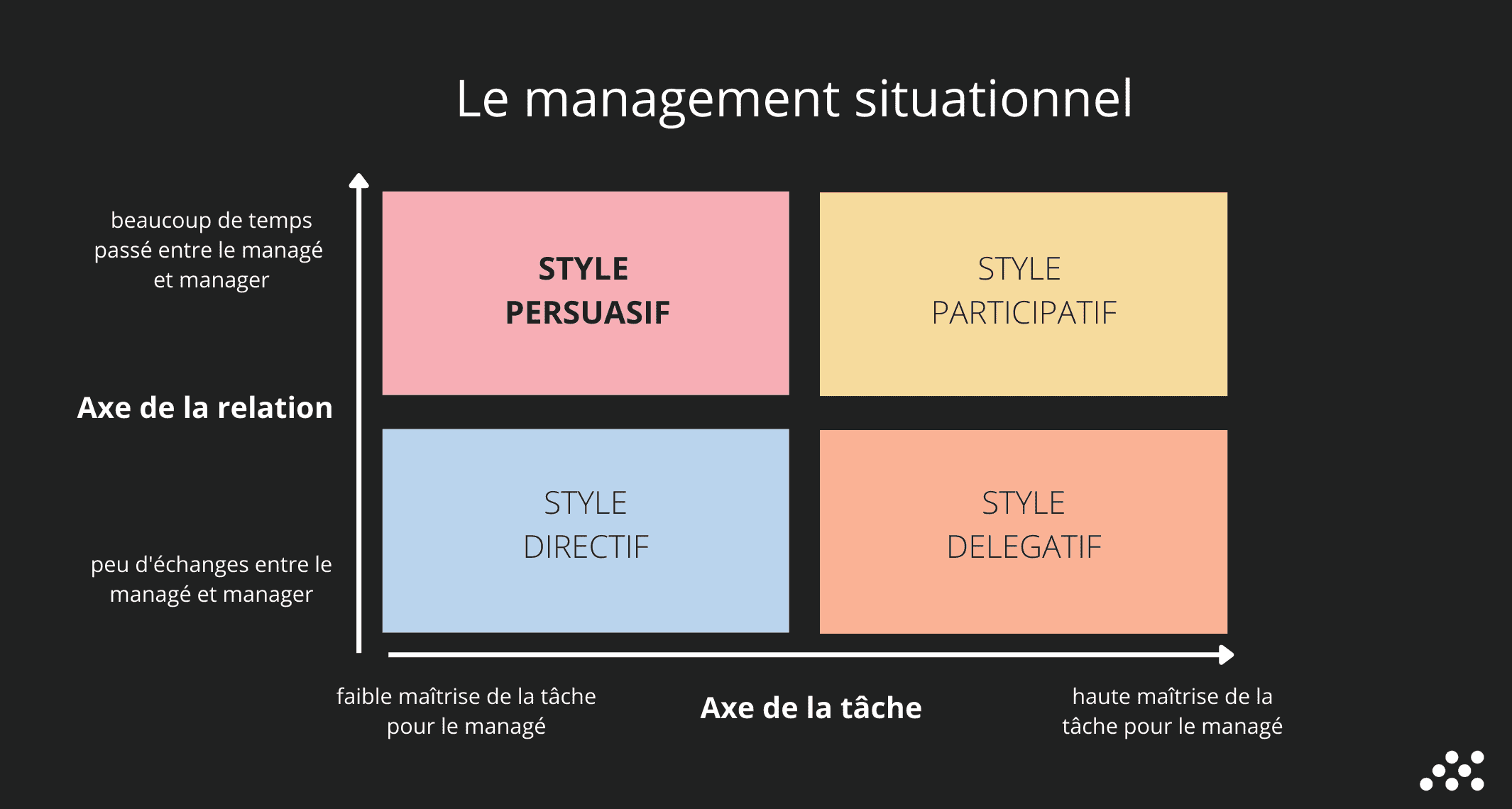
When an employee seems not yet to fully master the task and needs meaning, that is a sign that you should plan a discussion with them. During this discussion, you will clearly explain why an action must be carried out in a certain way. For example, you will give them more information about the company’s history, share the company’s values and long-term strategy, which will give meaning to the assigned mission. You, as manager, will no longer focus only on operational understanding (see the directive style) but will ensure that the strategy is understood. “If I advise you to use this argument when you contact prospects, it is because it aligns with the company’s overall vision; it is an action we carry out.”
The persuasive style has the advantage of engaging the employee even more deeply in the company culture and supporting their skills development. However, it carries risks: it can be time-consuming for both manager and employee, and it can be confused with the participative style (I discuss this further in the next paragraph). Indeed, an employee might think the final decision is theirs, whereas decision-making power always remains with the manager. To avoid any misunderstanding, it is essential for the manager to clearly state what they expect from their employee and indicate who is responsible for decisions. To remove doubt, they can also mention this Situational Leadership tool and explicitly state which style they have chosen.
The participative style to encourage idea generation and growing autonomy
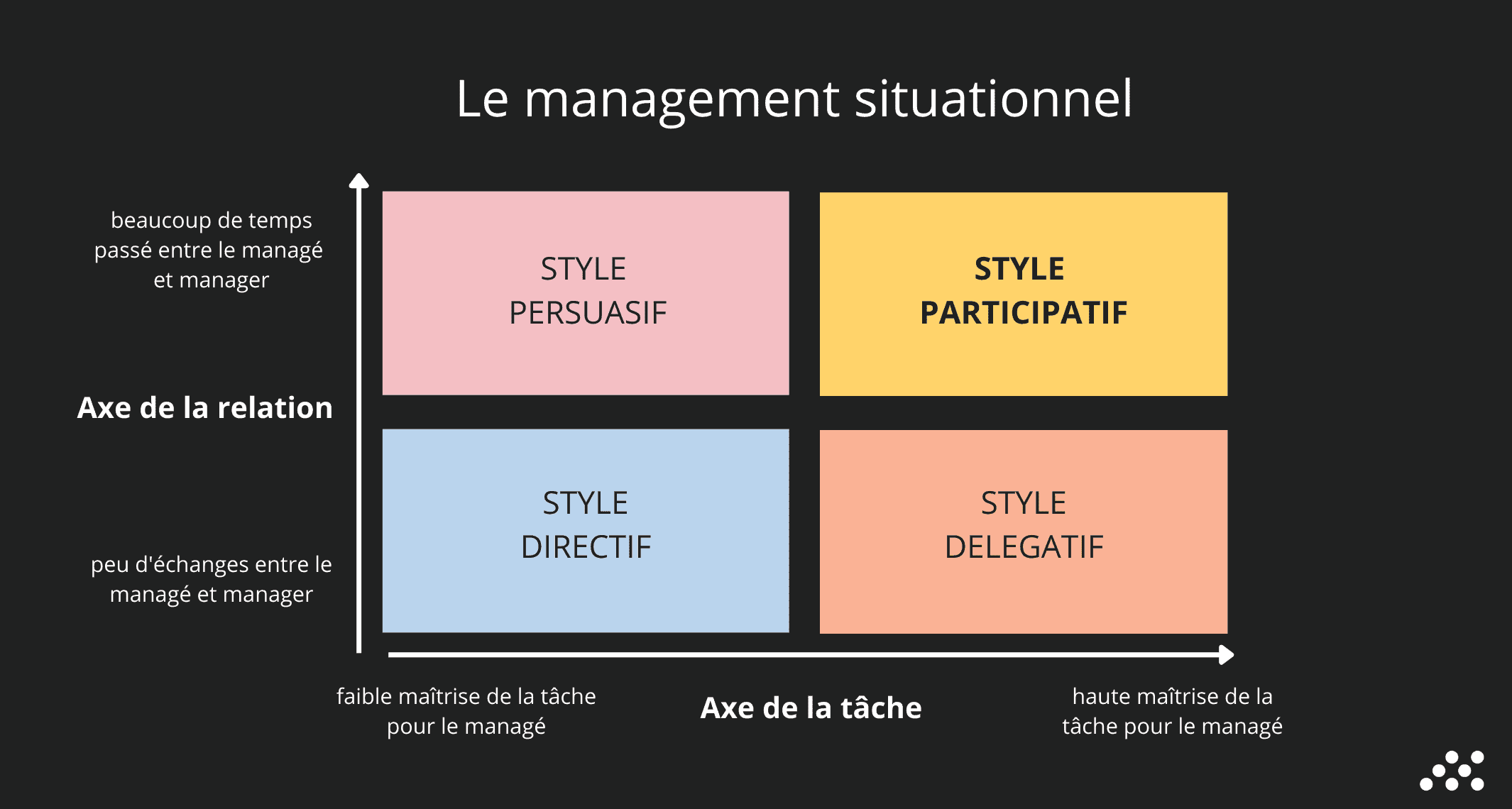
As soon as an employee gains experience and begins to understand their company’s DNA well, they will be more inclined to propose innovative and relevant actions for the company. In this case, it may be useful for their manager to adopt a participative style, during which they take time to discuss with the employee, listen, and above all take the employee’s suggestions into account. These two stakeholders would think together about the next high value-added actions, and their relationship, previously unbalanced, would evolve into a more equal one (or at least move in that direction).
This is a particularly empowering style for the employee, since they no longer simply carry out what is asked of them, but now share their opinion on the right actions to implement. This is the moment when they move beyond task execution to show initiative, demonstrate their ability to reason, and provide well-structured responses. However, participative management remains the most time-consuming style for both manager and employee. It can prove problematic when quick decisions are needed and may also affect the manager/employee relationship. It is therefore better to clarify who the decision-maker(s) is (are) in order to avoid misunderstandings, false hopes, and preserve a quality relationship.
The delegative style for full autonomy and delegated responsibility
The last style shared by Paul Hersey and Kenneth Blanchard is the delegative style, where the manager fully delegates to the employee both the strategy to adopt and the way the task is carried out. To apply it, it is essential that the employee masters the mission entrusted to them and has a clear vision of the most appropriate strategy. A new hire joining a company, but with strong experience in a field, could very well be managed with the delegative style. Why should they be confined to other management styles if they have the competence and have earned the trust of their hierarchy?
With the delegative style, the employee is fully autonomous in what they do and decides how actions are executed. For them, this is very satisfying because they are a decision-maker and know they have their superior’s trust. For their manager, it is also more comfortable, because the manager no longer bears responsibility for the mission and knows their employee has the capabilities to meet the objectives. Unlike the persuasive and participative styles, which both involve lengthy discussions between parties, the delegative style offers real time savings for both of them, perhaps even more than the directive style. But this style also has a limitation: it can lead to a lack of exchanges and information between manager and employee, ultimately giving the manager little visibility into how their colleague’s mission is progressing. To prevent this, it is important that the employee shares what they are doing with their superior so that the latter can ensure actions remain aligned with the company’s strategy.
The learning curve: from directive to delegative
When a person starts learning something new, they generally go through the four management styles in the following order: directive style, then persuasive style, then participative style, and finally delegative style.
At first, the learner does not master the task or skill required and needs to be guided by a competent person. The Situational Leadership tool will recommend applying directive management, where very precise instructions on the process to follow are provided.
Take the example of driving a car. During your first driving lessons, your instructor showed you how to use the pedals to start the car and handled almost all parallel parking maneuvers for you.
At stage 2, the learner starts to understand how to carry out a task, but is not yet able to make decisions alone. In the case of driving, this is when you begin to master starting the car, shifting gears, entering the highway, and maneuvers, but you still need supervision and advice to improve your driving practice.
In phase 3, when using the participative style, the person acquires the skills needed to carry out the task autonomously, but still needs to concentrate and think consciously. This is what happens in accompanied driving. You alone have control of the pedals, and it is up to you to make decisions.
The transition from participative style to delegative style is confirmed by passing your driving test, which gives you the right to drive alone without an instructor or accompanying person.
But ultimately, to support an individual as effectively as possible, enable them to grow professionally, carry out varied missions, and feel stimulated, it is preferable to adopt these four management styles simultaneously. Since an employee may perform several missions, the styles applied should—and even must—differ. It is important to entrust them, over the same period, with some missions in a directive style, others in a persuasive style, others in a participative style, and still others in a delegative style.
———
Did this article help you reflect on your way of managing or on the way you are managed? Have you identified actions you could take to improve? During Seven workshops, we support our participants in facing the challenges of an ever-changing professional world. We work with them to identify the most appropriate management styles in different situations. Directive, persuasive, participative, or delegative style—which is most appropriate at a given moment for carrying out a given task with a given employee? In light of the work of Paul Hersey and Kenneth Blanchard, the directive style seems aimed at those who are starting a task, have just joined a company, a new department, or are in crisis situations. Meanwhile, the persuasive style seems suitable for engaging employees who question the meaning of their work. The participative style, for its part, can prove effective when managers want to encourage the emergence of new ideas and are ready to take time to agree on the best strategies to develop. Finally, the delegative style is more suitable for experienced and autonomous employees, those who have earned their superior’s trust. Situational Leadership is in fact an evolving tool that makes it possible to analyze past and present situations in order to make appropriate management choices for the future.