>
>
>
Lean Canvas: How can you build it to gain a clear vision of your business strategy?
Lean Canvas: How can you build it to gain a clear vision of your business strategy?
Published on
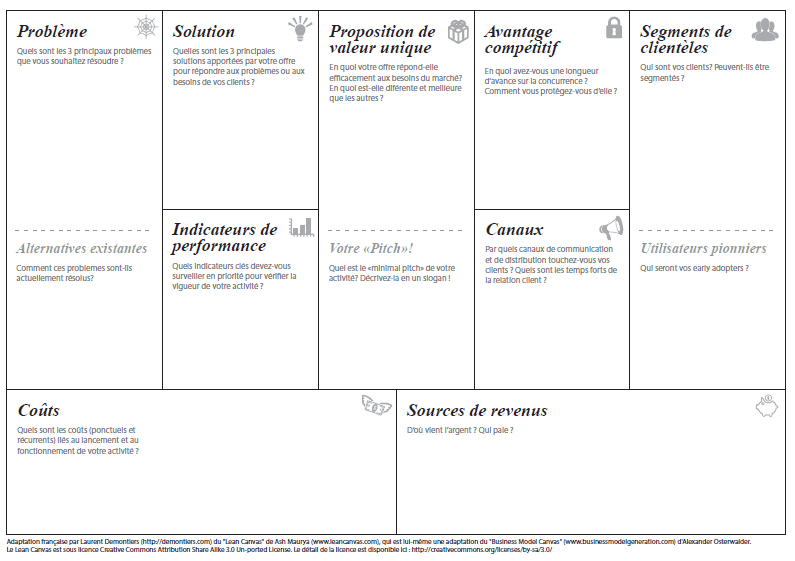
When you start your professional activity, pitch your business project, want to convince investors, or need to make important decisions, relying on a “Lean Canvas” proves to be a valuable help. This tool offers those who use it a visual, concise, and iterative representation of a company’s overall strategy and its Business Model. Because building it can bring considerable value before launching a business or while managing operations, we suggest breaking it down. Create your “Lean Canvas” step by step with us!
————
The definition of the Lean Canvas
A strategic tool to focus on what matters most...
Let’s explain what a “Lean Canvas” is. Created in 2009 by Ash Maurya, this tool presented in the form of a 9-box table (most commonly) aims to define a project. Completed on paper, with sticky notes, or online (thanks to templates), it centralizes a company’s key information (segments, user problems, proposed solutions, revenue, costs, etc.) to make it understandable.
If we translate “lean,” we get the adjective “thin.” However, this meaning evolves with the expression “Lean Canvas” to refer to the action of getting straight to the point—in other words, focusing on the essentials. This is why building this tool is encouraged when you want to know which direction your company is heading in and make decisions quickly. Thanks to this clear and concise representation, it becomes easier for companies using this tool to test their ideas and adjust them if needed.
… included in the Lean Startup method
To fully understand this tool, you should know that the “Lean Canvas” is an evolution of the different Business Model Canvases based on the core principles of the “Lean Startup” movement (which was also the subject of a book). This approach aims to help people who want to start a business and therefore launch their product or service “without waste”. Initially developed in 2008 by Eric Ries, an American entrepreneur who worked in Silicon Valley high-tech companies, the “Lean Canvas” has the advantage of being applicable to all individuals, teams, or companies wishing to introduce a new product/service to the market.
Note, however, that the “Lean Canvas” is different from a “Business Plan”. The former is based on iteration, which means there is room for adjustments. It remains flexible depending on situations encountered and is a visual summary of how the project and company operate. The difference between these two tools is mainly seen in the expected volume. Indeed, a “Business Plan” is a document that can reach around one hundred pages, detailing all the technical elements that make up the company. Whereas the “Lean Canvas” takes the form of a one-page summary table outlining the main points related to core activity, the value created by the company, and how its business model works.
Building the Lean Canvas in 9 points
To get to the heart of the matter and guide you step by step in building your “Lean Canvas,” we will study each of the 9 boxes.
Customer segments
Who do you want to address? Who are your potential users? Who are your current customers? How do they behave? What do they like?
The first step in producing these elements is collecting information about your (future) customers. The more you know about them, the better you will be able to offer them an appropriate solution (or solutions).
To fill in this box and refine your customer knowledge, several actions can be carried out. The first is research using: online articles, most frequently made queries, comments left on social media, reviews published on platforms, private messages sent, studies, and users’ comments about your competitors. This initial phase will help you better understand the people you want to reach.
Once this is completed (note that this step can last as long as you want if no specific deadline has been set), the second action is to get in direct contact with your typical users, your partners, or people whose opinion matters. Surveys then become a gold mine of information. For results that are close to reality, it is essential to gather as many opinions as possible. Beyond surveys sent through channels appropriate for your audience, conducting interviews, which will bring a more qualitative dimension, will be complementary.
Finally, the third action is immersion in the daily life of your typical users. You want to launch an app to reduce waiting time in museums—have you experienced enough waiting lines to understand all their “pain points”? Through this phase of observation, interaction, and then immersion, you will be better able to create your persona (a fictional character corresponding to your ideal customer) and start your “Lean Canvas” on solid foundations.
Problems
Thanks to the customer journey analysis phase (partly carried out in box 1, customer segments), you can focus on the problems your consumers face. What difficulties do they encounter? What do they currently do to solve them?
However, the goal is not to stop at the first difficulty mentioned, but to seek the root cause of their problem. If we take our previous example of lines at museum entrances, waiting is the initial problem, but it is not the root cause. Why don’t visitors like waiting? Because they feel they are wasting time. Why don’t they like wasting time? Because they could be doing higher value-added activities instead.
By continuing this line of thought, we might arrive at a deeper problem than loss of time—for example, a desire to learn at every moment. Here we have begun the 5 Whys method: an approach consisting of asking the question “why” five times in a row, based on the previously given answer. By repeating the process 5 times (this is the recommended number), understanding the user’s real problem becomes easier.
Solutions
Then, in the “Solutions” box, you write how you intend to respond to the problems identified earlier. In this box, you illustrate your MVP or Minimum Viable Product, a version of your product or service with which you can obtain maximum feedback with minimum effort. In other words, this is your unfinished product (or service) containing the basic elements (or priority features). Thanks to this condensed presentation of solutions, company collaborators can validate their project more quickly or modify it, and consequently save time.
Unique value proposition
When your first three boxes are filled in, you reach the stage of appealing to your customer segments. This is the moment when you try to convince your users that your solutions perfectly meet their expectations. You therefore build your unique value proposition. It must be differentiating and catchy, so that consumers notice its unique character.
It can take the form of slogans, titles, or paragraphs, each including strong arguments and vocabulary similar to that used by customers. To give you an example, McDonald's unique value proposition could be the speed of service provided.
Channels
To deliver your unique value proposition, it is essential to use the right channels. When you studied your customer segment, perhaps you noticed communication channels used more than others? Is it relevant for you to launch on TikTok if none of your users are there? Probably not. In fact, it is all the touchpoints with your users (before, during, and after purchase) that will allow you to identify the channels through which to communicate on behalf of your company.
By channels, we also mean “distribution channels,” i.e., external partners that allow you to deliver your solution or product. This can include supermarkets, market merchants, etc. Keep in mind that channels play a key role, because it is through these levers that your potential users discover you, develop interest in your company and your unique value proposition, and then decide to get in touch with you.
Competitive advantages
To break into the market you are targeting, having one (or several) competitive advantage(s) is essential to capture the attention of your customer segments. What do you do that your competitors do not? Can they copy you? If you have something impossible to copy, you will become unique in the eyes of your consumers.
To stay within the cultural theme, if a museum is the only one to exhibit paintings by a certain renowned painter, the place will spark curiosity. Take the example of the Louvre, which attracts in large part because it exhibits the Mona Lisa, a unique painting in the world.
For certain activities, there are intrinsic competitive advantages. A barrier to entry means that market conditions (in a given sector) limit or make impossible the entry of new firms (competitors). A few examples: unique or patented technical expertise (cutting-edge technologies, nuclear power plants); an astronomical initial investment (rockets, football clubs: capital requirements and economies of scale); government regulations (such as the fact that a Casino must be built near a thermal spring according to a law dating back to Napoleon); access to a distribution chain (if there is only one single supplier already working exclusively with another existing player). There are others, and these barriers are all competitive advantages if you manage to overcome them!
Performance indicators
The only way to know whether your actions are relevant is to set indicators beforehand, which will give you clues about the performance of your actions. You want to send a newsletter next spring. How many people clicking on the email do you expect? You want to launch a new product. From how many products sold would you be satisfied? You care about customer satisfaction. From what NPS (Net Promoter Score) would you consider your mission successful?
The point is not to invent performance indicators, nor to set goals that are too easy or too difficult to reach, but to rely on studies, observations, and calculations to set SMART indicators. To briefly recall what this means, the acronym helps remember 5 key indicators: S for Specific, M for Measurable, A for Achievable, R for Realistic, and T for Time-bound. An example of an indicator based on the SMART method could be: achieve an average of 3,000 adult visitors per day by May 2022.
Revenue streams
A necessary category to assess your project’s long-term viability is revenue. What are your sources of income? Are they one-off or recurring? Are prices fixed or do they vary according to specific conditions? Is there seasonality in revenue? By creating a projected budget table in which revenue sources and costs are detailed, the collaborator will observe the balance between revenue and costs—or perhaps a potential deficit. Based on these observations, they can determine the year from which revenue will exceed expenses.
Costs
Finally, let’s end with costs: a box that cannot be avoided. Do you pay rent every month? Do you have employees? What are your fixed and variable expenses? By making a list of your costs, you could agree on plan Bs to avoid increasing your budget. You want to be present at a cultural fair—why not reuse last year’s promotional banners? By showing budget creativity, you will minimize costs.
These last two boxes, Revenue streams and Costs, must be completed with sufficient precision without getting into complex calculations. They will allow you to quickly calculate your PNL (Profit & Losts), at least in broad terms, and to project yourself toward an initial break-even point (the date when your activity will generate more profit than it costs).
————
Therefore, if you have a new product or service to make known, do not hesitate to start building your “Lean Canvas”! This tool will allow you to lay the foundations of your strategy and not forget the essentials. Then, beyond its help when launching a new project, it helps verify that you are keeping the direction you defined. It is thus a document you can review after your project is launched on the market to gradually readjust your strategy. Know that we, the Seven team, can support you in building this document through personalized training.