Best teaching practices to promote learning
Published on
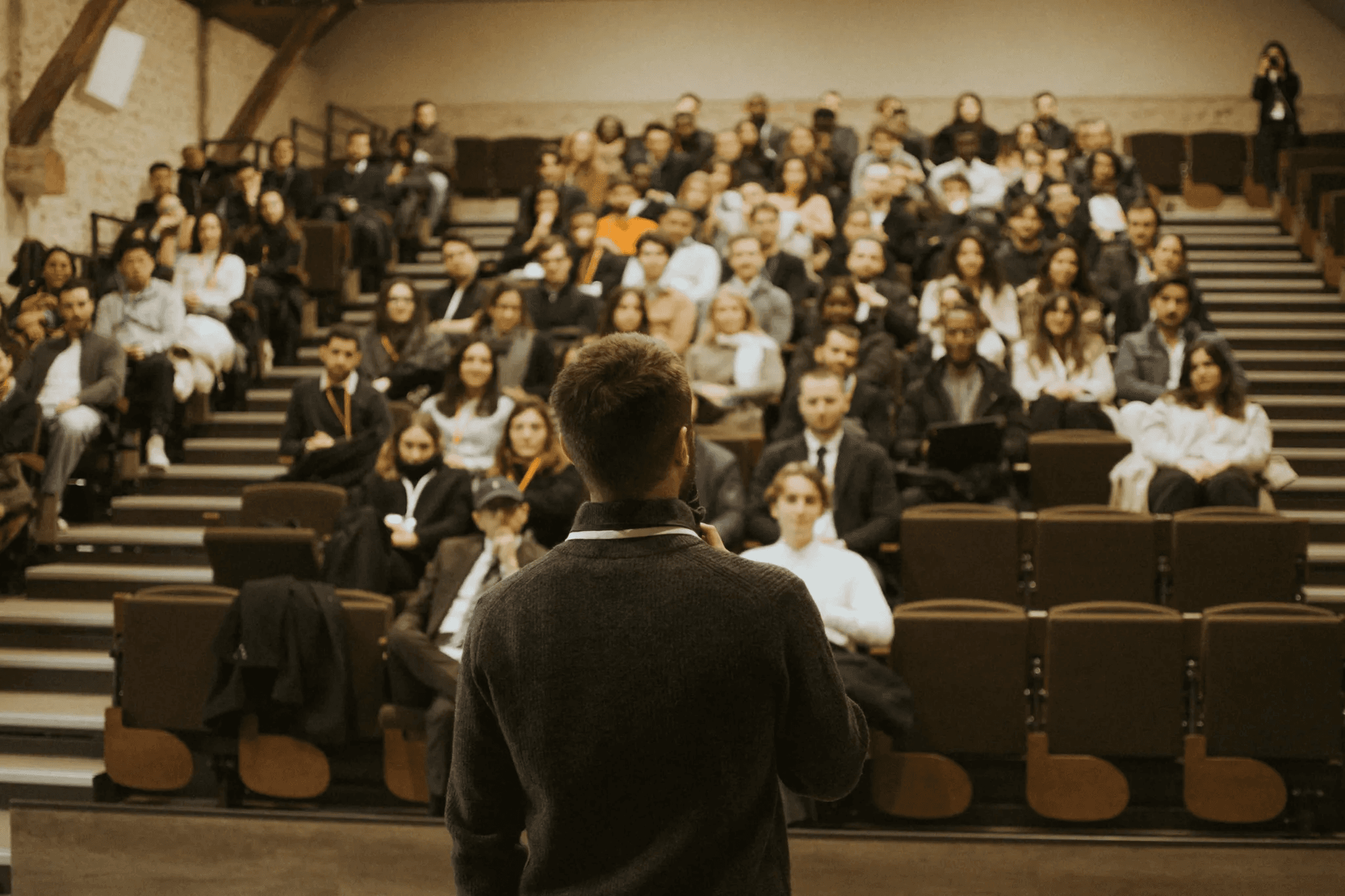
At Seven, there is one mission that matters a great deal to us: that participants leave training sessions having grown. When we select our facilitators, in addition to the high level of expertise we expect from them, we make sure to raise their awareness of the personal and professional development of participants. The goal: that all participants—not just the majority—understand the concepts studied. We are proud to have a community of facilitators (which is growing more and more, by the way) who are motivated, eager to evolve the way content is delivered, and committed to adopting the best teaching practices. Through our experience, constructive feedback from former participants, and discussions with our partners, we have identified three best practices (although there are more) that every facilitator can apply, as well as anyone who needs to share content with an audience. We share them with you in this article.
———
Fostering participants’ autonomy
When we pass knowledge on to others and want to apply effective teaching practices, there is one condition that first seems essential to us: offering freedom to the learner. When our facilitators, whom we internally call “Seveners,” ask participants about a topic, they most often choose not to give them the answer right away. By having them search for answers on their own, they remember better. And even if they have not found anything convincing, hearing the opinions of their peers and of their facilitator intrigues them. Once participants’ suggestions have been collected, the facilitator provides additional information and adds corrections if needed. The topic put on the table sometimes has neither a right nor a wrong answer, but serves only to stimulate group interaction. In this context, the facilitator does not take sides and ensures that participants provide arguments, listen to one another, are able to defend their ideas, and convince their peers.
This topic of freedom led us to ask which countries most encourage autonomy in education. We found that the United States is one of them, compared with France, where it is used a little less. If we take homework as an example, we can observe a clear difference in practice. While assignments given to French students are mainly used to verify that knowledge has been acquired, American pedagogy rather encourages students to discover for themselves a concept that has been little or not at all studied in class. In this regard, Anis Jarboui, a professor at the University of Sfax (in Tunisia) and at EM Normandie (in France), who is therefore fortunate enough to know both French and Tunisian pedagogy well, pointed out to us the similarity between the American educational system and the Tunisian one. Indeed, in Sfax, students are invited to develop their personal reflection and supplement their classes with additional research.
Encouraging them to try
A second teaching best practice that seems essential to us: encouraging people to try. On the one hand, we can speak of trying in the context of Seven training sessions, when participants apply the tools they have received in their daily lives during or after workshops, observe the impact of the training on their lives, and make optimizations based on their observations. We believe there is no better way to learn than by doing. Our motto: “learning by doing.”
But to encourage trying, you still need to create favorable conditions so participants feel comfortable and confident! Our Seveners and we at Seven have a role to play. So, we make sure that in each of our training sessions, there are inspiring examples showing that trying leads to positive results. We therefore make it a point of honor that each workshop includes hands-on application time, during which participants apply the shared advice through fictional or real cases. They then rely on the facilitator and their colleagues for guidance and to feel more at ease before launching out on their own.
On the other hand, we can also speak of trying when participants share, during training (or class), an ongoing reflection or an idea even if they are not sure about what they are saying. Whether at school or in business, our facilitators place the greatest value on discussion time, sharing exercise outcomes with all participants, and debates opened to the whole group, and they reassure the group that they are not expecting correct answers but opinions. All these actions build a climate conducive to participation. Seven training sessions thus become the opposite of classes where people do not dare participate for fear of being wrong or making a fool of themselves. They move away from lecture-style classes, during which “students” sit down, listen, take notes, raise their hand to ask for the slide deck, and leave without asking questions. In our view, valuing a culture of failure within training is essential. For participation to be free and relaxed, it is important to establish a reassuring atmosphere from the start. One contributing factor is the ice breaker. During this short 10- to 15-minute workshop, participants are invited to perform a simple and engaging action whose purpose is linked to the overall theme of the session.
Making every stakeholder a content passer
When we describe Seven, we sometimes refer to ourselves as “content passers,” but on closer look, our participants are too! Indeed, they exchange advice with one another, share information, and raise points worth dwelling on. That is the beauty of training! And what is even more interesting is that each participant can bring something unique. Anis Jarboui, a professor in France and Tunisia, told us that depending on their country of residence, his students had deeper expertise in one area or another. By observing student profiles, he noted that Tunisian students had, in his view, a higher level in technical subjects such as mathematics, statistics, or probability; and conversely, that French students were better at developing critical thinking, synthesizing content, and speaking in public.
Facilitators learn, enrich themselves, and grow thanks to their exchanges with participants, regardless of their expertise, years of experience, or degrees. Many of them point this out to us, in fact. Indeed, many tell us how happy they are to strengthen their ability to adapt and to confront the limits of theories thanks to participants’ remarks. One of the facilitator’s goals is even to show participants that they themselves are contributors of content, and that their different profiles are a strength for arriving at innovative solutions. Alternating pair, group, and whole-class exercises therefore allows participants to experience peer learning and stimulate their interpersonal intelligence. In addition, facilitators ensure that participants’ intrapersonal intelligence is awakened through moments of introspection and sharing of their own experiences.
Finally, what matters most to us is that participants associate learning with pleasure. Instead of conveying theory in a traditional way (“I share what I know and then I leave”), we have participants experience a specific situation, sometimes invite them to hands-on activities (they may end up cutting or drawing) or writing activities, support them so they can project themselves into a given situation, have them solve riddles, etc. In other words, we work on the way we deliver content so it is captivating and the training moment is memorable!
———
While there are several teaching best practices, three seem essential to us for the person who is “learning,” although we distance ourselves from this term, because it implies a vertical relationship with the facilitator on one side and participants on the other.
The first best practice for the trainer: foster the autonomy of the people in the group. By encouraging everyone to conduct research, alone or together, while waiting before sharing one’s own point of view (so as not to influence), participants will look for answers by themselves and remember better.
The second best practice: create, from the start, a climate of trust that allows everyone to let go. There is no right answer that must be given at all costs. The most important thing is to try, even if we are not sure, and to see what happens in order to derive improvements. This atmosphere of serenity can be developed through a subtly chosen ice breaker in which each participant is given a voice, but also through special attention to kindness, respect, and listening, and finally through a reminder of the importance of trying. Nothing ventured, nothing gained, right?
The third best practice: develop a horizontal relationship where the facilitator is both the one who knows and the learner; and the participant is both the one who knows and the learner. In this way, an equal relationship is created among all the actors in the training, who all become “content passers” and passionate learners. You will then see that the desire to learn is contagious!
Finally, if you would like to go further, you can always listen to episode 41 of the Learning By Doing podcast, in which Thomas Fraudet, founder of Seven, reveals part of the Seven method.