Moving Motivators: How to identify and boost your motivations?
Published on
Do you remember times when you were eager to see someone again? The prospect of knowing that you were going to reconnect with someone you like and trust was especially pleasant! Maybe you have even felt this sensation before meeting coworkers again. Knowing that we are going to spend our workday alongside people we care about can be a real source of motivation. The peak is reached when we know we can rely on them, both in moments of joy and in hardship, when their kindness is tangible, and when we feel free to share our thoughts and opinions with them. Let us note, however, that there is a distinction between affection and trust, because while we may like certain colleagues, that does not necessarily mean we place complete trust in them. Moreover, among the colleagues we do trust, our closeness with each of them and the confidences we share vary considerably from one person to another. More than simply feeling affection for someone, it is the development of mutual trust with our colleagues that brings us concrete benefits at work. So how can we identify our allies among our colleagues? How do we know whom to trust? How do we maintain and strengthen our relationship with them? This article explores the importance of surrounding yourself with trusted collaborators and relying on them to ensure professional success.
——
Moving Motivators: what are they and how do they work?
A tool to understand (and help others understand) your deep motivations
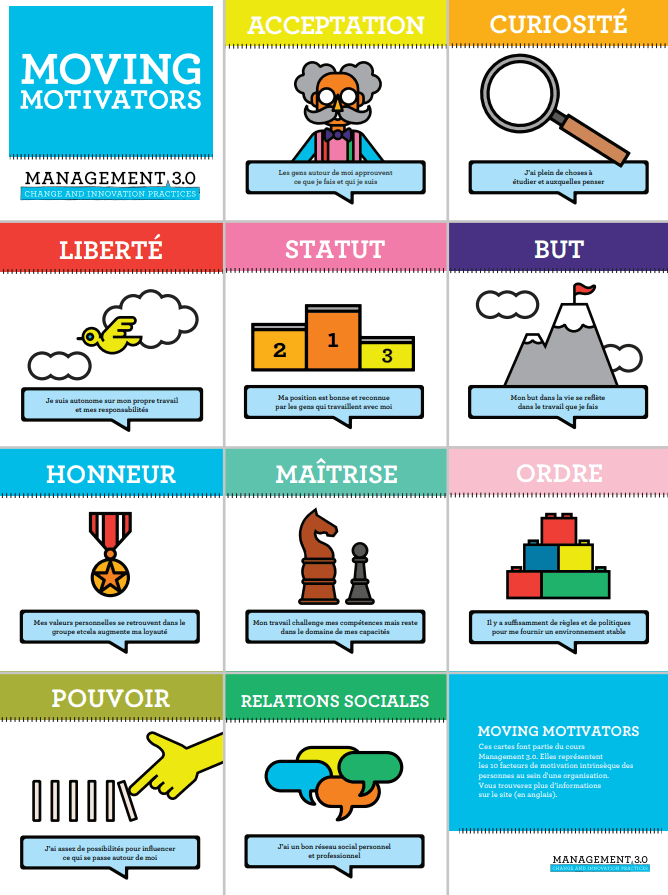
Jurgen Appelo, an agile management specialist and author of a book titled “Management 3.0” (published in 2010), theorized “Moving Motivators.” This concept is based on identifying 10 major intrinsic motivations, and thus contrasts with extrinsic motivations, which provide satisfaction for external reasons such as rewards (financial, material, etc.), social pressure, or approval from a third party. Intrinsic motivations influence individuals’ behaviors in both professional and personal spheres. With Moving Motivators, the 10 intrinsic motivations are represented as cards, each symbolizing a specific motivation: acceptance, curiosity, freedom, status, purpose, honor, mastery, order, power, and social relationships.
Used in a professional setting, “Moving Motivators” facilitate communication within work teams, enabling managers and employees to better understand each other’s motivations. This tool is valuable for putting into words what guides us daily and observing alignment (or lack of it) between our expectations and our actions. Finally, it serves as a reference point for communicating information about ourselves to others. This is the so-called “public” area that expands, if we rely on the Johari window. “I share information about myself that was previously unknown to others.”
An ally for initiating exchanges with colleagues
Users of “Moving Motivators” are led to rank their motivations in order of importance according to themselves. Only the person concerned can truly say what boosts them, even if it does not come naturally. This ranking helps workers better understand the reasons behind their actions and thoughts, but also share them with colleagues, fostering better mutual understanding within the team. By analyzing how each of the 10 motivations is stimulated in specific contexts, individuals can identify situations where certain motivations are particularly engaged and moments when they are less so. Then, they can—and are strongly encouraged to—share their feelings precisely with their team.
In practice, applying “Moving Motivators” happens in two stages. First, the user arranges their 10 motivations on a horizontal line according to the impact each has on them. Motivations placed on the left have a strong impact on the person. In the second phase, the user thinks of a specific situation and evaluates how each motivation is stimulated. If a motivation is highly engaged, the card is raised vertically; if it is only slightly engaged, the card is lowered. This analysis makes it possible to visualize potential gaps between one’s motivations and completed actions, and therefore trigger awareness among colleagues. Imbalances can then lead to adjustment proposals from the person concerned or their collaborators.
The 10 intrinsic motivations: understanding what drives us
Each intrinsic motivation is unique. There is no “good” or “bad” motivation. Here is a presentation of the 10 motivations identified by Jurgen Appelo, which we have chosen to divide into two categories: those that depend on others and those that depend on oneself.
5 sources of motivation that come from others
For some people, their professional and personal circle is their fuel. They need to receive feedback, rely on clear instructions, and be supported to feel energized. Among their motivations that come from others, we find: Acceptance, Social Relationships, Status, Power, and Order.
ACCEPTANCE: People around me approve of what I do and who I am.
People who place acceptance among their main motivations feel a deep need to see their efforts recognized by those around them, whether managers, colleagues, clients, or service providers. They actively seek feedback and are happy when they receive positive comments. Validation of their work and their inclusion within a group contribute to their satisfaction and engagement at work. They feel motivated and valued when their contributions are not only noticed, but also appreciated and validated by those around them.
Take a project manager in a media agency who invests effort both in ensuring flawless execution of each campaign and in client satisfaction. This project manager will be especially motivated when their manager publicly congratulates them during team meetings for excellent results and dedication. They will also be receptive to positive feedback from colleagues and clients, reinforcing their joy in being considered a valuable team member.
SOCIAL RELATIONSHIPS: I have a good personal and professional social network.
For some people, social relationships are a primary motivation. Indeed, for them, interactions with others are essential, including at work. They thrive particularly in a friendly atmosphere and are interested in knowing their colleagues beyond the professional sphere. They appreciate human contact and meeting new people.
Imagine an employee whose main motivation is based on social relationships. If they are isolated or have few interactions with others during workdays, they may feel loneliness and demotivation. For them, regular social interaction will be essential to well-being and happiness at work.
STATUS: My position is good and recognized by the people who work with me.
Placing “status” among one’s main motivations means appreciating public praise and visible recognition of achievements. This can take the form of promotions, titles, perks, bonuses, and any other form of official recognition.
For example, someone who obtained the title “Senior Engineer” might feel great pride in seeing their professional growth publicly recognized. Likewise, an employee who becomes a member of the executive committee (CoDir) might see their new position as a symbol of success and recognition of their skills and dedication.
POWER: I have enough opportunities to influence what happens around me.
People who place power among their main motivations want to make important decisions and appreciate having their opinions taken into account. They care about having an impact on their surroundings, seeing their ideas implemented, and having significant influence within their company. In short, they like to be heard and followed.
An employee who shares their viewpoint on a strategic company choice and sees their proposal accepted will feel great satisfaction if power is one of their main motivations. On the other hand, someone who gives little importance to their influence in the professional environment will not be affected in the same way.
Another example: a manager who addresses their teams to raise awareness about a necessary change will be happy if they observe behavior changes among colleagues following the intervention. They may think: “I had influence on them.”
ORDER: There are enough rules and policies to provide me with a stable environment.
People who consider order among their main motivations seek work environments where processes are clear and well-defined. They prefer companies where deadlines are known in advance and missions clearly delimited. They rely on rules, make sure to follow them, and ensure others respect them too. When they know their responsibilities and those of their peers, they feel in their element, like a fish in water!
A person for whom order is one of their top three motivations might feel deep discomfort in the face of many unexpected events. Such uncertainties could harm their effectiveness and ultimately their well-being at work.
5 sources of motivation that come from oneself
Here are now Jurgen Appelo’s 5 intrinsic motivations that come from within: Curiosity, Mastery, Freedom, Purpose, and Honor. People concerned by these motivations tend to be self-motivated, fairly autonomous, and independent. They have what can be called “high” energy and often carry the profile of “positive leaders” in the eyes of their colleagues.
CURIOSITY: I have lots of things to study and think about.
People who place curiosity at the top of their motivations seek to go beyond the missions assigned to them. For example, they will take the initiative to read articles on professional topics or listen to podcasts to stay up to date in their sector.
The unknown does not scare them. They are in constant pursuit of novelty and seek renewal, exploring creative and innovative processes. They are open to all opportunities that allow them to broaden their knowledge and go further.
MASTERY: My work challenges my skills but remains within my abilities.
For those who place mastery as a primary motivation, they very often want to become experts in their field. They are ready to do whatever it takes to progress and develop specific skills. Clear-sighted, they have a precise idea of the topics to master and the skills to acquire in order to keep growing.
They actively seek training opportunities to strengthen their skills and accept assignments that match their area of expertise while being complex enough to push them beyond themselves. They thrive when entrusted with tasks that are achievable yet stimulating. Conversely, tasks that are too simple for their level may frustrate them due to lack of intellectual stimulation.
FREEDOM: I am autonomous in my own work and responsibilities.
Moreover, people for whom freedom is crucial will seek flexibility in their working hours, preferring to work when they wish. Most commonly, they want great autonomy in carrying out their missions and appreciate the possibility of working from anywhere. For them, work-life balance is essential to their well-being.
This motivation is particularly high among writers or freelancers, who can work from any place (at home, in a café, while traveling, etc.) and at schedules that suit them (at night, early morning, late evening, etc.). For them, the ability to organize time and workplace as they see fit is crucial to their fulfillment and productivity.
PURPOSE: My purpose in life is reflected in the work I do.
People who place purpose among their main motivations need precise goals to accomplish their missions. Above all, they want their actions to have a significant impact on society.
A real estate agent whose objective is to find the ideal property for clients will be particularly engaged and happy if they see amazement in their clients’ eyes. Likewise, a French teacher whose purpose is to see students improve in writing will feel fulfilled if they observe major progress in one student and that student now makes only a handful of mistakes.
HONOR: My personal values are found in the group, and this increases my loyalty.
Individuals for whom honor holds a central place need their personal values to align with their company’s philosophy. They seek alignment between their professional missions and personal convictions, and may refuse projects if they do not match their principles.
A rigorous person passionate about pastry will feel strongly motivated working with a demanding pastry chef who cares about detail. Conversely, if their supervisor is replaced by a chef who favors quantity over quality, this misalignment between values and professional environment could make them lose the meaning of their work, trigger sadness, or even push them to resign.
What behavior should you adopt based on your colleagues’ motivations?
If your collaborators have shared the ranking of their intrinsic motivations with you through the “Moving Motivators” tool, as well as how these were stimulated in each of their tasks, use this to react appropriately.
Pay particular attention to their top three motivations and ask yourself whether, at your level, you could stimulate them more. If there is a gap between the motivations that matter most to them and how the situations they face do or do not stimulate these motivations, there is a risk your teammates will lose motivation and productivity, which “in fine” could harm your company. To avoid this, take action!
If the main motivation is acceptance
For some people, their professional and personal circle is their fuel. They need feedback, clear instructions, and support to feel energized. Among their motivations that come from others, we find: Acceptance, Social Relationships, Status, Power, and Order.
Share constructive feedback
Take the time to give positive and constructive feedback in private, highlighting your colleague’s strengths and areas for improvement. If this is not yet part of your habits, do it gradually. Follow the Kaizen method, or the method of small steps. First one feedback per week, then every two days, and so on.
If the main motivation is social relationships
Organize team activities to encourage interaction
Plan informal moments with your teams or work to ensure team events actually happen. Group breakfasts, lunches out, team-building workshops, afterworks where everyone can join the group on a voluntary basis—these will definitely appeal to them.
Encourage open and honest communication
Set up weekly meetings where team members can freely discuss their ideas and concerns, thus creating an environment of trust.
If the main motivation is status
Publicly recognize your colleagues’ achievements
During a team check-in or in an internally distributed newsletter, congratulate the employee for their accomplishments and outstanding contributions.
Offer titles or distinctions based on accomplishments
When a project is successfully completed, why not grant the employee concerned an honorary title or reward? No specific resources or special budget are needed to value their efforts. You can absolutely assign titles such as “employee of the month,” invite them to prestigious events—public signs that you value them.
If the main motivation is power
Involve them in decision-making
Invite the collaborator to take part in strategic meetings and ask for their opinion on important decisions. They will feel flattered. You will see they won’t let this opportunity pass.
Recognize and value their contributions
During team meetings, highlight their successes (there are certainly some) and publicly acknowledge their role in the project’s achievements.
If the main motivation is order
Provide clear guidelines
For a new project, the manager or the person with the most expertise can create a detailed guide of the steps to follow, with clear deadlines and defined responsibilities for each team member.
If the main motivation is curiosity
Encourage initiatives
What if you suggested this colleague work on an innovative project that is out of the ordinary and requires research and exploration?
Offer stimulating projects
What if you proposed new, unprecedented tasks to this colleague that would allow them to acquire new skills?
If your colleague’s main motivation is mastery
Entrust them with missions that will help them grow
Assign increasingly complex tasks that require using and developing new skills.
Offer opportunities for training
Enroll them in training programs, seminars, or online courses where they can deepen knowledge in specific areas. You can also provide resources so they can further develop their existing skills.
If the main motivation is freedom
Give them autonomy in managing tasks and projects
If possible, let your collaborator choose (or at least suggest) their own work schedule (if that matters to them) and let them decide which methods to use to reach their goals. A relationship of trust should first be in place in order to offer this freedom.
Be open to their initiatives
Encourage the employee to propose ideas for improving existing processes and give them the green light to test their initiatives.
If the main motivation is purpose
Communicate your company’s reason for being
During a quarterly meeting, you could take time to recall the company’s history, the mission you work toward daily, and your long-term objectives. By better understanding your past, present, and future choices, your collaborators may find much more meaning in what they do, positively impacting their effectiveness. You could say: “Our objective is to reduce carbon emissions by 50% by 2030. Thanks to the project you are currently working on, we are getting significantly closer to this objective. Thank you!”
If the main motivation is honor
Respect and value their principles
One of your employees places great importance on ethics and refuses to work with questionable suppliers. Support this courageous decision and explain during a team check-in how their position strengthened their credibility and reinforced the company’s values.
Understanding and stimulating personal motivations are essential for improving individual performance and team dynamics. The “Moving Motivators” method starts with introspection, helping each person know themselves better and allowing them to reveal their true motivations to others.
This tool offers a structured framework for ranking and analyzing intrinsic motivations, facilitating more open and transparent communication among team members. By identifying these motivations, managers and employees can adjust their behaviors and work environments to better meet individual needs.
Ultimately, this method goes beyond a simple personal development tool. It invites each individual to deeply reflect on what drives them to act and what fosters their fulfillment. It is important to keep this practice alive and regularly question your motivations. Today, honor, curiosity, and freedom may be in your top 3, but nothing guarantees they will still be there in 10 years. Your future experiences, the challenges you face, the people you meet, and the life changes you go through may modify your “Moving Motivators.” You evolve, and your personal motivations do too!