Nudge Marketing: the power to guide our actions with our consent
Published on
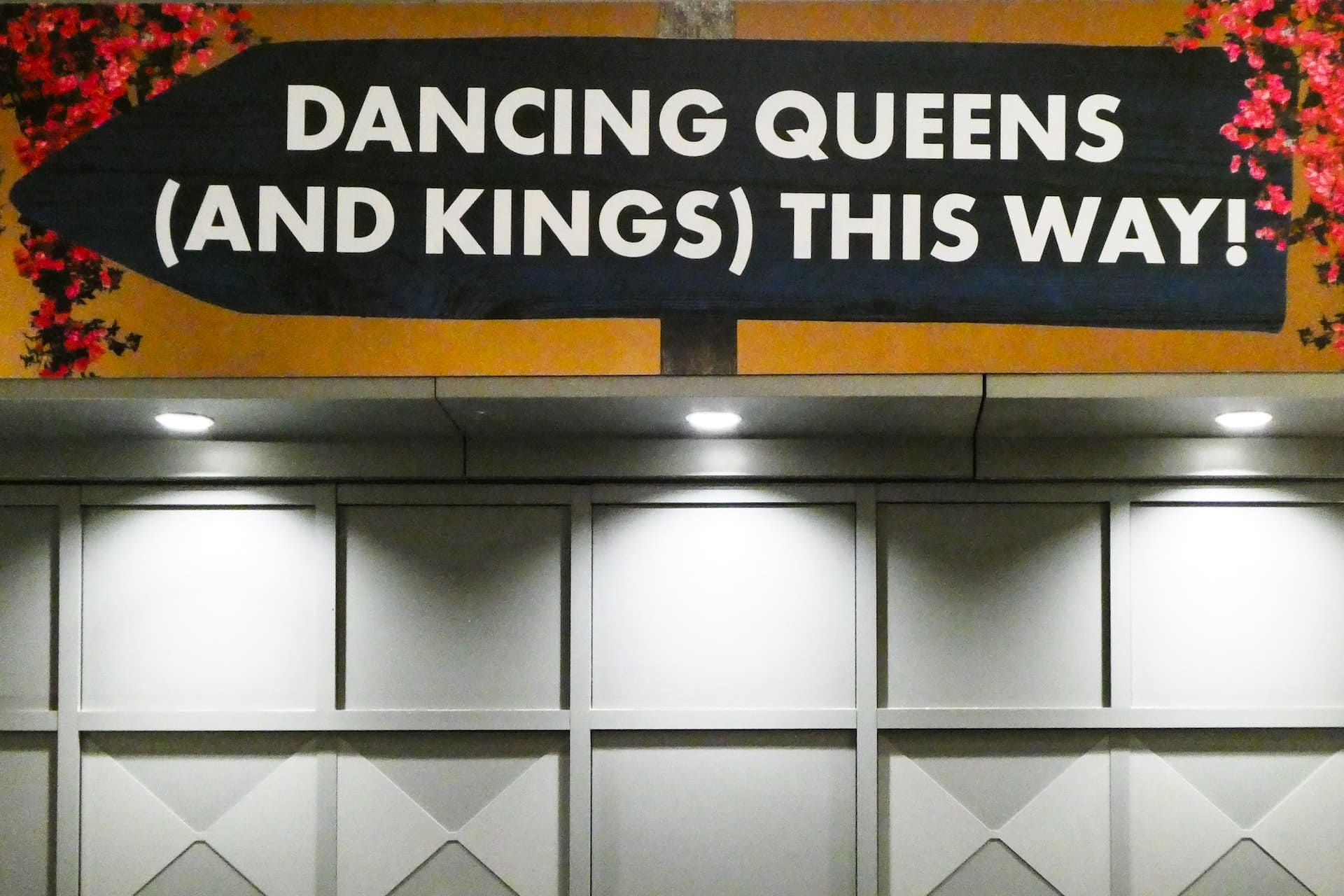
“You come across a sign humorously indicating that a dance floor is to your left. You are then struck by the originality of this signage and choose to follow the indicated direction. The objective of this sign (namely, that you turn left) worked. Without realizing it, you experienced a “Nudge Marketing” approach.
To get an audience to buy into a message, there are two possibilities: convince them or persuade them. The first uses logical arguments (facts, evidence, dates, figures, studies, references, etc.), while the second relies on what individuals feel (laughter, surprise, fear, joy, sadness, etc.). It is on emotions, therefore on persuasion, that “Nudge Marketing” is based: a new emerging discipline, also called “Incentive Marketing.” It focuses on consumer behavior and the mechanisms that drive people to act.
In addition to persuading, “Nudge” approaches include a subtlety: encouraging the consumer to make the most virtuous choice. An example of “Nudge” that we have all encountered in our daily lives is redesigned trash bins. Through the symbols chosen, the colors used, and the messages written, it is difficult not to throw your waste into the intended bins. We are in fact encouraged to dispose of our litter in the right place and ultimately carry out a responsible action. Because “Nudge” approaches have the power to guide our actions—and to do so with our consent—we propose taking a closer look at this still little-known topic, which is nevertheless widely present around us.
———
Why initiate a Nudge approach?
Removing doubt and making decision-making easier
Initiating a “Nudge” approach means making decision-making easier for consumers, eliminating their possible questions, giving them a “nudge” (which is in fact the translation of “nudge”) so that carrying out an action feels natural and becomes obvious.
Offering a gentle, non-coercive method
If Richard Thaler and Cass Sunstein were the first to use the term “Nudge marketing” in 2008 in their book “Nudge: Improving Decisions About Health, Wealth, and Happiness,” this approach was launched much earlier in the 1970s by economist and psychologist Daniel Kahneman. Even today, this approach is still analyzed and used.
Its advantage is that it is not restrictive for users. Indeed, they lose nothing by choosing to adopt the desired behavior. The range of possibilities remains open. They are free to take—or not take—the options recommended to them. On the other hand, they gain nothing by following the action encouraged by the “Nudge” approach since there is no reward at stake. The only one that exists is the satisfaction of having carried out a good action for oneself and others.
Making the consumer a contributor to positive change
Many brands promise to enable an eco-responsible action. Take Christmas tree bags sold after the holiday season: they make wrapping your tree easier and transporting this greenery more practical. In addition, they are compostable with green waste, and part of the proceeds is donated to Handicap International. Buying one ultimately means carrying out a civic and ecological action.
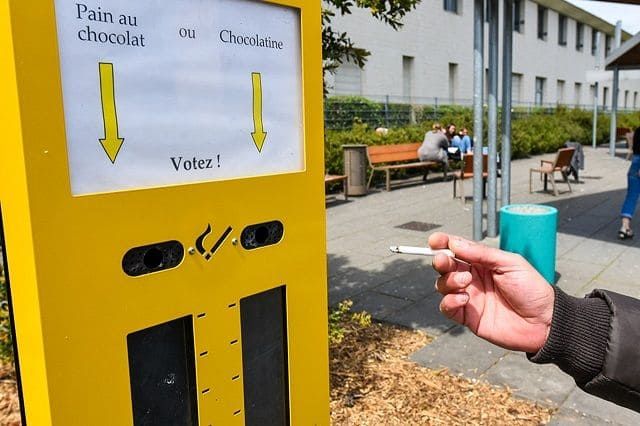
Another example of incentive marketing: playful ashtrays placed in high-traffic areas. Instead of blaming those who throw their cigarette butts on the ground, these ashtrays catch smokers’ attention by diverting their traditional use. Thus, you will find ashtrays inviting you to throw your butt into one hole rather than another depending on whether you prefer the Beatles or the Rolling Stones, whether you say chocolatine or pain au chocolat, whether you are a morning smoker or an evening smoker. Throwing your butt in the right place ultimately resembles casting a ballot in a ballot box.
Anchoring the experience in the consumer’s memory
Using the “Nudge” method means presenting a product or service in an original way and thus giving consumers an unforgettable moment. The experience is so rare that the desire to share what one has lived through (whether on social media or with loved ones) is strong. This is how the phenomenon of virality develops.
If we return to playful ashtrays, a smoker who discovers one outside a town hall might smile slightly upon seeing it and want to show it to a friend joining them.
Another striking example: fake flies stuck in urinals whose purpose is to encourage men to aim at the fly. Through these tiny fake insects, greater cleanliness in men’s public restrooms is observed. Since they are rarely confronted with this customization, men may more easily talk about what they have just seen and remember this moment several months or even years later.
Factors influencing our choices
Emotions
Individuals’ decisions are most often made because they affect their emotions. In 1994, Antonio Damasio, professor of neurology and neuroscience, supported the idea that emotions are necessary for decision-making. According to him, there are somatic markers, associating a positive or negative bodily reaction with each situation encountered. It is because a negative stimulus and an unpleasant sensation are triggered in us when a wasp gets a little too close that we adopt the necessary measures to prevent it from stinging us: move away from it, chase it away, trap it, kill it, etc.
To encourage a particular action on our part, “Nudge” approaches will try to awaken certain stimuli in us. A city whose mission is to work for road safety will seek to encourage pedestrians to cross at crosswalks and to prompt drivers to slow down. To do this, several options exist: play on fear (crossing in the wrong place can cost lives), rely on memory (recreate the Beatles photo crossing a crosswalk in London), etc. In Iceland, a crosswalk was painted to give the impression of being three-dimensional. Catching motorists’ eyes more effectively, a positive action is triggered as they approach it (or at least, that is the intended goal): reducing drivers’ speed.
The senses
“Nudge Marketing” techniques rely heavily on the senses. Present in some shopping malls and train stations, piano stairs are a good example of “Nudge Marketing” using the senses. Their special feature: they engage both sight and hearing. The steps, painted black and white, take on the appearance of piano keys. As soon as someone steps on one, a specific sound is heard. Some visitors, drawn into the game, end up spending several minutes going up and down the stairs to create a harmonious melody. Their ascents and descents turn into unusual experiences. The choice of stepping on one stair rather than another, and their pace of movement, quickly become fun activities. Without realizing it, visitors are engaging in physical activity. That is the full strength of “Nudge Marketing”: encouraging individuals to choose stairs over escalators in order to increase their physical exercise.
Cognitive biases
Cognitive biases are created from our lifestyle habits, the environment in which we grew up, our beliefs, and the shortcuts we make despite ourselves. There are several; to mention just a few common ones, you will find:
Representativeness bias, which leads us to make judgments based on the few elements presented before us (e.g., because of their tall stature, a salesperson may inspire and reassure more than a shorter salesperson).
Conformity bias, which makes us think and act like others (e.g., a family wishing to dine out will favor the restaurant with a few customers rather than one with none).
Positive illusion, which leads individuals to consider themselves better than they are (e.g., a fairground visitor who, in front of a shooting stand, thinks they can make every shot within the estimated time).
Status quo bias, which explains a low preference for changes involving more risks than benefits and thus a preference for keeping things as they are (e.g., an employee with more than 30 years of seniority in their company who prefers to stay rather than change jobs).
Scarcity
“Nudge Marketing” techniques adopt rare communication methods, which has the effect of drawing our attention more strongly. Since we do not encounter them on every street corner, the desire to try these “Nudge” experiences grows stronger. We ultimately become victims of FOMO (Fear of Missing Out), that is, the fear of missing something. Imagine that you have moved to the countryside and discover “book donation” boxes for the first time. Intrigued, you turn your gaze toward these boxes, perhaps even browse the books made available, and possibly consider dropping off old books in turn.
Social proof
Unlike rare products, services, and experiences that attract attention, those tested by a large number of people appeal—or rather reassure: this is the principle of social proof. Cialdini, social psychologist and author of “Influence and Manipulation,” explained this in 1984. In his book, he cites 6 levers of influence, including scarcity, which we have just discussed, and social proof, the subject of this paragraph.
Concretely, influence through social proof means that an action carried out and validated by a large number of people will encourage new people to do the same. Validation by the many is a guarantee of quality and becomes a reassuring factor.
In addition to scarcity and social proof, Cialdini’s other levers of influence, such as reciprocity, liking, and consistency in commitment, also work in “Nudge Marketing.”
Fun
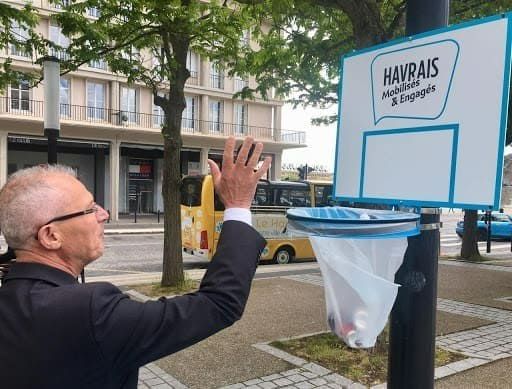
Turning initially mundane actions into games is becoming more and more common. Trash bins have become sources of inspiration for creators of “Nudge Marketing” techniques. Tired of waste left on public roads, they transform throwing litter away into a moment of fun and play. Thus, in Lille, you can find hopscotch next to a bin; in Le Havre, a bin transformed into a basketball hoop, attracting both children and adults alike.
———
“Nudge Marketing” approaches have the ability to influence our actions, all with our consent. What power! These techniques are particularly useful because they serve both the common good and our own well-being. Indeed, they can encourage us to throw our litter or cigarette butts in designated places (which is positive both for us, as we perform a good action, and for society, which sees sidewalks becoming cleaner), make us take stairs rather than escalators, lead us to slow down in our cars when approaching crosswalks, and inspire us to give away old books…
To capture our attention and influence us gently, “Nudge” approaches require a genuine analysis of consumer behavior and emotions, careful thought about which senses to awaken in individuals, and an in-depth study of cognitive biases.
Thanks to their original and gamified concepts, the “Nudge” experiences offered are unique and quickly become attractions in their own right. Not trying a “Nudge” approach means missing out on something. What a shame it would be to miss such an experience, especially when a large number of individuals have tested and adopted it!
We encourage everyone to consider adopting such an approach. Remember that originality has no limits, provided you carefully observe your consumers and lead them to carry out a non-restrictive action that benefits both them and society. Now, it’s your turn to try “Nudge Marketing”!