>
>
>
Organize an effective brainstorming session to encourage idea generation
Organize an effective brainstorming session to encourage idea generation
Published on
You are about to launch a new product or service, you are deploying a business strategy to retain your customers, you are starting to draft the slogan for your latest product… In other words, you are looking for a multitude of ideas to select the most relevant ones! Brainstorming can help you do that. This technique, which brings together a few colleagues around the same topic, aims to stimulate participants’ creativity so they generate a large number of ideas, which, in the best-case scenario, can lead to a brilliant solution.
Born in 1940 when Alex F. Osborn, an American advertising executive, was looking for differentiating ideas to promote his communications agency, this informal meeting gradually spread throughout the professional world. Here, we will look at its current use, as well as the best way to organize effective brainstorming.
————
Why include brainstorming within your company?
With this problem-solving technique, a team can generate a large number of ideas on a given topic. All its members are then free to express themselves, confront their ideas, unleash their creativity, and share their opinions, including particularly atypical ones.
To get back to the essence of this section, this approach offers several significant advantages:
Equality among each participant, where their idea counts just as much as anyone else’s,
Faster integration within a group when a new talent joins,
Multiplied creativity thanks to the merging of minds,
Increased motivation because everyone’s opinion is requested,
Low financial burden for companies.
However, the real question here is not so much why this group technique is so important, but rather understanding the steps that lead to relevant results. In other words, organizing one (or several) brainstorming session(s) is a good start, but committing to making it as effective as possible is better. Below, we present the essential steps for launching effective brainstorming and encouraging idea generation.
How do you launch effective brainstorming?
Get organized in advance
First of all, for brainstorming to produce strategic avenues and be considered a time-saver by both the organizer and participants, good preparation is crucial. Thus, defining the brainstorming topic, identifying the objective, the initial issue, and the project boundaries will give direction to the meeting and guide participants toward a shared ambition.
Ideally, it is recommended to form a group of fewer than 10 people. However, it is not so much this maximum number that should be relied on, but rather the relevance of participants’ profiles. Why is it useful for them to take part? Do they have specific knowledge on the subject? For discussions to be rich and the likelihood of reaching varied solutions to be high, it is preferable to invite participants from different hierarchical levels and with varied expertise. The number of members actually depends on each situation, the rapport between colleagues, and their group productivity. Some will prefer to include a maximum of 6 people, while others will find their exchanges still manageable up to 13 individuals.
During the pre-brainstorming phase, taking time to choose the facilitator will also be necessary. If you are in charge of project management, this role may follow naturally. However, the project lead may also choose a “neutral” team member. What is certain is that the meeting leader must have good, or even excellent, facilitation skills.
Plan the logistical aspect
Beyond the meeting topic, the number of invited colleagues, and the choice of facilitator, organizing a group discussion implies finding an available time slot in everyone’s calendar. Once the day and time are chosen, all that remains is to determine the duration of this collective session and ensure an appropriate length. Since everyone’s attention and concentration are expected during brainstorming, short periods ranging from 15 minutes to 1 hour should be favored.
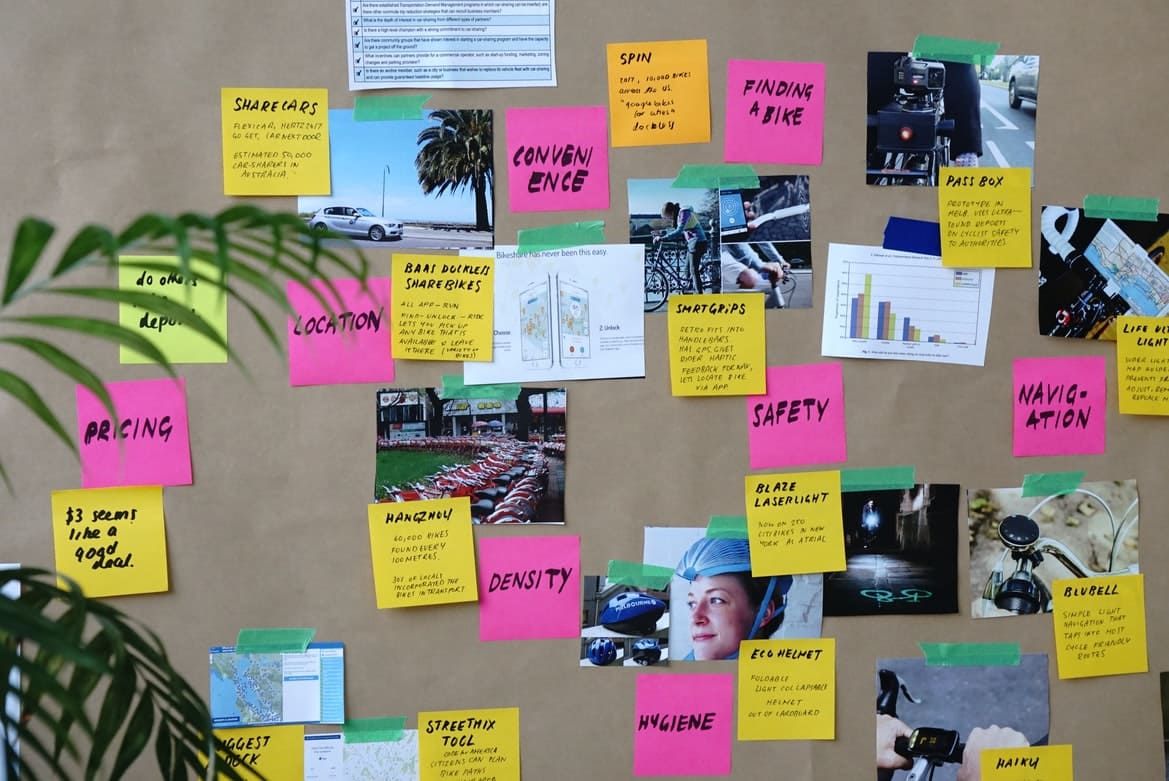
In preparation for the big day, a room sheltered from other colleagues and large enough to accommodate each participant must be booked. A circular or “U”-shaped layout may prove effective for smooth communication and physical proximity among everyone. During the session, note-taking and everyone’s involvement are necessary, so providing materials such as post-its (in different sizes, colors, and shapes), sheets of paper, pens, markers, and a board will make it easier to share everyone’s ideas with the group. With this material, drawings, sketches, diagrams, and keywords can be produced to illustrate the ideas obtained and better understand those of other colleagues. Besides, if you do not wish to (or cannot) use physical material, consider online tools, which are just as effective.
Brainstorming thus proves to be a valuable visual aid for better memorization. Some adopt the so-called “mind mapping” technique: a graphical representation starting from one initial word and leading to several others, thus presenting information in a tree structure. Since the brain works through connections and associations, it aligns perfectly with the “mind mapping” concept.
Still regarding this logistical aspect, it is preferable that a volunteer be responsible for transcribing the discussions, whether by writing a report or taking photos of the diagrams, drawings, and post-its used during the reflection session. These elements will not only help recall key moments but also support strategy development and, consequently, reflection on future action plans.
Prioritize quantity over quality
Brainstorming is a technique based on the profusion of a large number of ideas, sometimes very far apart from one another. In fact, participants can (and should) say whatever comes to mind, regardless of their doubts. All ideas, including the most original ones, are therefore welcome. If they go off the beaten path, that is ultimately good news and an opportunity to surprise. So it becomes preferable to let your ideas wander within a work process! Let us specify, however, that prioritizing quantity does not mean ignoring quality. If the initial idea mentioned is imperfect, it can be refined later and lead to a high-quality idea.
A lack of enthusiasm or inspiration can hinder the emergence of ideas. Ultimately, it will be up to the facilitator to suggest activities that stimulate their teams’ creativity. Exercises beginning with individual phases and continuing with collective phases can contribute to this. Likewise, role-playing games inviting participants to immerse themselves in defined scenarios and act accordingly can encourage the rise of ideas.
Encourage everyone’s involvement
As a participative method, non-participation can prevent brainstorming from running smoothly. If that happens, it will be necessary to ask what reason(s) are limiting each person’s willingness to speak. Is it due to fear of being judged, poor rapport between certain colleagues, lack of experience on the meeting topic, or the recent arrival of a new talent in the company? Whatever the cause, the consequence will be the same: participants will self-censor. Yet, since brainstorming is meant to prioritize quantity over quality, the key mission will not be fulfilled.
For everyone to feel comfortable participating, establishing a climate of trust in the introduction will be necessary. For pleasant and productive exchanges, the facilitator must state from the outset the key principles of kindness and non-judgment. It is then up to them to commit to several principles: give everyone equal speaking time, manage critical participants, encourage the “wildest” ideas, refocus the discussion, and control timing.
Explore each idea that is expressed
Whether participants shared their ideas in writing or orally, it may be useful to collectively revisit everyone’s ideas to go deeper. Perhaps some will not require further exploration. While others, on the contrary, will lead to long discussions and make it possible to identify the root of the problem.
Digging into the ideas expressed can also be done after the brainstorming exercise, with a fresh perspective. These may lead to new measures to adopt and therefore to building an action plan that everyone commits to following.
————
Thanks to careful organization, it is highly likely that brainstorming will be effective for a company’s employees, which means participants were strongly involved and a variety of ideas were discussed. Following these collective exchanges, reflection continues. Initial thoughts are then transformed into concrete and feasible actions. If you have never tried this method, know that we can help you become familiar with it and show you that conclusive results can emerge from these exchanges.