Switch from participant to trainer
Published on
When taking a training course, it is the feeling of discovery that is experienced at every moment: What should I expect? What will I accomplish in the next five minutes? What is the message? Unlike the facilitator, the participant knows nothing about how the content is structured. So to speak, they have a fresh perspective. As for the trainer, their objective is to focus on the participant’s experience and therefore be able to move from the status of observer to that of “content transmitter.”
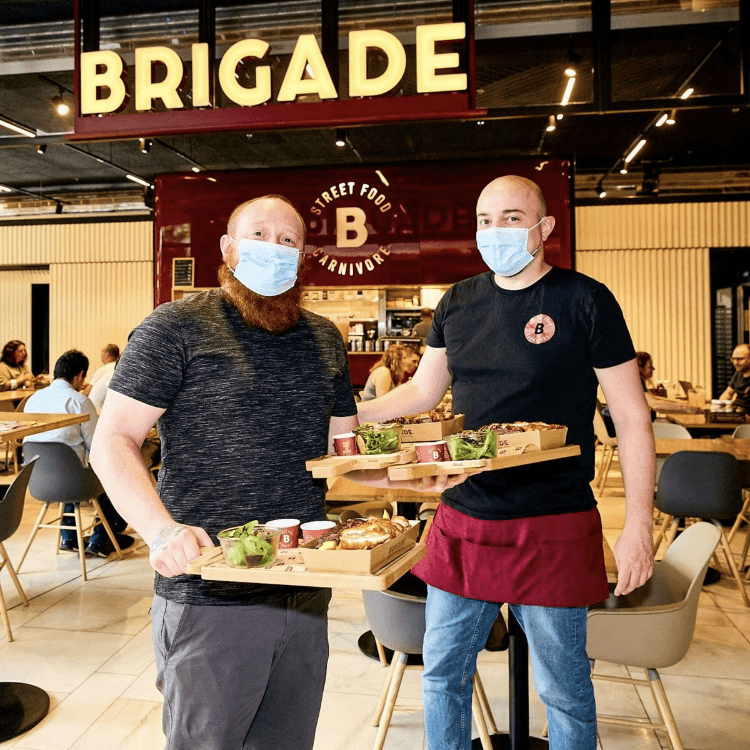
In this regard, Léo Willefert, Operations Director of La Brigade restaurants, initially a participant in many Seven workshops, became so passionate about the trainer profession that he recently took the leap! He has therefore recently taken on a new hat: that of training designer and facilitator for his colleagues. His change of roles as well as his two perspectives, as participant and trainer, make for a journey that could spark vocations!
————
Starting training with Seven
Before starting a training course, some participants may have a traditional image of training organizations: a format often considered academic, with the teacher on one side and learners on the other. At Seven, we are committed to brushing off this perception in order to focus on the participants’ experience. That they have a good time, retain as much information as possible, and put into practice the content delivered in their daily lives: these are the missions we care about succeeding in.
Léo Willefert was notably able to get introduced to training courses and attend around ten of them. His taste for knowledge transfer gradually expanded into a desire to facilitate in-house training himself. Thus, in March 2021, he contacted us again to become “La Brigade’s training guy.” A great challenge that we obviously encouraged!
Becoming a trainer: the example of Léo Willefert
To become a trainer, what matters is not years of experience but passion, a taste for pedagogy, exchanges, and the willingness to pass things on. These are qualities that are very much Léo Willefert’s. In addition, his many participations in our Seven workshops helped him understand how training is built. He himself told us he had understood “the importance of setting a rhythm and facilitating to continuously capture the audience’s attention.” He added that “with the workshop on multiple intelligences, I was able to learn how to adapt my message depending on the people present, which is particularly useful to me in my profession and with my personality, which lead me to communicate with a great many people.”
Concretely, he designed and facilitated 3 training courses between December 2020 and January 2021; namely 2 three-hour sessions for groups of 7 people. This challenge was a real boon for him, allowing him to bring together everything he loved, both in his professional and personal life. After his first day delivered, all of his colleagues were unanimous: they wanted to attend a second training course “made by Léo”!
Essentials for successful training
1- Involve individuals and make them active participants
Because we believe that facilitating just a few hours of training already constitutes a first enriching experience, we continued our discussions with Léo so he could share with us what he considers to be the secret of good training. Without hesitation, he cited the ability to engage trainees. “I remember that the participatory format put in place by the Seven teams appealed to me. So I wanted to reproduce with my colleagues what I had appreciated. Getting the people in front of me to participate—that is my main mission since becoming a trainer.” !
2- Establish a framework of trust throughout
We wanted to learn more about how Léo encouraged as many people as possible to speak up. “I aim to establish a climate of trust and good spirits,” Léo said. By combining the two notions mentioned, he was in fact advising making learners feel at ease. Indeed, not judging them for what they say and explaining that information remains confidential are essential in the trainer’s profession. To help them open up, two actions can contribute in particular: establishing a caring framework from the very first minute as well as the trainer sharing personal experience. By immersing themselves in an atmosphere that is both relaxed and studious and by seeing their facilitator communicate about their own experience, they will, by similarity, be more inclined to engage in sharing.
3- Make exercises engaging through gamification and concrete examples
Finally, playful exercises are a key success factor for impacting participants’ daily lives. To do this, we can only recommend gamifying theories or complex concepts through riddles, moments of competition, pair exercises, or larger group activities, etc. Moreover, the choice of examples when explaining theories will be decisive in making the content understandable. Indeed, by selecting examples close to participants’ lifestyles, they will find it easier to picture themselves applying the theory once the training is over. The use of Howard Gardner’s multiple intelligences is also a good avenue for building dynamic content aimed at capturing learners’ attention.
Léo’s journey—becoming a trainer within his company after having been a dedicated participant at Seven—can only inspire. Passion for passing on knowledge is essential, but it must also be accompanied by additional qualities: the ability to involve learners, the establishment of a framework of trust, and the design of playful workshops.. If you would like to better understand what you have just read, we would be delighted to discuss your needs with you and let you experience Seven!