Unlock your potential with the Ofman quadrant
Published on
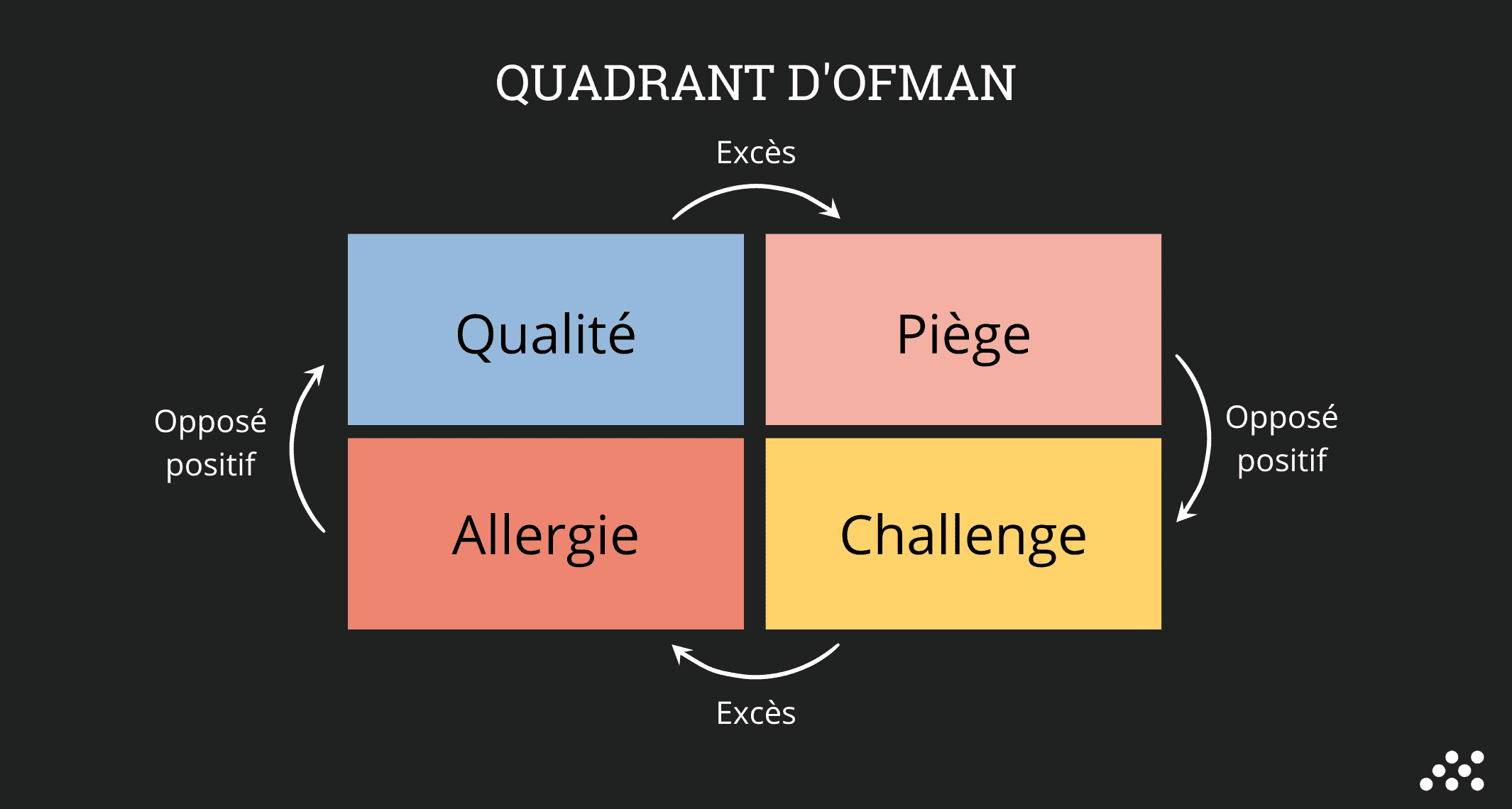
Do you often have ideas flying around? Do you regularly suggest new, original, innovative, and surprising actions to take? Do the people around you say that your brain is bubbling and appreciate that you are never short of ideas? Then one of your greatest strengths is creativity. Because you are creative, it is possible that at times you may spread yourself too thin, seek to frame things better, and want to motivate people who are not proactive to become so. Your strengths, your weaknesses, your skills to develop, and your irritations are connected. Daniel Ofman, a Dutchman who took an interest in relationships between individuals in the professional sphere, illustrates this very well through a concept that even bears his name: the Ofman quadrant. This tool, presented as a circle divided into 4 parts, allows everyone to take stock of themselves, of how they react in contact with others, and of how they behave when they find themselves in situations that are uncomfortable for them. By identifying what he calls their “core qualities,” “pitfalls,” “challenges,” and “allergies,” Ofman invites everyone to reflect on what they could do to feel even better. While reading this article, we invite you to do some introspective work, not judge yourself, and keep a solution-oriented mindset (yellow hat or yellow glasses if we rely on Edward de Bono’s theory). The objective: become aware of your richness and be able to reveal your potential with the Ofman quadrant.
———
4 connected parts
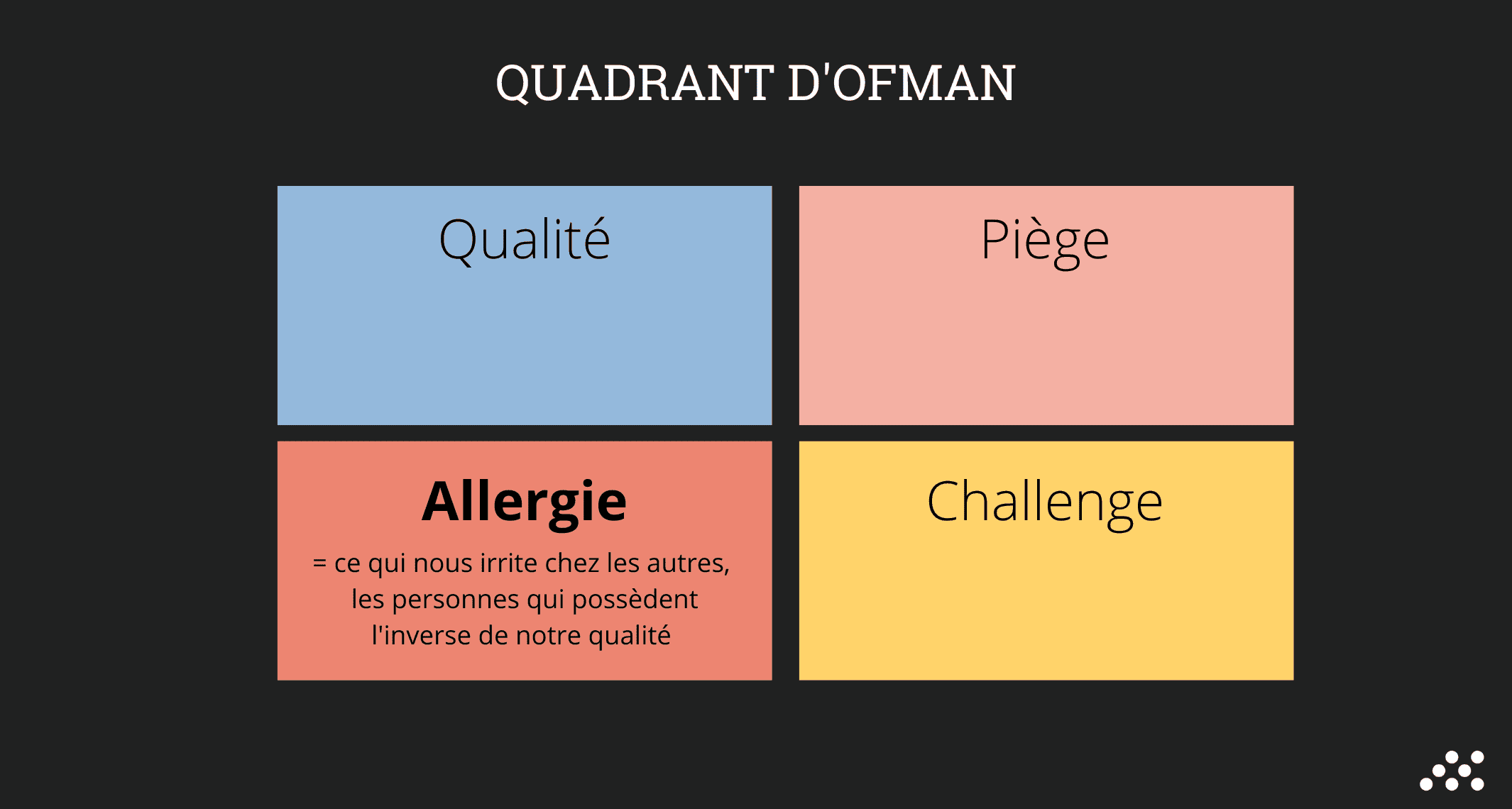
The Ofman quadrant is a tool conceived and theorized in 1992 by Daniel Ofman, a Dutchman who wanted to understand organizational development and lead each individual to identify their main strengths, weaknesses, qualities they should develop, and attitudes they cannot stand. Core Quality - Pitfall - Challenge - Allergy: these are the 4 points highlighted by Ofman. We detail them below:
Core quality
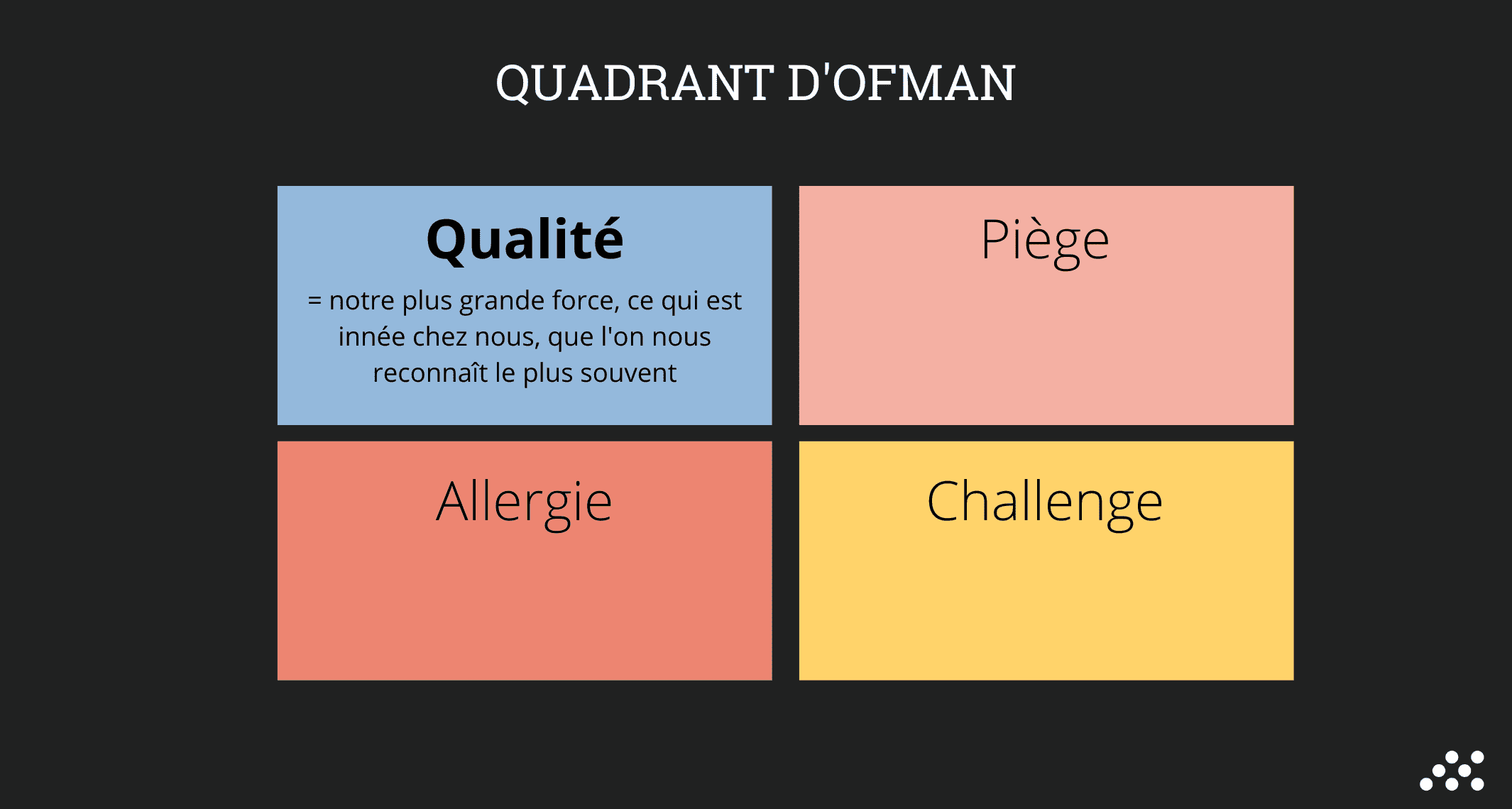
We speak of a core quality to refer to our greatest strength, what shapes our personality, what is innate in us, what requires little effort from us, and what those around us most often recognize in us. For example, your family, friends, and colleagues have repeatedly told you that they appreciate your kindness toward them, the attention you give them, your great empathy: then one of your core qualities is potentially being altruistic.
Pitfall
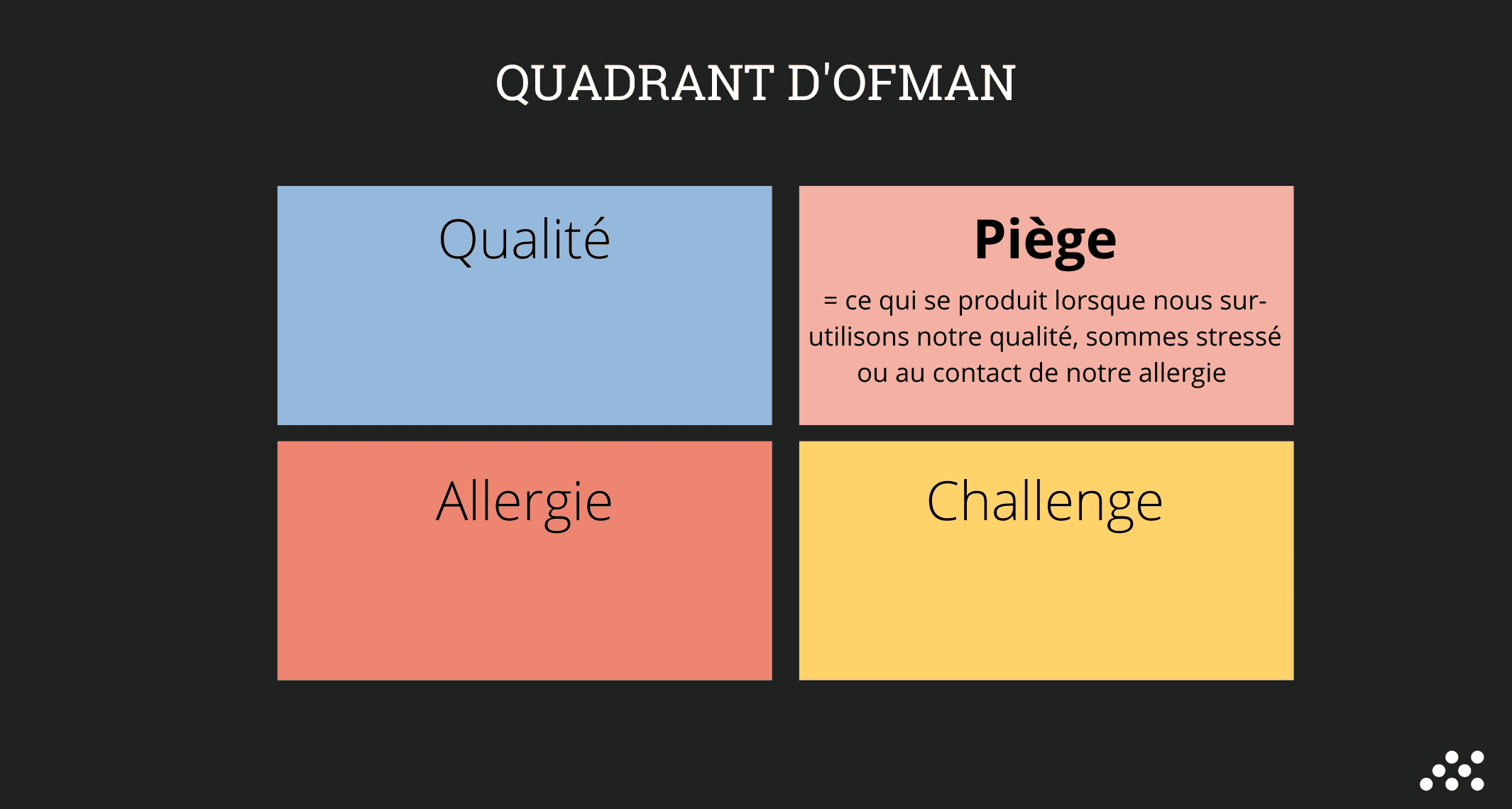
The pitfall means, in turn, the excess of our quality. It is the behavior or attitude we risk falling into when we are in a state of stress or a situation that is uncomfortable for us. It most often appears in contact with others. If your core quality is being attentive, by wanting too much to please the people around you and for fear of telling them “no,” you might agree to carry out actions at the expense of what matters to you and ultimately let yourself be overwhelmed and forget yourself.
Challenge
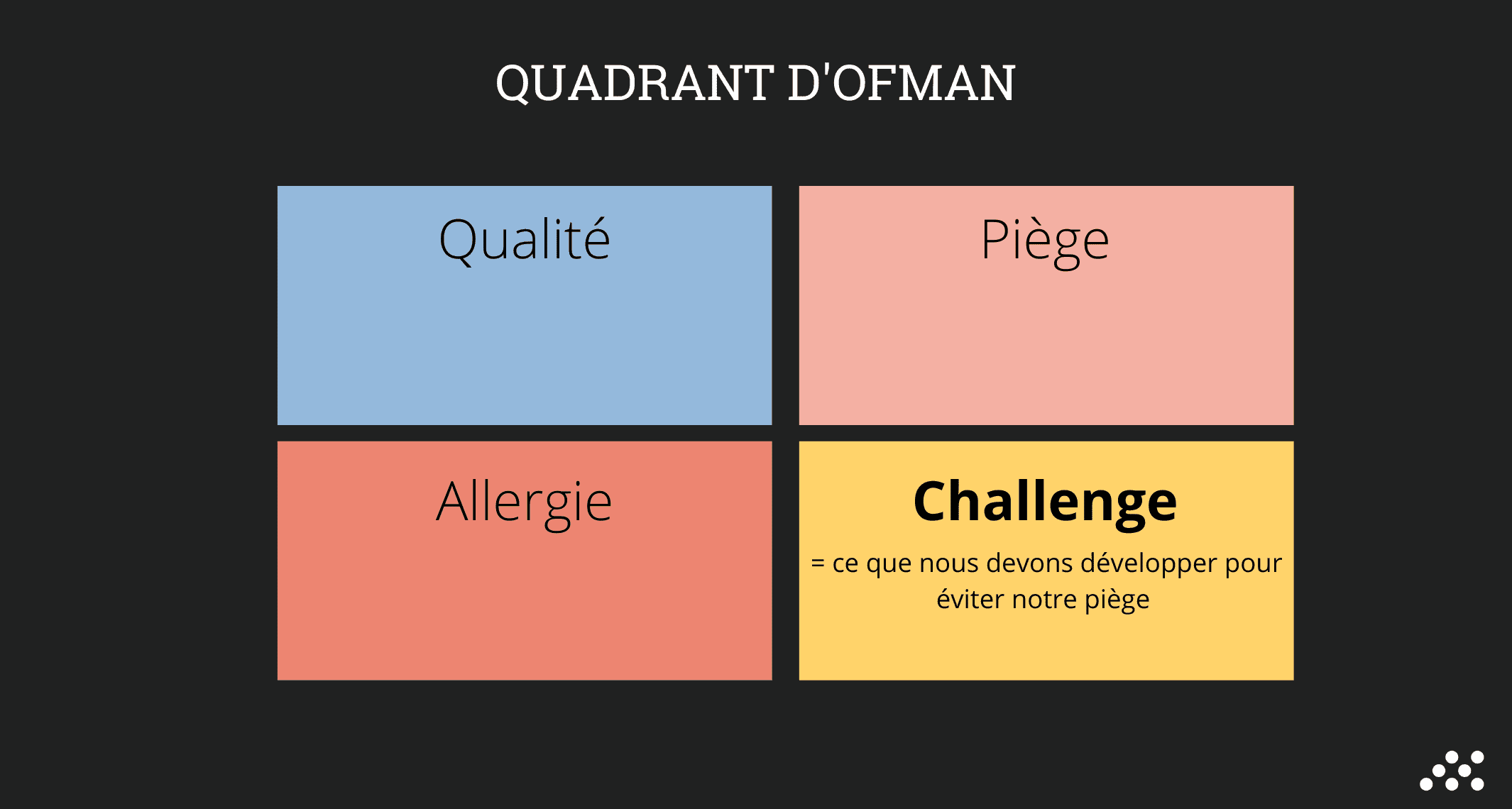
To avoid drifting toward one’s pitfall, each person must identify their challenge, in other words the resource quality they should develop to feel better. It is actually the opposite of their pitfall, but in a positive version. To use the previously mentioned example again, which, as a reminder, is self-neglect, the positive opposite would be taking time for yourself, doing what feels right to you, planning more activities for yourself, and therefore reconnecting with yourself.
Allergy
But when we are faced with individuals who show an excess of our challenge, we say that we are facing our allergy. It is what we most often dislike in others, what irritates us. So if your challenge is to take time for yourself, it is likely that your allergy is people who show selfishness. On closer inspection, being selfish is the exact opposite of your core quality, which is being particularly attentive. Meeting people who embody our allergy is common; the issue is that in their presence, we may tend toward our pitfall. Thus, a selfish person will tend to ask more of you than they should. Because you will feel uncomfortable, not want to disappoint them, nor oppose them, you will do what they demand of you even if it disadvantages you. In front of them, you reveal your pitfall, which is neglecting yourself. However, this does not mean that you cannot appreciate “selfish” people. Indeed, you can spend time with them, be friends with them, even though you are not comfortable with one aspect of their personality.
How do you apply the Ofman quadrant?
Applying the Ofman quadrant can begin from any part. To start this introspective work, we invite you, while reading this article, to ask yourself the right questions and begin reflecting to identify your qualities, pitfalls, challenges, and allergies. Be careful not to judge yourself during this introspective process and always keep a solution-oriented mindset (yellow hat or yellow glasses if we rely on Edward de Bono’s theory).
Do you want to identify your core qualities?
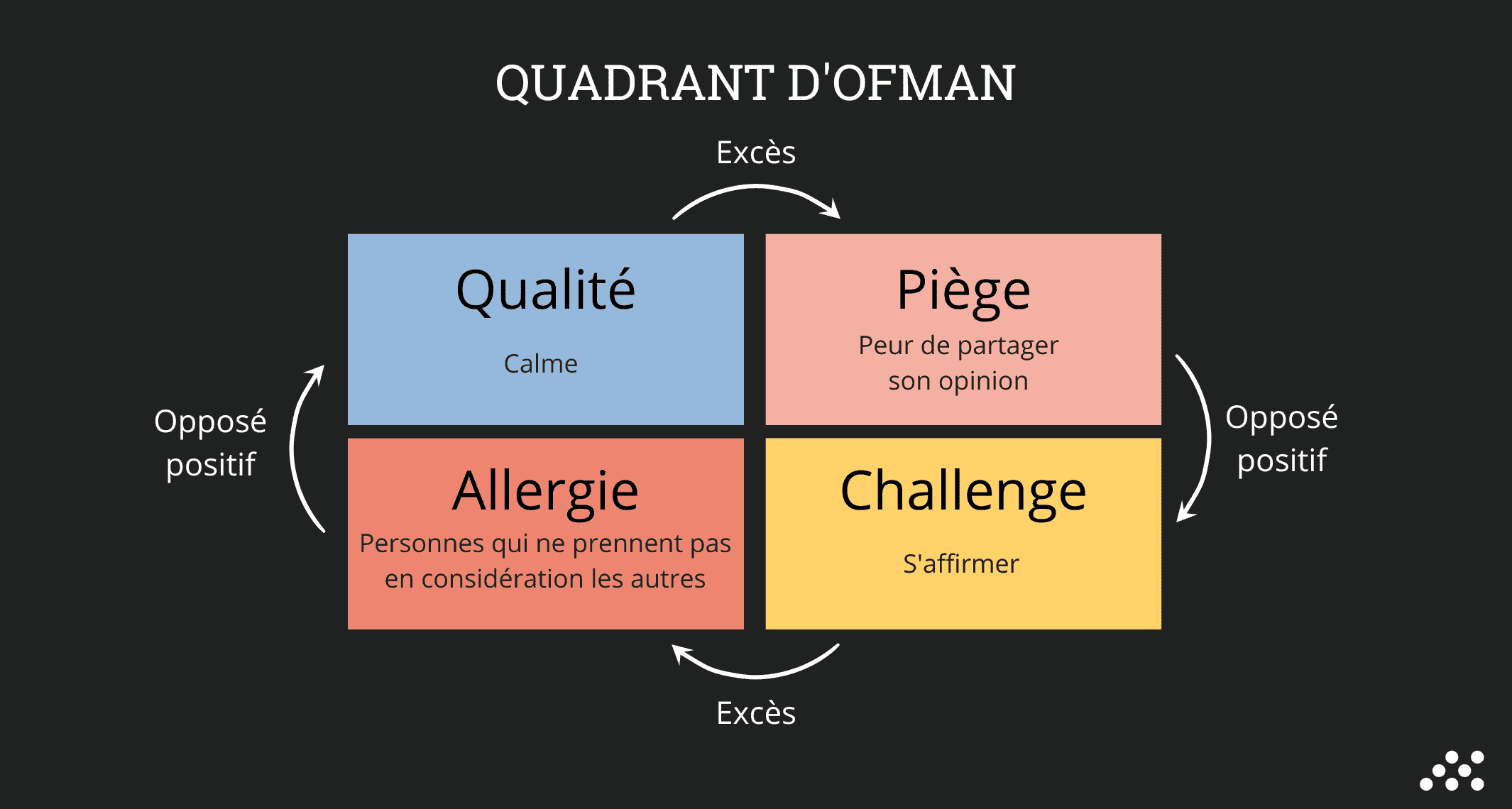
Ask yourself the following questions: What qualities do you naturally have? What is innate in you? What requires little effort from you? What do others appreciate about you? You are naturally calm and can easily show serenity in complex situations, and those around you envy you for it. Calm is potentially one of your core qualities that must be preserved and nurtured. To identify your core qualities, you can also start from behaviors in others that annoy you. If people who constantly need to be in conversation bother you, it is probably because you are naturally calm and that is one of your greatest strengths. We can say that people who talk a lot represent your allergy. Your quality is in fact the positive opposite of your allergy.
Do you want to identify your pitfall?
Ask yourself what happens when you overuse your quality, when you find yourself in a situation that is uncomfortable for you, and when you are faced with someone who acts opposite to what you would have done. If you are too calm, the risk is that you fade into the background around others, do not share your opinion, and in extreme cases become invisible.
Do you want to identify your challenge?
If you now start the Ofman quadrant from the challenge, think about what you admire most in others, and what seems necessary for you to develop to feel better. And if you have already identified your pitfall, then think of its positive opposite. To revisit the example of being invisible, which is a pitfall, the quality to develop to avoid being forgotten is learning to assert yourself.
Do you want to identify your allergy?
If you already know your challenge, you can ask yourself what would happen if you started expressing it too much. What would happen if you asserted yourself too much? You would risk not listening to the people around you and therefore not taking their opinions into account. To find your allergies, you can also rely on your core qualities and determine what their negative opposites are. Finally, if you start the quadrant directly with the allergy, think about what you do not like in others.
At Seven, we support participants in identifying each of these points, as well as in identifying their qualities, pitfalls, challenges, and allergies. We start from these observations to reflect with our participants on the best actions to put in place.
How can you leverage your potential?
The Ofman quadrant has the advantage of leading us to do introspective work, identify what constitutes our greatest strengths in order to use them more, so as not to repeat patterns that are not beneficial, solve problems, and improve relationships.
Determine your “pitfalls” to counter them
When pushed to the extreme, our quality can steer us toward our pitfalls. To avoid them, it is essential to understand the factors that lead us toward them and ask ourselves whether these are not often the same factors that bring us into uncomfortable positions. By identifying our pitfalls at the very beginning of problems, or even before they form, we become more vigilant when we encounter uncomfortable situations and are better able to act to avoid revealing our pitfalls. And when we combine an innate quality in us with the associated challenge, we further reduce the impact of our pitfalls.
Question yourself about the evolution of your qualities / pitfalls / challenges / allergies
From one period to another, our strengths, weaknesses, challenges, and allergies evolve. The type of people who were once our allergies when we were younger may, over the course of our life experiences, have changed boxes in our Ofman quadrant and entered the category of our core qualities. A very indecisive person 5 years ago may have grown and become someone much more assertive in their choices, to the point that today indecisive people—who looked so much like them not long ago—are now their allergy. What was once one of their main characteristics (indecisiveness) has become their core quality. Surprising but possible, and not as exceptional as one might think.
Help those around you
By understanding our own posture, we are more inclined to understand that of others. You noticed that one of your clients particularly disliked jokes and was very meticulous about the language used. Because their allergy is probably made up of people who regularly use humor, you know that their core quality is seriousness and that their pitfall is severity. Knowing this, when you interact with them, you make sure to avoid all jokes and show seriousness in return so that they feel confident with you and dare to reveal their challenge, which seems to be flexibility.
———
Applying the Ofman quadrant is wonderful for refocusing on yourself, taking stock of your strengths, weaknesses, skills that would be better developed, and your behaviors when facing people who possess the exact opposite of your qualities. This tool, which also integrates into the Process Communication model, not only gives you better self-knowledge, but also helps you understand how you interact with others and how others interact with you.
The quadrant is divided into 4 components, all interconnected: core qualities, pitfalls, challenges, and allergies. There is no specific order for identifying them. You can therefore start filling in your quadrant from any aspect. As for the meaning of each element, core qualities refer to the qualities you possess innately, those that are for the most part appreciated or envied by those around you. Pitfalls, for their part, represent the excess of your qualities. In a stressful or delicate situation, they can play tricks on you and put you in uncomfortable positions. Challenges are the qualities you need to develop in view of your existing qualities and the pitfalls toward which you may tend. Allergies, finally, refer to the behaviors of individuals you do not really appreciate. In contact with them, you most often reveal your weaknesses. To prevent your pitfalls from appearing (because you will always meet people different from you), it is preferable to act as soon as your allergy appears and move toward your challenge.
Qualities / pitfalls / challenges / allergies are not fixed. Depending on your life experiences, they evolve. Allergies you may have had in the past may, in the meantime, have changed and become qualities. There are as many quadrants as core qualities, and as many quadrants as there are people. Two individuals can absolutely share a common core quality but develop two different pitfalls in contact with their allergy. Likewise, two individuals can have the same pitfall but want to move toward a challenge that is specific to each of them. By completing the Ofman quadrant exercise based on one’s personality and attitudes, each person’s uniqueness is revealed and the actions to unlock their potential are brought to light.
During our Seven training programs, we support our participants in completing their Ofman quadrant; we guide them step by step, reassure them, remind them that there is no reason to judge themselves, point out their qualities (which are more numerous than they think), and let them define the challenges that seem most appropriate to them (because above all, it must be something they truly want). If you would like support in building this quadrant or wish to develop other areas for personal growth and better understand the people around you, we remain available.