>
>
>
Capturing an audience’s attention: a real exercise in thoughtful consideration
Capturing an audience’s attention: a real exercise in thoughtful consideration
Published on

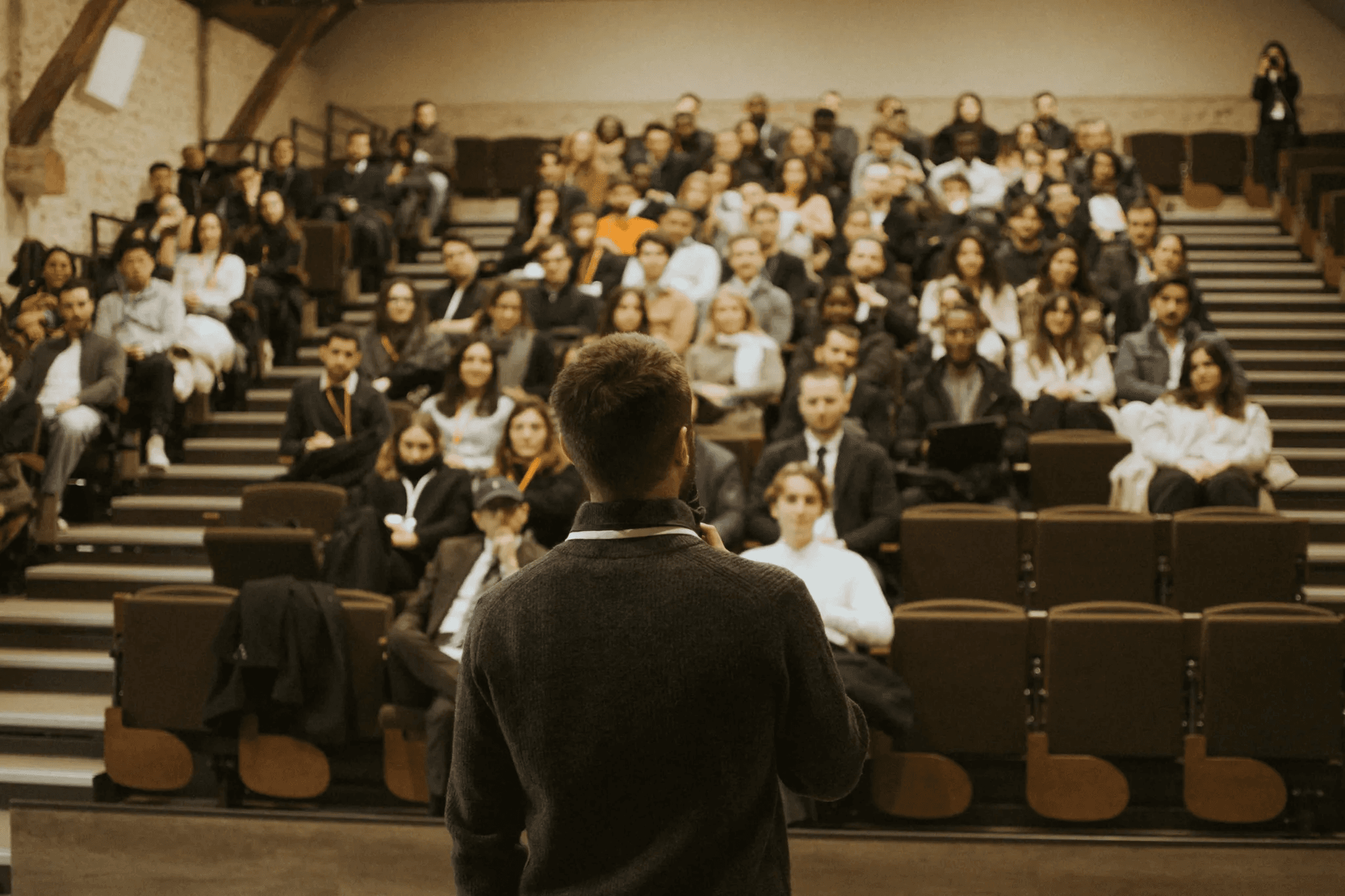
Hey, hey, look over there! Not so easy to capture attention. When we want to share information with an audience, whether they are initially interested or new to the topic, the hardest part is not so much getting them to remember what we just said (even over a short period), but getting them hooked by our words and eager to go further. Of course, some topics will be more likely to appeal to them. Learning methods to better organize one’s agenda may be more interesting than lobster fishing (though maybe not)! But how do we capture attention when the population’s attention level is declining? Indeed, while the average attention span of an individual was 12 seconds at the beginning of the 2000s (according to a study conducted by Microsoft in 2015), it is said to have dropped to 8 seconds today: a decline that reflects how complex it has become to speak in front of an audience and how rare a resource attention has become! But by the way, what “attention” are we talking about? The ability to concentrate, or to care for someone? For this article, we will mainly rely on the first meaning, namely the ability to focus one’s mind on an idea, something, or someone. Hoping this article captures you…
———
Showing attention
Selective attention
Before looking at the most relevant methods for capturing attention, we wanted to share with you the main types of attention that exist, and the first one we will focus on is selective attention. This shows that when an individual is faced with several pieces of information, they will consciously or unconsciously retain some and leave others aside. On their own, they will decide to focus on a single piece of information, because they know it is the best thing to do in order to be effective. If you go to a restaurant with a friend and are therefore in a rather noisy environment, you will generally focus on the conversation you are having with that person (or at least try to), and not on the exchanges happening around you.
Another example in which you use selective attention is when you watch the video, which you may already have seen, in which several people pass a ball and the viewer is asked to count the passes (if you want to see or rewatch it, it’s here). Our vision, sometimes so focused on the number of passes made, explains why we do not always see the person dressed as a gorilla. Conversely, people who expect to see it will indeed notice it, but will not necessarily notice that the curtain color has changed, or even that the number of people passing the ball has been reduced (oops, now you know)! Why? Because, having possibly missed the gorilla on the first viewing, people behind their screens will look for the gorilla throughout the video.
Divided attention
There is also what is called “divided attention” or “shared attention.” This makes it possible to process several relevant pieces of information simultaneously. You use it if you drive a car. Indeed, while driving, you must pay attention both to other vehicles moving around you, entering the lane, slowing down or speeding up, and to traffic lights and signs, the weather, pedestrians, animals, etc. But the more information there is to process at the same time, the greater the risk of making one (or several) mistake(s). Divided attention has its limits!
You also use this mode of attention when you take notes during a meeting, a conference, a webinar… You write what was said a few seconds earlier, while listening to what is being said now in order to write it down afterward. Thus, what you write is different from what you hear, requiring concentration that is not so easy. The secret: regularly alternate between these two tasks. For example: 10 seconds of listening, then 10 seconds of writing. Automatically, you will repeat the following pattern: you take micro-breaks in your note-taking to listen to what is being said, then focus on your writing so you do not lose the thread.
A final example of divided attention, even more relatable for all of us: sending messages while walking down the street, crossing crosswalks. Of course, we do not all have the same ease in carrying out these two actions simultaneously, but see how regularly we do it (if not us, we observe it in the street). To avoid any danger (for ourselves and for others) and make sure we are going in the right direction, we cast quick glances outside. The frequency and duration of these glances vary depending on our skill and our external environment.
Sustained attention
A third type we could mention: sustained attention, that is, the ability to maintain a high level of efficiency during a long activity that requires a certain rigor, even intellectual effort. If you take part in a tennis competition, you know full well that for several hours you will need to stay focused and, for that, you will deliberately put yourself in your bubble, possibly perform reassuring rituals, use what you learned in training, etc. The risk if you do not take these actions is multiplying bad shots, receiving them poorly, and ultimately letting your opponent gain the advantage.
In our daily work, there are tasks we distinguish from others, because we know we must focus our minds 100% on those tasks. In fact, writing this very article, which is a mission that takes several hours, required sustained attention, coupled with selective attention!
If you are drafting a strategy proposal for a client, since this mission is longer and high value-added, it is better to devote several hours to it, show self-discipline, and apply Carlson’s law. This time-management law explains that work done continuously takes less time than work done in several installments. As part of your consulting assignment for a client, you could physically isolate yourself in a room, put on headphones, turn off your notifications (or force yourself not to check them) for a sufficiently long set period (2 to 3 hours), and respond to colleagues’ requests only once that set time is over. Coupled with good time management, it will be easier for you to show sustained attention.
Capturing a person’s attention: a rare resource
Paying attention is not such an easy activity, and capturing attention is even less so when we know we are in an attention economy era. Starting in the 1970s, and even more since the mid-1990s, the traditional economy shifted toward an attention economy, as Yves Citton, literature professor at the University of Grenoble, states in his book “The Attention Economy: A New Horizon for Capitalism?”.
When you think about it, in the past, consumers had to make efforts to access information. Indeed, those with the necessary budget ordered hand-copied illustrated books, and patiently waited several weeks to obtain the knowledge they were seeking. Today, when a question comes to someone’s mind, they try to find the answer instantly (or most often do) on the Internet. It is no longer content creators who are hard to get, but their users!
Try to get someone’s attention, whether to communicate information (e.g., we are organizing a conference next Thursday and would like to invite you), sell a product or service (e.g., our whole-wheat pasta range will bring you pleasure and balance), and you will see that it is not easy to intercept their attention when that person is faced, at every moment, with a plethora of information. More than 2 billion websites exist, more than 600 hours of video are uploaded to YouTube every minute, more than 50,000 Instagram posts are published every minute (source: Internet Live Stats). Information overload has changed behaviors. Content creators and anyone wishing to deliver a message must think longer and harder about the best strategy to adopt so that people look forward to them. That is why we have listed below a few directions to follow to gather this precious asset: people’s attention!
How to maintain a person’s attention?
Show empathy
To engage an audience, whoever it may be, it is important to understand them. Companies that offer services or products to a public conduct upstream research on the consumers they want to reach: what is their socio-demographic situation? what are their lifestyle habits? what do they like? what annoys them? what do they consume? how do they use social networks? what topics matter to them? what state of mind are they in at a specific moment? … The more we know about them in detail, the better we can address them using the right codes. You noticed that your prospects most often consulted LinkedIn on Thursday mornings from 7:30 to 8:00, and that they were more likely to interact if the post contained a selfie and started with a problem they regularly experienced. From this observation, you will deliberately post on LinkedIn with the elements you identified, and thus show empathy.
Have confident non-verbal communication
At SEVEN, when we run modules on communication or public speaking, we start by sharing three numbers: 7, 38, and 55. After several Q&A exchanges, we come to Albert Mehrabian’s theory. This psychologist demonstrated, after studies conducted in 1967 on a panel of women, that our verbal communication has a 7% impact on others, our vocal communication 38%, and our visual communication 55%. Results that show the influence of non-verbal language in our messages. Sparkling eyes, a confident posture, assured hands, and stress gestures erased will more readily support the quality of our speech.
So, whatever channel you use to convey your message (video, phone, article, email, meeting, etc.), keep in mind that form will greatly influence how your message is received. In an article, the font used, differences in text size, chosen colors, spacing between words and paragraphs, the choice to place certain elements at the beginning and end… will make people more or less willing to read part or all of the content. Capturing attention through content starts first with what we see even before understanding its meaning, before reading what is written.
Design and communication teams regularly have strategic choices to make when they want to attract someone’s gaze, whether through posters placed near public transport, on roads, or via advertising banners visible on websites or social networks. Think again about the posters/online banners that intrigued you. Was it because of the chosen photo? The contrast between foreground and background? The leading lines, all directed toward one particular detail? The color combination? The slogan, the words written, the tone used? Were particular emotions awakened in you? Was the arrangement of information done thoughtfully and effectively? Knowing that readers tend to favor Z-pattern reading, we should place priority information in the upper-left corner of the poster and place other relevant information along the Z trajectory, paying attention to the lower-right corner that closes the viewer’s gaze.
Move each person from a passive to an active posture
During SEVEN training sessions, we encourage all our facilitators to focus on the participants’ lived experience. By making the effort to put themselves in participants’ shoes, facilitators are better able to adjust their content so that no one gets bored, everyone learns useful concepts, and participants become actors in the training. To do this, they all begin their sessions with an icebreaker. Concretely, before even introducing themselves, explaining the training flow or objectives, the facilitator invites participants to perform an action, answer a question, or complete a simple task. Participants have no choice but to be in an active rather than passive posture. The icebreaker ends with a conclusion that links to the training theme.
For example, in a team management workshop, we invite participants to pair up, hold the other person’s hand, and try to score as many points as possible by trying to make the back of the other person’s hand touch the table. They do this exercise for three rounds. They share the results of each round, we observe them together, and debrief the observed facts.
Use multiple intelligences
Because there is not just one, nor even two intelligences, but more (seven according to H. Gardner), and because everyone has their own skills and personality, it is better to play with different types of intelligence when we want to capture attention. We make sure to use them as much as possible in training sessions. Thus, to mobilize participants’ logical-mathematical intelligence, we offer riddles and activities that call on their reasoning ability. To stimulate their verbal-linguistic intelligence, we invite them to write content and read. So that they think both alone and with others, we set up introspection times (thus mobilizing their intrapersonal intelligence) and exchange times (thus mobilizing their interpersonal intelligence). So they are not always static, we sometimes invite them to stand up to role-play or present their project. Other times, we give them manual activities because we know the power of touch as a memory vector. Another intelligence they may develop less and yet must still be maintained: visual-spatial intelligence. This refers to the ability to use mental images, to visualize in one’s head something not currently seen, in order to understand, move forward, and make decisions. One activity we offer during corporate team buildings is building a Lego tower. We ask participants to build, in groups and as quickly as possible, the tallest, most economical, and most beautiful tower. During this activity, they imagine how they see the tower and then place the Legos.
Create surprise
Capturing attention means suddenly changing the subject, delivering innovative information (e.g., a statistic, breaking news, etc.), asking the person in front of us to perform a new action, or doing something ourselves that the other person is not used to seeing from us. If your meetings had so far been very monotonous, with only theoretical moments without interaction and short Q&A times at the end, and you decided to change this format by including, right at the beginning, a poll where you invite your colleagues to express themselves, the probability of capturing their attention (at least during the first part of the meeting) will be higher. Because they will have made the effort to share their opinion, will be curious to know their colleagues’ feedback, and interested in the survey results, meeting participants will be particularly attentive.
The phenomenon of surprise, coupled with the rarity of the situation (here, it is the first time employees answer a poll in a meeting) and the broadening of knowledge about others (survey results are a way to better know colleagues’ points of view), will intrigue them. Another method that surprises is Nudge Marketing. You encounter Nudge applications in particular when you take piano stairs instead of escalators. All nudge actions actually catch consumers’ attention because they manage to get consumers to take actions whose impact is positive both for themselves and for society.
———
Focusing attention on one (or several) specific subject(s) necessarily requires effort. We do this work when we show selective attention (= we focus on one element and ignore the rest), divided attention (= we juggle between two actions), or sustained attention (= we show rigor and reflection over a long period). However, being all human, it is natural that after 10/15 minutes, there is a risk of disengagement. It is no coincidence, moreover, that TED conferences have been limited to a maximum format of 18 minutes! Perhaps they should reduce this duration again? Beyond the scientific reasons that can explain a person’s natural drop in concentration on a specific topic, the multiplication of distractions (notifications, outside noise, etc.) and solicitations (email, calls, ads, etc.) has increased the difficulty for each person to stay attentive on one subject.
Capturing attention has thus become one of this century’s challenges. By adopting a few methods, it is possible to engage an audience. Among existing actions to capture attention, we could mention: in-depth knowledge of one’s audience, care given to visuals, getting others to perform actions that make them active rather than passive, using multiple intelligences, and surprise. This list is not exhaustive and could be extended, but because we are aware that particularly long content increases the risk of losing your attention (and that is normal), we prefer to stop here and keep the rest for future articles.