>
>
>
Growing without becoming disorganized: how can the OKR method align all your teams?
Growing without becoming disorganized: how can the OKR method align all your teams?
Published on
When a company grows — and very quickly at that — aligning the company’s strategic vision with the goals of its different teams becomes a real challenge. The risk? Falling into disorganization.
That’s where the OKR method (Objectives & Key Results) fully comes into its own. It makes it possible to set ambitious and measurable goals, giving all employees a clear direction and a structured framework to move forward together. Most often, OKRs are associated with large companies such as Google, Netflix, or Twitter, but this method is just as valuable for SMEs and fast-growing startups. This is exactly the case for Najar, a solution that helps companies simplify and control their purchasing with flexible, AI-driven tools.
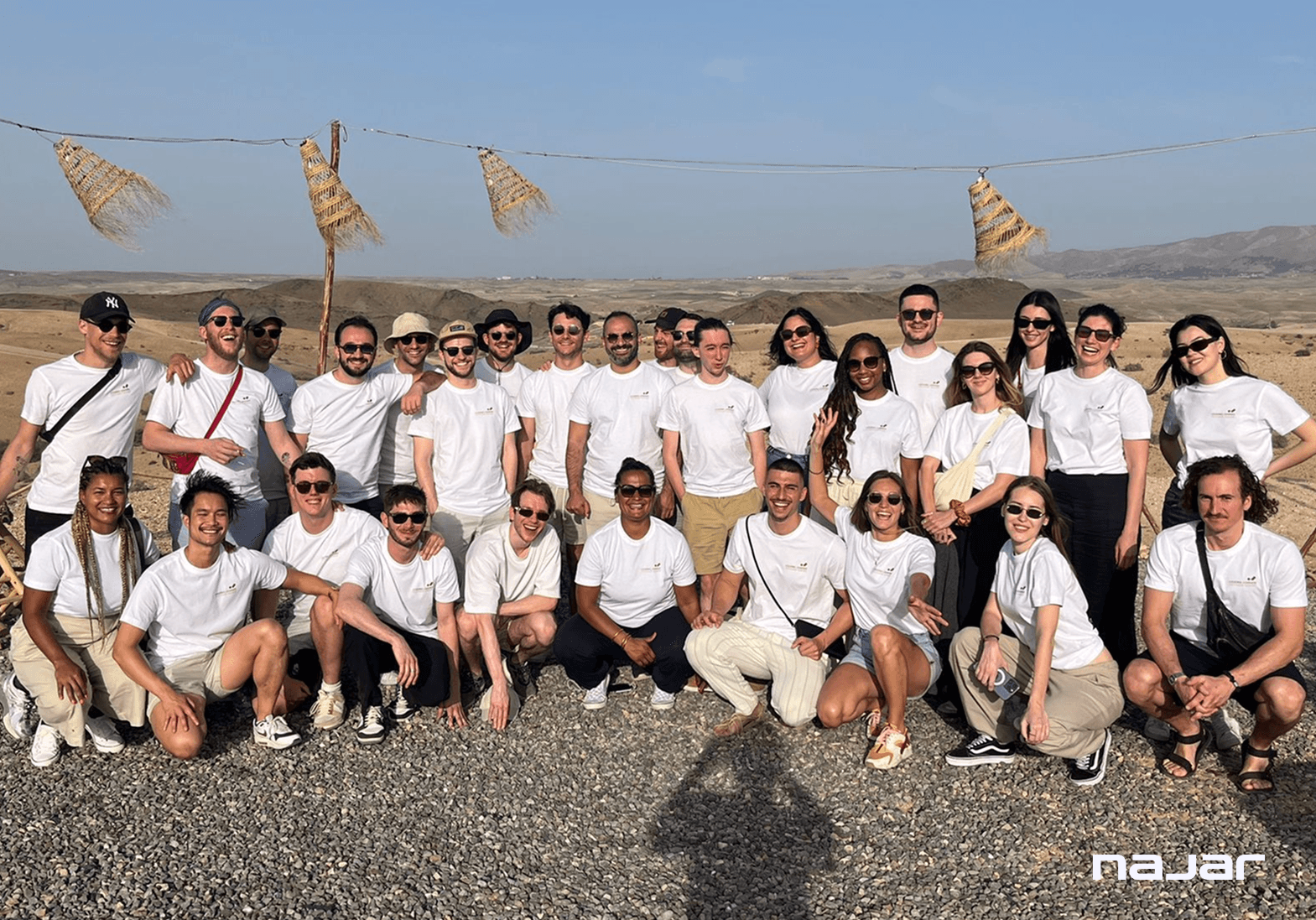
In 2024, the Najar team grew from 30 to 75 employees, making objective management a “true science,” as Lucas Liabeuf , Chief of Staff (CoS) at Najar, told us. For him, ensuring consistency across departments while maintaining rapid growth required a clear framework.
To structure this transition and align the actions of all its teams, Najar chose Seven to support it in implementing OKRs. Thus, in January 2025, the two co-founders, four VPs, five managers, and CoS Lucas Liabeuf took part in a one-day OKR training session with Seven. Their objectives? To gain in-depth mastery of the OKR method and structure its implementation at Najar, both at the overall level and within each team.
From the origins of OKRs to their global adoption
While the OKR method is now adopted by companies around the world to structure their growth and align their teams, its history goes back several decades.
It all began in the 1950s with Peter Drucker, a professor and business management consultant, who introduced the concept of Management by Objectives (MBO). He championed the idea that an organization works better when its objectives are clearly defined and aligned with its overall mission.
Twenty years later, Intel faced a major strategic challenge. Should it leave the DRAM memory market to reposition itself in microprocessors? Its CEO, Andy Grove, then rethought MBO to make it a more agile and ambitious tool. This was the birth of OKRs (Objectives & Key Results). Their aim was to create a framework enabling teams to set high ambitions while ensuring precise tracking of their progress. Among the innovations introduced at Intel were:
Bold objectives, encouraging employees to aim higher.
Measurable results, with 3 to 5 indicators per objective to concretely track progress.
Regular follow-up, quarterly or monthly, to quickly adjust priorities.
Total transparency, by making OKRs public within the company, in order to promote alignment across all teams.
It was in this environment that John Doerr, then an employee at Intel, discovered the power of OKRs. When he became an investor at Kleiner Perkins, he introduced this method at Google in 1999, convincing Larry Page and Sergey Brin, Google’s co-founders, to make it a pillar of their company’s development. The success was such that other giants like LinkedIn, Twitter, and Uber quickly followed suit. Then, in 2017, with the publication of John Doerr’s book Measure What Matters, OKRs established themselves as a strategic management standard and are now adopted by companies of all sizes and across all sectors, such as Najar.
OKR: a method to combine ambition and precise results tracking
So, what exactly is the OKR method? Objectives and Key Results is based on two pillars: 1/ ambitious objectives - 2/ measurable results to assess whether they are achieved. Designed to push teams to exceed themselves, it encourages everyone to step out of their comfort zone by aiming for stimulating and inspiring objectives.
It should be noted that OKRs differ from KPIs (Key Performance Indicators). While KPIs measure the performance of a stable and recurring process, OKRs are designed to drive the achievement of ambitious objectives aligned with the company’s vision.
At Najar, before implementing OKRs, growth was mainly tracked through overall indicators such as number of clients or generated revenue. But at the department level, there was no clear framework to align priorities.
"It was difficult for us to measure alignment between the company’s overall strategy and each department’s priorities. Before adopting OKRs, we only had broad company guidelines and specific objectives for each department, with no real link between them." Lucas Liabeuf, Chief of Staff at Najar, told us.
How do you set an OKR properly?
A good OKR must meet several criteria to be effective and motivating.
1. Be precise, clear, inspiring, qualitative, and quantitative
The OKR system is made up of an objective (the O) and associated key results (the KRs). Most often, each objective consists of 3 to 5 key results. In the OKR method, the objective (the O) should be qualitative and ambitious. Meanwhile, the key results associated with the objective (the KRs) should be quantitative so that achievement—or non-achievement—of the objective, as well as room for progress, can be measured.
An example of what does not fall into the OKR category: "Significantly increase customer satisfaction by improving responsiveness and personalization of after-sales service responses." This is an objective that is too long and imprecise, mixing several ideas and not really providing a clear direction to follow.
Now an example of a real OKR: "Become the European leader in the electric bike rental sector." This objective is inspiring and pushes employees to go beyond themselves. Moreover, it is qualitative.
2. Aligned with the company’s strategy
An OKR defined for a team should always be aligned with the company’s overall vision.
Let’s assume your company’s general objective is to become the benchmark for professional training in France. If your marketing team applied the OKR method, it could look like this:
O: Improve the company’s brand awareness among professionals.
KR:
• Increase organic website traffic by 30% in 6 months.
• Generate 1,000 qualified leads through content campaigns and targeted ads.
• Obtain 50 brand mentions in articles, podcasts, or LinkedIn posts by thought leaders.
3. Measurable to track progress
In the OKR system, it is recommended that each objective be accompanied by 3 to 5 key results to assess progress made. A poorly defined or hard-to-measure objective risks losing impact and making result evaluation more complicated.
A common method is OKR scoring on a scale from 0 to 1:
A score of 0.3 means the objective may be too ambitious or poorly defined, making results difficult to achieve.
A score of 0.8 means the objective is almost achieved, showing a good level of accomplishment with still some room for improvement.
A score of 1 means the objective is achieved but also signals that it was too easy and could have been even more challenging.
4. Ambitious and stimulating
The definition of the objective (the O in OKRs) and the key results (the KRs), or expected outcomes, should represent a motivating challenge for teams. The goal is not to set an objective whose results are easy to achieve, but to encourage teams to push their limits.
5. Independent from compensation
It is not recommended to link OKRs to bonuses or salary increases, as this could reduce risk-taking and experimentation. By dissociating OKRs from the financial aspect, teams feel freer to set ambitious objectives and innovate.
6. Evolving and adaptable
An OKR is not fixed. It must be able to evolve according to priorities and changes within the company. Regular reassessment checkpoints (monthly or mid-cycle) allow objectives to be adjusted if necessary, so they remain relevant and achievable.
Smooth OKR implementation at Najar
"We were aware that implementing and adopting OKRs would take time, but we were very surprised by how quickly implementation happened at Najar, thanks to Seven’s valuable support. Two months after rollout, the method has already been assimilated by more than 50% of the company, which is a very positive signal" shared Lucas Liabeuf, Chief of Staff at Najar.
How can we explain fast and natural OKR adoption within Najar? Several factors:
1. A clear understanding of how OKRs work
From the start, one essential point was clarified within Najar’s teams: OKRs would not be tied to compensation. This distinction helped avoid potential resistance to the OKR method and also encouraged smoother adoption.
Lucas explained to us that "Najar chose not to tie OKRs to employee compensation, in order to maintain a very ambitious approach in building its objectives for the year."
2. Convinced internal ambassadors
Even before Seven’s training, some Najar employees were already familiar with OKRs and could already see their value for better structuring their work.
"The need to reassure people about the OKR method was less necessary than expected," Lucas specified. "Several internal employees were already convinced by this approach, and some departments had even started adopting it at their own level."
It is certain that having internal advocates favorable to the method greatly facilitated OKR integration at Najar.
3. A need for alignment already expressed internally
Long before the introduction of OKRs, Najar’s teams felt a need for objective clarification, which naturally encouraged buy-in to this new approach.
"In fact, implementing OKRs responded to a strong internal expectation, which sparked real enthusiasm within the teams." Lucas emphasized. What a pleasure to know that Seven’s training was so eagerly awaited!
4. A motivating and empowering dynamic
One of the elements that particularly appealed to teams in the OKR method is the ambitious approach, fostering a positive dynamic and collective motivation.
"During the training with Seven, employees particularly appreciated the idea of ambitious objectives." Lucas said. "Our discussions were therefore unfiltered and sincere, allowing us to better align on a shared level of ambition."
5. Structured and engaging support from Seven
Seven’s support for Najar’s teams played a key role in the rapid adoption of OKRs. Thanks to immersive, fast-paced training, teams quickly became familiar with the method and understood its benefits.
"Everyone gave extremely positive feedback on Seven’s training." Lucas told us. "The trainers’ energy and expertise, the immersive and practical pace—everything was designed to get us into action from day one. From this experience, I remember that: 1/ OKRs must be ambitious by nature; that is even their fundamental principle. 2/ They are not directly linked to KPIs. 3/ They must not be associated with compensation."
Following the training, Lucas told us that the success of this training was based on several key points such as:
Strong preparation beforehand by the Seven team.
Indeed, before the training, we had conducted interviews with Najar’s two founders and several managers. The objective? To precisely understand each team’s specific challenges.A pragmatic format, without over-intellectualization.
It was a way for Najar’s teams to stay close to the field. "Seven’s training day was intense, but in the good sense of the term," Lucas explained.Engaging pedagogy and energy that got all participants on board.
"The energy, preparation, and day-of momentum made all the difference." Words that warmed our hearts, Lucas concluded.Freedom in building OKR boards.
This allowed everyone to fully take ownership of the method.
Najar’s experience shows how the OKR method can be a powerful lever for supporting rapid growth while maintaining a structured organization and a clear course. By setting ambitious and measurable objectives, a company gives its teams a common direction, strengthens their commitment, and aligns each department around a shared vision. While OKR adoption happens progressively, several factors can speed up their integration: a good understanding of the method, a clear need for strategic alignment, a culture focused on collective achievement, and a structured framework to support change. If, like Najar, you want to structure your growth and create team momentum around clear and motivating objectives, adopting OKRs could be a real accelerator. And to make this transition successful, tailored support from Seven can make all the difference.