>
>
>
Creating a workplace mural: a fun format for learning and collaboration
Creating a workplace mural: a fun format for learning and collaboration
Published on
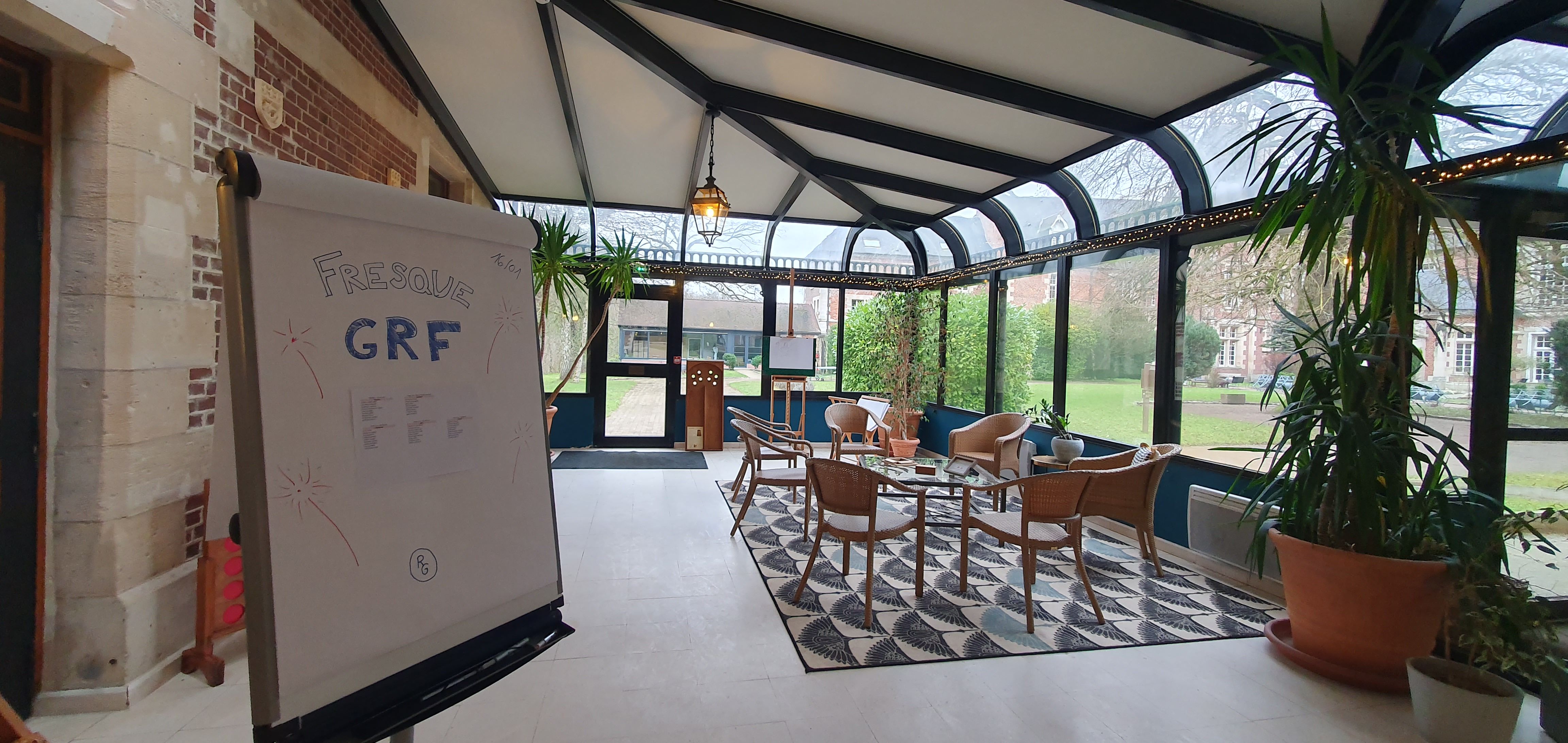
From the walls of the Lascaux caves to the ceilings of the Sistine Chapel, frescoes tell stories and convey knowledge through time. Today, they go beyond the artistic sphere to become playful tools serving learning and collective reflection. In business, a fresco workshop offers teams the opportunity to co-build a shared vision, clarify strategic challenges, and strengthen their commitment. It is in this spirit that Seven supported the employees of Gedeon Richter France in the design and facilitation of a fully customized corporate fresco. The objectives for this international pharmaceutical group? Better understand the internal organization, foster collaboration between different departments, and establish a clear direction around the launch of a new medical treatment. How did Gedeon Richter France, supported by Seven, use the fresco to give meaning to teams and strengthen their cohesion? In which situations can a fresco become an effective lever in business? Let us discover the business impacts of this format.
From the origins of frescoes to the Climate Fresk
A means of artistic expression through the ages
Since prehistoric times, humans have used images to capture stories. The depictions of wild animals in the Lascaux caves bear witness to this. In the past, frescoes were used, for example, to explain how a hunt unfolded or how rituals were practiced, but also to convey a message capable of enduring over time.
If this art form has its roots in prehistory, it developed and became more refined over the centuries. In Antiquity, frescoes became more elaborate. The Egyptians used this technique to adorn the tombs of the pharaohs, while the Greeks and Romans decorated their buildings with mythological scenes and refined architectural motifs. The Renaissance later marked a turning point with artists such as Michelangelo and Raphael, who covered the walls and ceilings of churches and palaces with monumental frescoes.
Toward a tool for awareness and engagement
Today, frescoes go beyond a purely artistic framework and prove to be a tool for awareness and engagement. Seen on city walls, they enter public spaces to carry committed messages on topics such as social justice or ecology.
Interactive and collaborative formats have also emerged, transforming frescoes into a true collective experience. The public no longer simply observes them, but can take part in their creation. It is within this dynamic that the Climate Fresk was born in 2018. Designed to make IPCC reports accessible, it differs from traditional wall-painted frescoes. Concretely, it is organized as an educational workshop and relies on a card game that makes it possible to visualize and understand, through discussion, the mechanisms of climate change.
The playful, creative, interactive, and visual format of the Climate Fresk has become a source of inspiration for anyone wishing to involve a group of individuals in understanding a specific topic, becoming aware of a change to be made, and defining concrete actions with a view to optimizing what already exists. Sensitive to this approach, the Gedeon Richter France team called on Seven to design and run, in January 2025, a half-day training workshop using the fresco format, close to the Climate Fresk model. The benefit of the fresco format? Inviting all Gedeon Richter France employees to reflect in groups on their vision of the organization, in order to better grasp everyone’s roles, understand the company’s overall challenges, anticipate everyone’s positions in the context of a product launch, and collectively determine new measures.
Frescoes in a professional setting: an immersive tool to align vision and teams
Gedeon Richter is an international pharmaceutical group based in Hungary, carrying an ambitious mission: to innovate for women’s health. At the end of 2024, the company contacted Seven to design and run a tailor-made fresco workshop intended for all Gedeon Richter France employees. They wanted to raise awareness among around fifty employees about internal organization and highlight everyone’s roles in the context of launching a new treatment designed to support women with endometriosis.
To meet this request, five Seven facilitators were selected to support the Gedeon Richter France teams, who were at that time divided into 5 groups, each made up of 8 to 9 people. The workshop then took place over half a day, outside the company’s premises, deliberately to stimulate teams’ ability to step back and their creativity.
This fresco workshop aimed to strengthen exchanges between employees from different departments and offer them a broader view of the organization. Another key objective: that they keep in mind the company’s central ambition, namely becoming a leader in women’s health.
Rather than offering a fixed fresco, employees were invited to co-construct their own representation of the organization using cards already prepared by the Seven team (following discussions with Gedeon Richter’s HR department). This fresco approach addressed a dual objective, as explained by Raphaël Hasson, Deputy General Manager: “With the Gedeon Fresk, we wanted, on the one hand, to clarify our internal processes so that everyone could visualize the overall organization and better understand who is involved at each stage. On the other hand, we wanted to strengthen the notion of collaboration by showing that collective success relies on everyone’s involvement. Each employee is an essential link in the company’s smooth operation.”
Undeniable benefits for participants and the leadership team
The fresco workshop organized by Seven was an enriching experience both for Gedeon Richter France employees and for the management team.
Better understanding and greater cohesion for employees
For employees, one of the main benefits of a corporate fresco was better understanding the internal organization and strengthening ties, including with colleagues with whom they interact little on a daily basis. In just three hours, the 43 participants refined their vision of the company through cross-department discussions. To encourage these interactions, the groups had in fact been deliberately composed in a heterogeneous way, allowing everyone to discover the missions and challenges of other departments.
This team time made it possible to better understand each person’s role and to become aware of the interconnections between the various activities. "The exchange between colleagues was a real strong point. We were able to question one another, compare our points of view, and clear up certain misunderstandings. It also opened the door to discussions about possible improvements, in a collective and constructive dynamic." R. Hasson.
Thanks to the friendly atmosphere specific to Gedeon and the climate of trust established by the trainers, employees fully committed to the workshop and actively contributed to building their collective fresco.
Stepping back for Management
For the management team, the fresco workshop pursued the same objectives, but with two additional dimensions: 1/ Better understand the expectations and constraints of each department. 2/ Identify employees’ perception of the organization.
"A very interesting aspect was seeing that each team had its own perception of the organization. By comparing the different frescoes created, we noticed they were not exactly alike, which reflected the diversity of visions and priorities depending on each person’s role," emphasized Raphaël Hasson.
Moreover, this exercise provided valuable perspective: "The frescoes produced in each group allowed us to take a step back from our own way of working."
A cross-perspective on the organization
Finally, the workshop made it possible to confront and compare everyone’s visions. Divided into five groups, the 43 employees created five unique frescoes. While some ideas overlapped, it was striking to note that each fresco reflected a distinct perception of the organization, despite using the same initial cards.
This exercise thus highlighted the diversity of perspectives and enabled everyone to better understand the priorities and concerns of other teams, strengthening cohesion and cross-department collaboration.
A duo of intelligences in action
When they created their fresco with Seven, Gedeon Richter France employees mobilized two forms of intelligence. According to Howard Gardner’s theory of multiple intelligences, these are visual/spatial intelligence and interpersonal intelligence.
This psychologist and cognitive science specialist argues that intelligence is not limited to a single universal capacity, but takes several forms, adapted to different ways of learning and memorizing information.
Visual/spatial intelligence: structuring information in space
The fresco workshop strongly engaged participants’ visual/spatial intelligence. For three hours, their mission was to visually organize the information available to them (in the form of cards) in order to build a clear and coherent representation of the internal organization. To achieve this, they first reviewed the different types of cards, then established links between them, and finally structured everything on a large table to give meaning to the information. This process not only facilitated understanding of the organization, but also strengthened knowledge retention thanks to a concrete and interactive approach.
Interpersonal intelligence: exchanging and learning together
At the same time, interpersonal intelligence was at the heart of the workshop. Above all, the fresco was a collaborative exercise based on listening, discussion, and cooperation. During the fresco workshop with Seven, each Gedeon Richter France participant was able to: 1/ Share their perception of the organization and everyone’s roles. 2/ Adjust their vision based on feedback from colleagues. 3/ Collectively agree on the final structure of the fresco. These interactions helped facilitate ownership of knowledge and stimulate essential skills such as communication, negotiation, and group decision-making.
Immersive and engaging learning
By combining these two forms of intelligence, the fresco goes far beyond a simple educational tool. It transforms learning into an immersive and engaging experience, strengthens collective dynamics, and anchors knowledge over time.
But the fresco is not the only format that leverages these two types of intelligence. Mind mapping, design thinking, brainstorming, and even escape games are all approaches that combine visual structuring and collaboration to foster effective and stimulating learning.
Other contexts conducive to using a fresco in business
The fresco format is particularly well suited to periods of launching new products or services, as was the case for Gedeon Richter France with the introduction in France of a new treatment for endometriosis. However, its application goes far beyond this and can enrich many business contexts. Here are some examples where a fresco can bring real added value:
1. Onboarding new employees
During an onboarding seminar, a fresco can prove to be an excellent medium for presenting the company’s history as well as its culture and organization. Its visual and interactive approach allows newcomers to better absorb key elements and accelerate their engagement.
2. Transformations and organizational changes
During a merger, a reorganization, or a strategic shift, the fresco remains a format that can help clarify ongoing change. It allows employees to visualize their role during this change, understand the new structure being implemented, and project themselves more confidently into the company’s future.
3. Adherence to company values
The fresco offers a participative approach to bringing company values to life. By co-constructing a collective representation, employees take ownership of company values and integrate them more naturally into their daily professional lives.
4. Raising awareness of strategic and societal issues
Like the Climate Fresk, which addresses environmental topics, the fresco can cover many other societal topics such as CSR, diversity, inclusion, or well-being at work. It is up to each organization to define the strategic issues on which to engage employees in order to foster collective awareness.
5. Retrospective of a project or period
Finally, a collaborative fresco is an excellent retrospective tool for highlighting successes, lessons learned, and areas for improvement in a project or a completed period. Its visual and interactive format encourages engagement and facilitates collective analysis.
Moreover, if you want to convey a strong message to your teams, align your employees around a shared vision, clarify everyone’s roles, and involve them in thinking about the organization and its evolution, a fresco workshop is an ideal approach. At Seven, we design tailor-made frescoes adapted to your challenges. Upstream, we discuss with you to understand your objectives and create personalized cards. During the workshop, a reference fresco serves as a starting point, but evolves very quickly through discussions and employee contributions, thus reflecting their vision and ideas.
The tailor-made fresco workshop designed for Gedeon Richter France showed that a visual and collaborative format could transform the way teams perceive their organization and interact with one another. Far more than a simple reflection tool, the fresco actively engages participants, stimulates discussion, and highlights complementarities between roles and departments. By making roles easier to understand and identifying concrete levers for action, it becomes a true catalyst for change. This workshop also revealed that perceptions of an organization varied from one individual and team to another. While this format was a key lever in supporting the launch of a new product at Gedeon Richter France, it is just as well suited to other challenges: steering transformation, aligning strategy, strengthening collaboration… What if you made the fresco a tool in service of your company? Seven supports you in creating a tailor-made fresco, adapted to your objectives.