>
>
>
Dunning-Kruger Effect: Raising awareness among people affected by overconfidence
Dunning-Kruger Effect: Raising awareness among people affected by overconfidence
Published on

Have you ever met people who claim to know everything about a subject, but whose knowledge is actually very partial? This overconfidence can be annoying, destabilizing, or even problematic, especially when these people hold positions of responsibility. This distortion between reality and their perception is called the Dunning-Kruger effect. People affected by it may struggle to question their own competence, which can have negative consequences for their personal well-being, professional effectiveness, and those around them. Communicating with them is particularly difficult, because they deny their shortcomings and may turn the blame back on you. It is therefore important to raise awareness among overconfident people in order to help them improve. In this article, we will decode this bias and explore different strategies to spark awareness in people prone to overconfidence.
———
The Dunning-Kruger effect decoded: the blind confidence of the least competent
The origin of the Dunning-Kruger effect
The Dunning-Kruger effect originated from the story of a not-very-scrupulous thief who believed he could make himself invisible to security cameras by covering his body with lemon juice. This astonishing overconfidence prompted two American psychologists, David Dunning and Justin Kruger, to pursue research on how individuals perceive their own abilities and to compare these individuals’ actual qualification with their self-assessment.
The overconfidence of the least qualified
In 1999, Dunning and Kruger conducted a series of experiments, including surveys at Cornell University, and formulated two postulates. When they asked students to rank themselves, they found
that:
The most competent tend to underestimate their rank.
The least competent tend to overestimate their rank.
The first point highlights that when a person is not very competent in a field, they may not be aware of their shortcomings and end up overestimating their skills. This phenomenon does not mean that less competent people consider themselves superior to others, but rather that they believe they are more competent than they actually are. It is their perception of themselves that is distorted. However, it should be noted that the Dunning-Kruger effect cannot be generalized to all contexts: depending on our environment and background, we can be aware of our true skill level and be able to admit our shortcomings.
The underestimation of the most qualified
The second point discovered by Dunning and Kruger is that highly qualified people in a field may tend to underestimate their abilities and be overly critical of themselves. Sometimes perfectionists, these individuals feel they could have done better and that their work does not meet their high expectations. They are very humble, sometimes even too much so. As Socrates said, "All I know is that I know nothing," which is a perfect example of humility, the opposite of the Dunning-Kruger effect.
At Seven, we sometimes observe this paradox when we support speakers who are younger than our participants. Because of the age difference, these speakers may question their legitimacy to lead. We then remind them of their expertise and competence: "You are the right person to lead, we are convinced of that. You master the subject. There is no age for learning or sharing.".
The Dunning-Kruger effect curve
The work of Dunning and Kruger led to the creation of the Dunning-Kruger curve, which consists of two axes: a person’s competence in a given task and their ability to accurately assess their competence in that task, in other words their self-confidence.
The curve highlights three stages that a person beginning to learn a task may go through:
The mountain of incompetence
The valley of humility
The plateau of consolidation
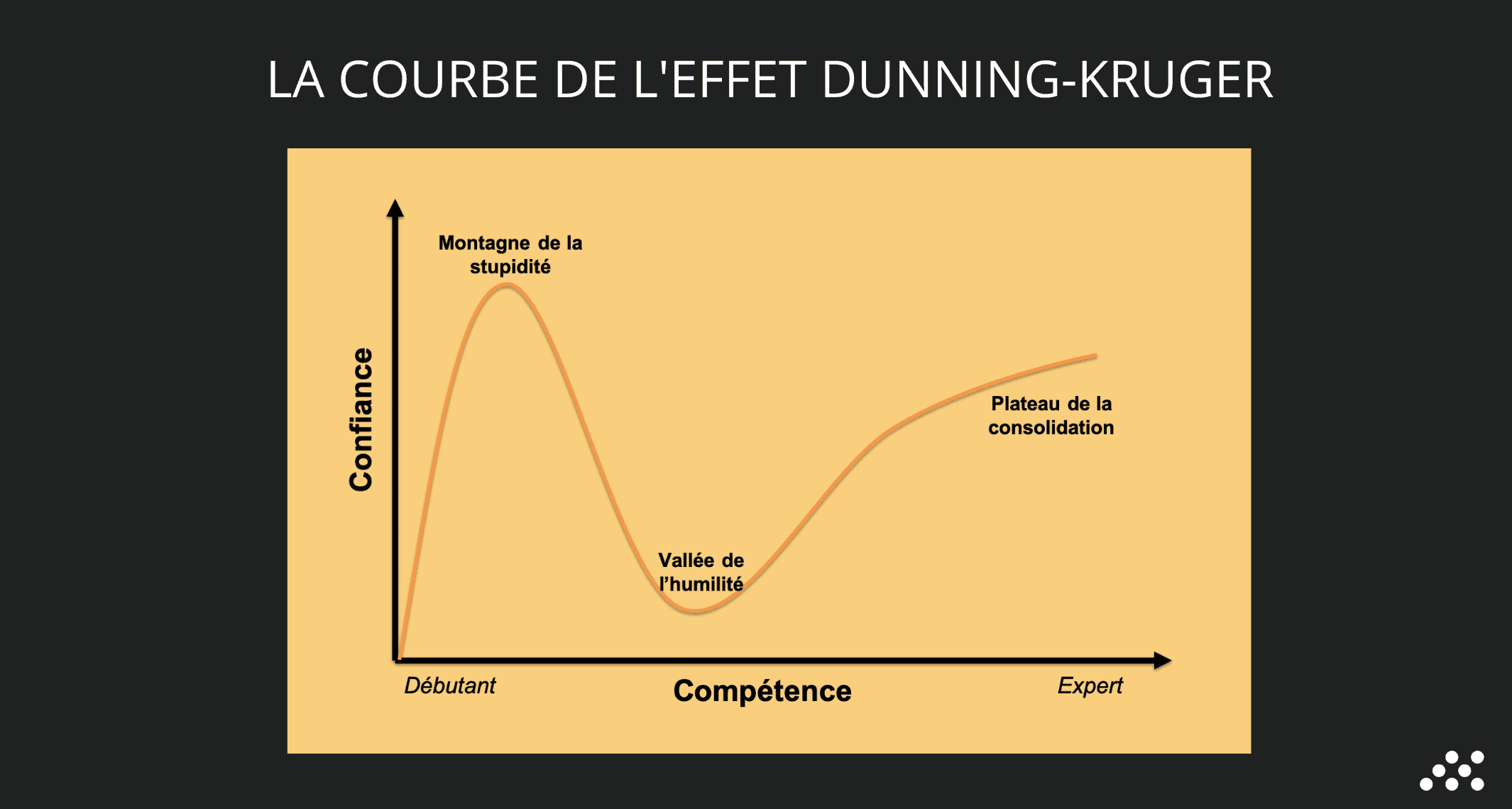
In the early moments of learning, the person discovering something may be excessively confident, not yet knowing the difficulties of the task and overestimating their nonexistent skills while underestimating experts’ opinions. They then climb toward the “mountain of incompetence” or the “mountain of stupidity”
When they face the task’s challenges and begin to learn, their excessive confidence decreases until it becomes very low. They then descend into the “valley of humility.”
As they develop their skills and gain an accurate understanding of the task, they regain confidence without ever falling back into the initial excess and reach the consolidation plateau
This graphic representation actually underscores the importance of training, continuous learning, and intellectual humility.
What are the dangers of overconfidence?
A distortion of reality
Individuals affected by this overconfidence bias actually have a deep ignorance of their shortcomings. Not knowing that they do not master certain fields, they do not question their skills. Their blindness is so strong and their perception of reality so flawed that it is difficult to have a constructive conversation with them. Even when presenting areas for improvement to make them aware of their limits, they deny it and still claim to be competent in that field."Ignorance more frequently begets confidence than knowledge does," argued Charles Darwin, the British naturalist. In extreme cases, this ignorance can even trigger a sense of omnipotence, also called hubris syndrome : a feeling of being above others, a desire to do more, to seek more power.
Misuse of authority status
Ignorance of one’s own shortcomings is particularly dangerous, especially when it affects individuals with authority status (e.g., a manager, parents, a teacher, professionals who have completed 8 years of study). Have you ever been confronted with an idea presented by someone that seemed strange, inappropriate, or even absurd? Did you feel perplexed but choose to say nothing, thinking it was you who had misunderstood? Now imagine if your general practitioner prescribes a medication inappropriate for your treatment, or worse, if their diploma is fake and they do not have the required knowledge. This healthcare professional’s error could have serious consequences for you.
How can you communicate effectively with people affected by the Dunning-Kruger effect?
Look for the reason behind their denial
People who deny their lack of mastery of a subject are in a denial phase, the first stage represented on the change curve, a concept we owe to psychiatrist Elizabeth Kubler-Ross. She supported the idea that during major upheaval in life, we go through 4 stages before accepting change: denial - anger - resignation - acceptance. Individuals affected by the Dunning-Kruger effect are in fact stuck in this first phase. The unknown, the comfort of current methods, the effort that would be required, refusal to admit fault, fear of revealing weaknesses, can all be factors. So when you are talking with someone who refuses to admit their incompetence and also refuses to do things differently, ask yourself about the reason(s) for their resistant behavior; this can potentially give you approaches to try (see sections below).
Trust yourself and stand your ground
Alongside people who do not admit their incompetence, you may behave in the opposite way. You begin to doubt your own knowledge, underestimate what you know, and ultimately become ineffective. Your intuition told you that this colleague’s idea was particularly strange. You had another vision for carrying out this mission, you had thought of a very different action plan, one that could totally fit. Trust yourself and share your proposal, at the risk of regretting not having said it. Be careful, however, with how you explain it, because without the right methods, you risk not being heard, not being taken seriously, losing credibility, or falling into an emotional state.
Mention a quality you truly admire in them
As we said, these people are unaware of their incompetence (or at least do not admit it, because they are still in denial). Thus, if you engage with them by presenting their shortcomings without tangible facts, without help from someone with authority status, without surrounding yourself with allies, your words lose value in their eyes and these people may become defensive, not listen to you, and cut the dialogue short.
What if you went along with them so that a discussion could take place between you? This is absolutely not about being hypocritical toward them, but sincerely telling them what you admire most about them. Everyone has strengths and weaknesses; you just have to look carefully. A person who is incompetent in one field necessarily has talents, innate qualities, developed skills, tasks they perform well. Every fundamental quality has its trap, its challenge, its allergy; this is what Ofman’s quadrant presents.
Let’s take someone who genuinely believes they have singing talent, boasting about the exceptional voice they have / believe they have. The notes they produce may not be accurate, but there is a quality you recognize in them: perseverance. That is therefore a starting point that allows you to begin a dialogue.
Share undeniable evidence with them
You could rely on concrete facts, elements showing in black and white the direction to take while indirectly highlighting your interlocutor’s incompetence. If what you share lacks logic and is only the result of your emotions, it is understandable that your interlocutor will not believe you and will deny your criticisms.
On the other hand, citing laws, listing historical or past events, reviewing the results of a study, highlighting excerpts from literary works, relying on written messages sent, basing arguments on scientific experiments, on researchers’ work, … will add more credibility to your words. Your arguments, because they are proven, will in principle be harder for the incompetent person who does not realize it to contradict.
Bring in a third party with authority status
Inviting an outside person into the discussion also has beneficial effects, especially if this person has authority status (expertise in a field, influence on social media, awards received, etc.) at the same level as your interlocutor (or even above). Indeed, in your interlocutor’s eyes, this third party’s words will carry more weight than yours.
Imagine you make a remark to a friend about her singing performance, but she does not take you seriously because you are not considered an authority in this field. She will then continue to believe she sings wonderfully well. However, if she meets a professional singer she admires who has sold thousands of records, and that person tells her she has not yet reached the level to become a professional singer and that she has room for improvement, she will likely take those words into account and begin to question her singing skills. This awareness can be a starting point for improving her skills and personal development.
Postpone the discussion
These people may reproach you for past mistakes from which you have learned and evolved. In this situation, it can be easy to lose your temper. So it is up to you to step back and not react impulsively. If needed, you can take a break to calm down and refocus. Why not get some fresh air, walk, breathe deeply, drink water, externalize things in writing? Once calmer, you can engage in a constructive discussion with your interlocutor. Over time, this person may realize their own shortcomings or incomplete knowledge on the subject. Over time, you may be able to respond in a more rational and factual way, rather than feeling affected by these past criticisms.
Find allies and come together
Alone, it can be intimidating to contradict a blind person who shows incompetence in a particular field. In such cases, it can be useful to gauge the opinion of people around you to build allies. Have others also noticed that the person in question does not have the skills they claim to have? If so, get closer to them to jointly define the best actions to take to trigger awareness in the person concerned. You can work as a group to gather tangible evidence and plan the best way to share this information. In addition to offering a form of emotional support and security, forming a collective gives more credibility to your message. If many of you highlight the individual’s lack of rigor, it will have more impact than if you are the only one doing so. The law of social pressure is at work: when a large number of people do something, we tend to think it is the best thing to do. This observation is supported by social psychologist Robert Cialdini in his bookInfluence and Manipulation.
Confront them with field reality
Trigger. Awareness. Action. This is the approach to help people affected by the Dunning-Kruger effect become aware of their real competence level in a field and take action. But how can this be achieved? By confronting reality in the field. Indeed, by directly confronting field realities, they will leave their comfort zone, realize for themselves their level of competence and the methods that work best. This method can be especially beneficial if they join a team of competent people, who will show them the way forward to improve. And if they start a project on their own, the effects will be just as positive. They will realize that their past successes were largely due to others and will open their eyes.
———
In short, the Dunning-Kruger effect can have serious consequences, especially when the individuals affected hold authority status. To avoid the resulting risks, it is important to take steps to trigger awareness in these people. First, we need to understand the source of their denial, so that we can present solid arguments and lead them to acknowledge their limits. Then, it is essential to cultivate a trusting relationship by valuing the interlocutor’s qualities. If necessary, it is also possible to rely on allies or experts to strengthen one’s arguments. Finally, practical experience is often the best way to progress and develop the necessary skills. In summary, by showing tact and teaching skills, it is possible to help individuals affected by the Dunning-Kruger effect become aware of their limits and progress toward competence.