Manager status: still in vogue?
Published on

“How do you see yourself in five years?” A classic job interview question that once revealed an almost universal ambition: becoming a manager. There was a time when almost all candidates aspired to this status, considering it the pinnacle of professional success. It is true that by becoming a manager, we gained—and still gain—greater decision-making power, a broader view of the company and the projects led by its teams, along with many other new responsibilities we commit to. However, with evolving views of work, greater emphasis on workplace well-being, the search for meaning, and work-life balance, the appeal of management is no longer as exclusive. Professional fulfillment seems to be breaking free from the simple status of manager. What is the current perception of managerial status? What does becoming a manager really mean? Is professional success still synonymous with team management? That is what we will examine in this article.
———
Manager: a symbol of success
Becoming a manager: a turning point in a career
The role of manager is often seen as a springboard to more strategic assignments and leadership positions. By taking on this role, an individual significantly increases their chances of being entrusted with broader responsibilities. The title of manager, often associated with upward mobility, brings a sense of pride and greater authority to the person who holds it. However, it is better to distinguish those who carry the manager title without managing a team—such as certain “Community Managers” who are responsible for content but not necessarily for people—from those who actually lead team members.
Relational and organizational skills by default?
Managing a team requires a manager to mobilize a set of skills, mainly relational and organizational, such as the ability to inspire and motivate one person and a group of people, the ability to handle unexpected events and conflicts, the ability to share the right company information, the ability to prioritize tasks and optimize time to devote some of it to their teams, and finally the ability to communicate clearly with the employees they supervise, but also with their own managers and clients. However, being appointed manager does not necessarily guarantee possession of these skills; rather, it indicates a commitment to actively develop them in order to successfully carry out one’s missions. It is up to people aspiring to managerial status to learn to self-analyze and question their core qualities, the excesses of those qualities, and the skills they should develop. To assess their potential, using the Ofman quadrant can help with this introspection.
The growing challenges of the manager role
The declining appeal of management positions: telling figures
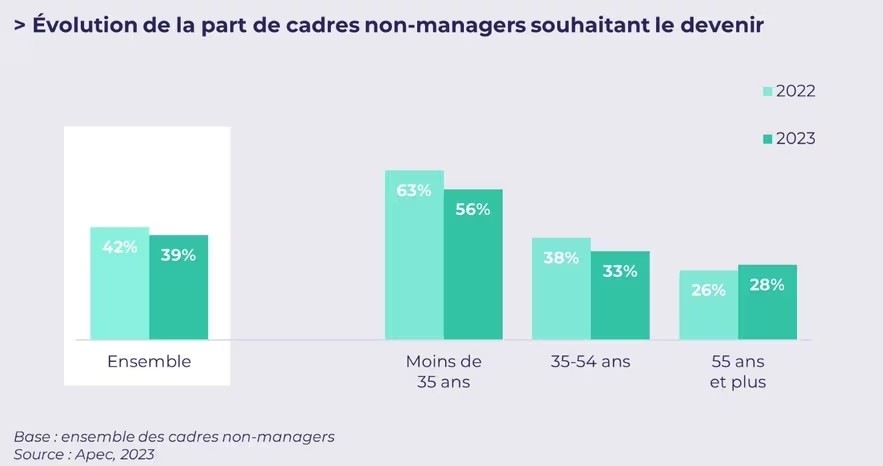
A recent study conducted by Apec in November 2023 reveals a decline in the appeal of management positions. Indeed, only 39% of non-manager executives expressed the desire to become managers in 2023, compared with 42% the previous year.
Why the reluctance to embrace this career path? At the top of the list, 39% of respondents said they feared managerial status because of people management, while 36% preferred to decline because they currently feel fulfilled in their current role (and that is a good thing), even though no managerial responsibility has been entrusted to them. In addition, 32% of respondents felt they did not have the personality required for this role—the well-known impostor syndrome! The additional workload is also a barrier for 24% of respondents. Among other discouraging factors are the company’s high expectations of managers, recognition considered insufficient, and a feeling of lacking experience.
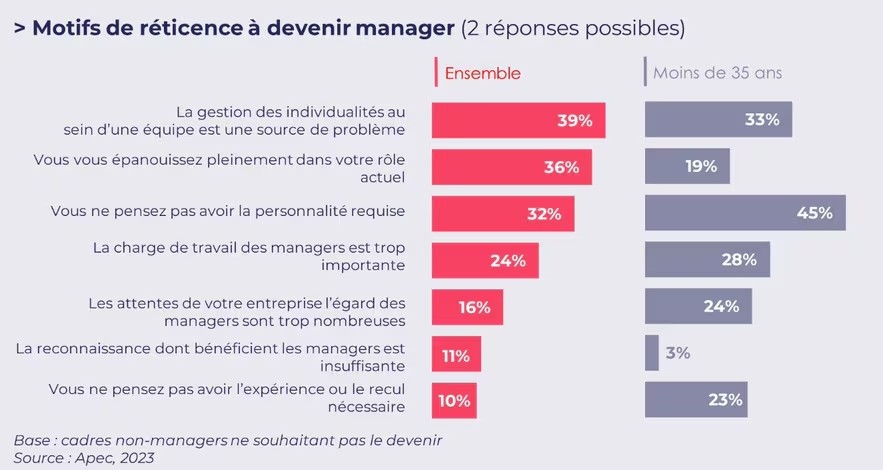
This perception among non-managers reveals a certain apprehension: being a manager requires strong resilience at work, a reality that weighs heavily for many non-managers.
Impostor syndrome: the fear of not being up to the task
Being a manager means representing a team and setting an example in the eyes of one’s employees. As a result, future, new, or even more experienced managers often feel significant pressure, because they feel they have no right to make mistakes, unlike their employees, who may benefit from a certain degree of leniency. Yet it is natural for managers, as for any human being, to make mistakes and proceed by trial and error. Thinking they are not up to the task, nor capable of embodying a model manager, some executives hesitate to move toward management positions. To overcome impostor syndrome, they can reflect on their real motivation(s) for the role, their desire to develop the required managerial skills, their concern for doing things well, and their ability to recognize both their strengths and limitations.
The balance between constraints and recognition
Management is complex, notably because it can involve an imbalance between the efforts required to fulfill missions and the rewards obtained. As a result, managers or future managers may ask themselves, “Why work more for barely higher pay?” or “Why invest more without encouragement or recognition?” Guaranteeing recognition commensurate with the effort provided is impossible, especially since the desired recognition will be specific to each individual and the efforts made will differ from one person to another.
In reality, the role of manager requires a great spirit of generosity. If a person agrees to give without expecting an immediate return, they will not feel frustration. It is up to each person to define their own indicators of success to be able to motivate themselves. If their team succeeds, that is excellent news—it is a direct reflection of their contribution, and they should be proud of it!
What being a manager really means
Adopting a new posture
Transitioning to managerial status requires the individual concerned to make changes in their professional approach. From now on, they carry a new responsibility: ensuring that their team accomplishes its missions and that its actions contribute to achieving set objectives.
Becoming a manager is no longer limited to a change in title, nor even to a new perception by those around them; it implies a deeper transformation in one’s way of working. It also invites us to rethink our daily routine, reorganize ourselves, face more delicate challenges, and demonstrate greater transparency and communication. Accepting change and being ready to adjust one’s posture are necessary for anyone aspiring to a management position.
Devoting time to one’s teams
Another key responsibility entrusted to them concerns the time they must now allocate to their teams to support them and contribute to their development. This will require scheduling dedicated time slots specifically for coaching their teams. During these times, they will be able to focus on tracking their actions, think through precise and practical advice to share, speak with them to listen sincerely, and work with them to find solutions suited to what they are facing. A good manager will know how to find the right balance between genuine support for their teams and the autonomy granted to them.
Facing the challenges that arise
Moreover, an effective and fulfilled manager will show enthusiasm and boldness when taking on new challenges that confront them with the unknown and lead them to take risks.
While a manager may sometimes have the option to choose their team members, this is not always the case. When it is not, they may very well lead people they did not choose, or supervise employees who are more experienced or older than they are, placing them in intimidating situations. In these moments, it is good to keep in mind that the challenges encountered are an integral part of managerial status, and that their failures are milestones on the way to success.
Accepting the ups and downs of management
One of the great privileges of the manager role is decision-making autonomy. Their decision-making power is increased (while still being mindful of the hubris syndrome, or thirst for power), their opinion is taken into greater consideration, and they more often have the final say. However, this advantage also requires them to handle difficult situations, such as discussing underperformance with an employee or managing the end of a collaboration. These moments can be challenging for them, but they remain unavoidable and essential for maintaining the team’s integrity and performance.
Succeeding professionally: with or without managerial status
Moving beyond the traditional notion of success
When discussing management, one point stands out: the definition of professional success. Is it possible to build a great career and thrive professionally without necessarily becoming a manager? Well, it all depends on one’s deep motivations and one’s own perception of success. But in practice, yes—you can succeed without being a manager. The paths to professional fulfillment are multiple.
If you want to strengthen your technical expertise, move into research, or if managerial responsibilities do not match your professional aspirations, it is advisable to communicate this to your hierarchy. Over time, you may be offered a management role. Accepting such a role without genuine enthusiasm could be harmful not only for you, but also for your team and your company. By being transparent with your leadership, you preserve your freedom of choice while enabling your company to recognize you as an expert—a collaborator whose specific know-how is highly valued and on whom it can rely.
Exploring alternative paths to professional success
Some professionals will fully thrive in missions other than management and thus find their path in technical expertise. In that case, strengthening their skills and gaining recognition for their know-how will provide them with strong satisfaction and high self-esteem.
People passionate about research and innovation can also thrive, particularly in roles dedicated to research and development, where discovery and the creation of new things are at the heart of their activities.
Others will prefer project manager positions. Although they do not directly manage teams, they enjoy leading projects, monitoring progress, and motivating collaborators to achieve defined objectives.
Finally, there are those who choose to become consultants and find particular enjoyment in untangling and solving complex problems for their clients.
Management is therefore not a sine qua non condition for professional success. Other alternative paths, just as rewarding, exist and are equally valuable.
Choosing not to manage: does this limit one’s capacity for impact?
One question remains: does the absence of managerial responsibilities limit an individual? In growing companies, expanding teams and recruiting new talent often create a need for new management positions. These are necessary to structure the organization and ensure efficient task distribution, making it possible to focus on high value-added strategic projects.
Choosing to remain a specialist in one’s field can be very satisfying professionally, but in the long term it may limit the scope of individual action. Conversely, a person with less expertise but leading a team of ten people could, thanks to this synergy, exceed the impact of an isolated expert. While the choice between a managerial career and a more technical career is personal, the absence of managerial responsibilities may nonetheless lead to a professional ceiling.
It is therefore essential that everyone determine their priorities: are we seeking to maximize individual expertise or to extend our influence? No choice is superior; it all depends on personal motivations. For example, a high-level athlete might focus on perfecting a specific skill, while a sports coach might choose to broaden their impact by guiding several athletes. No profession is better than another.
The decision to manage or not should be considered according to the opportunities and challenges of each position, but also one’s own personal and professional goals.
——
The aspiration to become a manager, once considered the sole vehicle of professional success, continues to evolve. The manager role is still largely perceived as a real springboard in a professional career. Becoming one means gaining greater responsibility and facing new challenges. For those who like challenges, want a broader perspective on the company, aspire to leadership positions, are passionate about individual development, knowledge sharing, and the development of human relationships, management may be right for them. But at the same time, other paths to success enrich the world of work. Roles specialized in technical expertise, research, project management, or consulting, for example, offer enriching and rewarding alternatives to management. Each person, according to their deep motivations, convictions, values, ability to commit to a new role, wishes for the future, and their very definition of success, will choose the path that seems to bring them the most—both professionally and personally. It is nevertheless important to keep in mind the potentially broader striking power of someone who manages.