Surround yourself and rely on trusted colleagues to succeed
Published on

Do you remember times when you were eager to see someone again? The prospect of knowing you were going to meet up with someone you like and trust was especially pleasant! Perhaps you have even felt this sensation before meeting up with coworkers. Knowing that we are going to spend our workday alongside people we care about can be a real source of motivation. The peak is reached when we know we can count on them, both in moments of joy and in hardships, when their kindness is tangible, and when we feel free to share our thoughts and opinions with them. Let us note, however, that there is a distinction between affection and trust, because while we may like certain coworkers, that does not necessarily mean we grant them complete trust. Moreover, among the coworkers we trust, our closeness with each of them and the confidences we share vary considerably from one person to another. More than simply feeling affection for someone, it is the development of mutual trust with our coworkers that brings us concrete benefits at work. So how can we recognize our allies among our coworkers? How do we know whom to trust? How can we maintain and strengthen our relationship with them? This article explores the importance of surrounding yourself with trusted coworkers and relying on them to ensure your professional success.
——
Why have trusted coworkers?
Boost your motivation
Communicating with your coworkers, whether face-to-face or remotely, is a common activity in the professional environment. Depending on the nature of your tasks, the projects assigned to you, and your company’s organization, the frequency of your interactions with them varies.
In March 2024, Gael Chatelain-Berry, an expert in benevolent management, conducted a poll on LinkedIn with 3,898 people. His conclusions highlighted the impact of coworker relationships on motivation at work. According to the results, 35% of respondents felt that the presence of their coworkers had a positive influence on their motivation, while for 34%, this impact varied depending on the day. For 19%, the presence of coworkers was essential, and for 12%, it was optional. According to this study, more than half of professionals see their coworkers as a key motivation factor. What about you?
Increase your performance
Beyond the boost in motivation brought by the presence of trusted coworkers, they can also affect your performance at work and thus partly contribute to the success of your projects. Indeed, working with colleagues you appreciate—and above all trust—generally creates an environment where you feel comfortable and free to express yourself. Your discussions with them, although they may lead to disagreements, are generally a source of constructive feedback. Exchanges stimulate the emergence of new ideas, encourage you to reconsider your perspectives, and sometimes help you solve issues that had been holding you back.
Gain emotional support
Wanting to succeed in your tasks at all costs can potentially generate stress and pressure for an employee, sometimes because of ambitious goals, unexpected issues to manage, approaching deadlines, emerging conflicts, etc.
In the same way that you feel better when supported by your friends, your family, your partner, in the professional sphere you are calmer when you feel accompanied. With trusted coworkers, you know you can share good news with them and that you will be listened to. In addition, it is reassuring to know that you can confide in them during difficult moments, whether facing low morale, mounting doubts, repeated mistakes, or intense fatigue. These reliable coworkers are there to listen without judgment, advise you, or simply offer a moment of relief when you need it—and that feels good!
Feel supported in every situation
When starting a new position, having identified trusted coworkers is all the more valuable, because when arriving in a new work environment, everything is to be discovered: work methods are different, company rituals are unfamiliar, company policies are new. During this onboarding phase, it is natural to feel uncertainty and anxiety due to unfamiliarity with internal processes.
Although autonomy may be encouraged from the start, it can also expose a newcomer to mistakes. Precisely to avoid them, seeking advice from trusted coworkers could help any new employee reduce their risk of error, while also accelerating their assimilation of company practices and adoption of norms.
Benefit from support in promoting your ideas
Your coworkers, depending on their role, department, seniority, and reputation within the organization, can act as ambassadors for your ideas, facilitate communication of the messages that matter to you, and make it easier for others to accept the projects you have envisioned. Thus, when you seek to introduce change or launch a new initiative, having the support of respected and influential coworkers is a real asset in convincing management, for example, and other teams of the value and viability of your proposals.
Moreover, John Paul Kotter, professor at Harvard Business School and author of the book Leading Change (published in 1996), identified 8 steps to gain acceptance for change within a group. Once a sense of urgency is created (the first step), in the second step he encourages creating a guiding coalition composed of people who carry authority, whether through hierarchical power, technical skills, seniority, presence, reputation, etc.
How can you recognize your allies at work?
They create a calm climate
Coworkers with whom you have trust create a climate where you naturally feel at ease. By their side, you do not feel pressure to conform, nor the urge to hide behind a rigid professional facade. You are yourself! When you start a new assignment, for example, these trusted coworkers know you need an adjustment period. They are aware of your strengths and your areas for improvement.
They check in on you and willingly offer help
You can also recognize them by their selfless attention toward you, which goes beyond superficial interactions. They have a genuine interest in your well-being and professional development: “Is everything going well with getting to grips with this new software?”, “Are you comfortable at this desk? Otherwise, we can find you another one.” In fact, they may offer their help even before you ask. They anticipate the challenges you might face, share advice, and tell you about some of their own experiences to help you deal with upcoming difficulties. You especially find these people among coworkers designated as mentors for newcomers. They have usually chosen to guide new hires; they enjoy exchanging and passing on knowledge.
They do not show up only when there is a problem
The presence of allied coworkers is not limited to difficult moments. Indeed, they do not only appear when there is a problem to solve or when they need your help. They are also present during quieter moments. They are ready to talk with you for no specific reason. Their regular and selfless presence shows they value the relationship beyond immediate professional benefits.
They give you sincere compliments
Receiving genuine compliments from coworkers can boost your self-confidence and strengthen your sense of belonging to a group. A trusted coworker will notice and acknowledge your successes and efforts. They will not hesitate to congratulate you when appropriate. Their encouragement is often specific and relevant, reflecting their genuine attention to your work.
They include you in the group
Allied coworkers encourage you to actively participate in team life, whether through professional projects or social activities. They may invite you to join meetings, brainstorming sessions, and even events outside working hours, which can facilitate your integration and broaden your professional and social network.
They share common points with you
Similarity creates common ground between two people, which can lead to deeper and more meaningful relationships. Allied coworkers may share professional values with you, but also personal interests or even similar life views, which strengthens your connection with them. Common points are often the foundation on which trust and collaboration are built.
They do not act for appearances
Your true allies help you in a consistent and authentic way. They do not try to put themselves forward because it might be visible to management or beneficial to their image. Their support is constant and driven by a genuine desire to see you succeed and contribute to your growth, regardless of their own interest.
They have allies you trust
Although you may appreciate someone, granting trust also depends on the trust you place in their circle. Can you be sure your confidences will not be shared with others, and that your trusted coworkers will know the difference and keep your confidentiality? Otherwise, this could compromise your position.
How can you make the most of the potential of your trusted coworkers?
Once you have identified the coworkers you can count on—those you consider reliable and capable of keeping the information you share with them—it is important to adopt appropriate behavior toward them. Failing to do so could deprive you of valuable opportunities.
Rely on the sociodynamic matrix
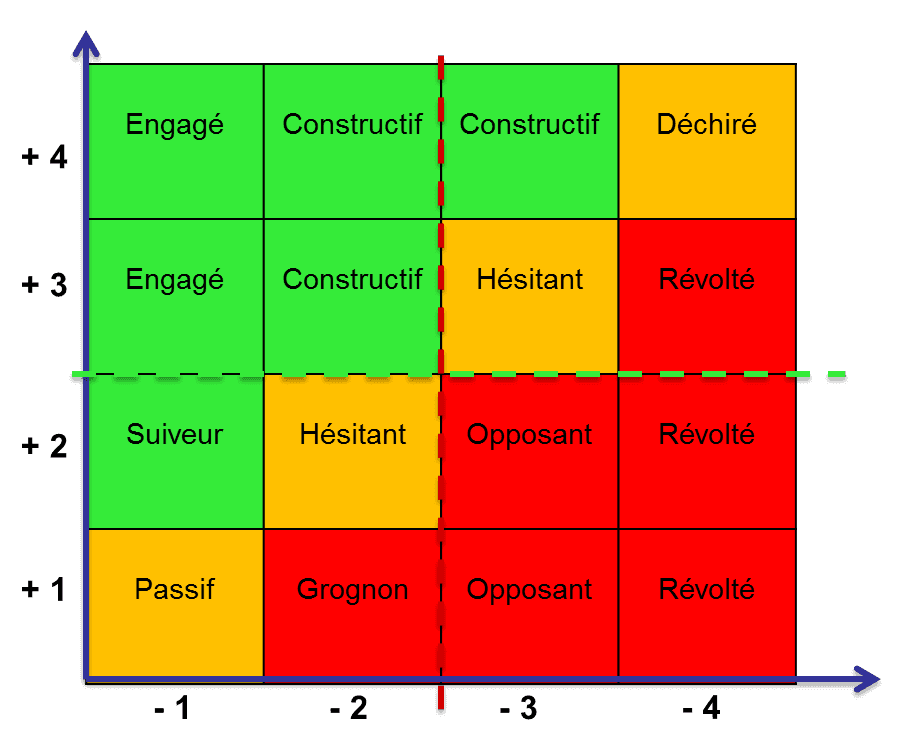
Jean-Christian Fauvet, a speaker and advertiser behind the sociodynamic approach, developed a two-axis matrix showing how individuals could position themselves for or against a project, but also how they could influence one another and potentially change positions.
Depending on the level of synergy (the first axis of the matrix)—that is, the investment deployed to promote or hinder the completion of a project—and the level of antagonism (the second axis), meaning being "for" or "against" a project, everyone can recognize themselves in one of the profiles.
To briefly describe the profiles Fauvet identified, you will find:
The committed, who is heavily invested in the project or initiative. But this person lacks credibility, which prevents them from convincing others.
The constructive, who is generally in favor of the project or initiative in question. Their energy and commitment are directed toward the success and promotion of the project. They can, through concrete arguments, rally other stakeholders to their cause.
The follower, who tends to follow others’ opinions or actions without expressing strong opinions. Their commitment is limited and often depends on others’ attitudes and actions. They can be influenced by the arguments other stakeholders present to them.
The hesitant, who expresses doubts or uncertainties about the project. They can be influenced both by the arguments of constructives and by those of opponents. Their position can fluctuate depending on the information and discussions provided during the decision-making process.
The passive, who shows no strong commitment to the project, and is indifferent or neutral regarding the ongoing initiative. They tend to follow the movement and not take proactive initiatives to support or challenge the project.
The grumbler, who expresses dissatisfaction or discontent regarding the project. Their attitude may be marked by cynicism or hostility toward the ongoing initiative. They may have legitimate concerns, but often adopt a negative approach in their interactions.
The opponent, who, as you may suppose, actively opposes the project or initiative. They are often motivated by deep disagreements or conflicting interests. They can use concrete arguments to bring to their side those who have not yet taken a position.
The rebel, who openly expresses opposition and anger regarding the project, directed toward contesting and questioning authority or decisions made. They may feel a sense of injustice or a strong desire for change in the organization.
The torn, who is in a state of internal conflict between support and opposition to the project, with a position that fluctuates according to information, discussions, and emotions arising during the decision-making process.
Note, however, that none of these positions are fixed over time.
Focus on constructives
Among the different listed actors, one particularly interests us: the constructives, also called allies. Their level of energy and commitment in favor of the project is generally positive. Their voice is influential, as they can convince the "passive" and "hesitant" using concrete arguments.
However, having them by your side does not necessarily mean being in total agreement with them. They may very well disagree with us while remaining constructive and benevolent. When you want to identify trusted coworkers and get closer to them to create a lasting relationship, prioritize constructives.
Adopt the right behavior
Dedicate a significant part of your time to them
Regularly organize one-on-one or small-group meetings with your allies to discuss ongoing projects, challenges encountered, and strategies to adopt.
Make sure to give them attentive listening during your interactions, being open to their ideas and suggestions.
Talk with them outside formal meetings, during lunches or company events for example, to strengthen ties and deepen mutual trust.
Involve them
Give them responsibilities and relevant tasks that demonstrate your trust in their ability to contribute significantly.
Consult them when making important decisions, informing them of the stakes and seeking their viewpoint and advice.
Encourage them to actively participate in ongoing projects, prompting them to share their ideas and expertise to improve outcomes.
Have them speak on your behalf
Provide them with additional resources and information to strengthen their credibility and ability to influence others’ opinions.
Encourage them to use their relationships and influence to advocate for your ideas in a constructive and persuasive way, emphasizing benefits for the team or organization as a whole.
Express your gratitude to them
Thank them for their commitment and contributions, publicly recognizing their efforts and achievements before the team or management.
Give them positive feedback on their work, highlighting what you appreciate and motivating them to continue.
Be attentive to their needs and concerns, offering your support and actively seeking ways to help them reach their own professional goals.
How can you build connections with your allied coworkers?
Try to get to know them
Initiate contact
Go meet them! Dare to approach them and start a conversation. If you do not know how to begin the exchange, you could ask them questions about their background, what they are passionate about, or what currently concerns them. You could also apply the small talk method by addressing simple and universal topics (e.g., the weather, a recent movie release, the next vacation destination). Once the conversation starts, sincerely listen to their answers and above all remain yourself.
Take part in informal moments
You could, if you feel like it of course, join your coworkers during coffee breaks, lunches, or events outside working hours. These informal occasions are conducive to breaking the ice and may allow you to discover personalities beyond professional roles. During these moments, you may deconstruct opinions you had formed about your coworkers (“I didn’t think he was that nice”) and make pleasant discoveries.
Value their experience
Show interest in your coworkers’ know-how and background. A sincere compliment on their work or skills could open doors to richer exchanges. If their expertise impresses you, let them know and ask them for advice; they will feel valued.
Help them
Make yourself available to them
Show that you are ready to offer your help, even if you do not have all the solutions. A short written message like “I saw that you seemed swamped; if I can help, don’t hesitate to ask me” or a simple spoken phrase “I’m here if needed” could have a positive effect. These attentions will demonstrate your altruism, an essential quality for earning their trust.
Practice reciprocity: give first and you will naturally receive
Take inspiration from the law of reciprocity, mentioned by R. Cialdini in his book Influence and Manipulation. By helping your coworkers when they need it, they will likely help you willingly in return when you need it. For example, if you buy your coworker a coffee because they are short of small coins at checkout, they may return the favor and bring you your coffee the next morning!
Open up
Share about yourself
Transparency is essential for building trusting relationships. Dare to share information about yourself, whether your point of view, your interests, or your experiences. You could rely on the Johari window, a tool that helps assess the information about us that we do or do not share with others, and what others do or do not share with us. This same tool invites us to step back and reflect on our own communication. Thus, if you share little information about yourself, you may be considered the discreet coworker—appreciated, certainly, but not someone people confide in because they do not know you. Think about your closest friends: if they know you very well, it is because you shared information about yourself with them. Of course, in the professional sphere, the elements to share about yourself will not be as personal or numerous. It is up to each person to draw the line between what they accept revealing to others and what they prefer to keep private.
Show your vulnerability
You do not need to appear perfect all the time at work. You can absolutely admit when something escapes you or when you need help. This will show your human side and may encourage your professional circle to share in return their own experiences from past uncomfortable situations. Other examples: you did not understand a coworker’s explanation of a method. It happens! Be honest and simply tell them. Or, you do not know how to phrase your leave request to your manager; perhaps a coworker could guide you on the best way to proceed.
Cultivate trust over time
Keep the flame alive
It is not about showing interest in a coworker once, simply to “look good,” and then stopping all good actions once you have obtained what you want. By doing so, you will not develop a long-term trusting relationship. Trust is built over time.
Acknowledge your mistakes if there are any
One risk once trust with a coworker is established is losing it. If you made a mistake, acknowledge it, sincerely apologize, and consider actions to improve, that is already a big step toward restoring trust.
Deal with fluctuations in trust and harmony
Accept that you cannot please everyone
It is impossible to please everyone in the workplace. Each person has their preferences, opinions, and visions, which means it is inevitable to encounter coworkers with whom we are not in harmony. Accepting this reality can help you avoid feeling discouraged or devalued when you face disagreements or tensions with certain coworkers. On the contrary, it can encourage you to stay true to your values and maintain respectful professional relationships, even in cases of differing opinions.
Acknowledge that trust in your coworkers will change over time
Your trusted coworkers today are not necessarily those of tomorrow. Professional relationships may be subject to change due to factors such as some people arriving and others leaving, changes in professional responsibilities, and shifts in organizational priorities. It is therefore essential to remain open and adaptable, while continuing to cultivate new relationships and strengthen existing ones.
——
Surrounding yourself with coworkers you appreciate—but above all truly trust—can strongly impact your desire to work and to go to work, while also positively influencing your performance, providing strong emotional support, helping you in delicate situations you encounter, and supporting you when you need to convince a group of individuals to carry out an action you deem useful. These trusted coworkers, also called “allies” or “constructives” if we refer to the sociodynamic matrix, have the advantage of using convincing arguments in their discourse, being able to speak on our behalf, and being listened to by others, especially the most hesitant and those without a strong opinion. To fully benefit from these relationships, it is preferable to choose carefully whom to trust, which requires knowing how to identify your allies at work. They are most often recognized because they generally create a calm climate, willingly offer help, come talk with us even when there are no problems, acknowledge our qualities, include us in the group, share common points with us, act out of pure kindness, etc. Next, it is important to actively cultivate your connections with allied coworkers. Trust is earned and nurtured over time through reciprocity, honesty, and constant support. Investing in trusting relationships is not just a career matter; it is a solid foundation for an enriching and motivating work environment. So take the time to recognize and value your trusted coworkers.